Education

.webp)
Quick summary
- Plan A brings genuine scientific credibility, now inside a larger group. Its GHG Protocol-compliant, TÜV Rheinland-certified platform is backed by a Scientific Advisory Board with significant climate policy credentials, and it's now integrating with Diginex following its January 2026 acquisition.
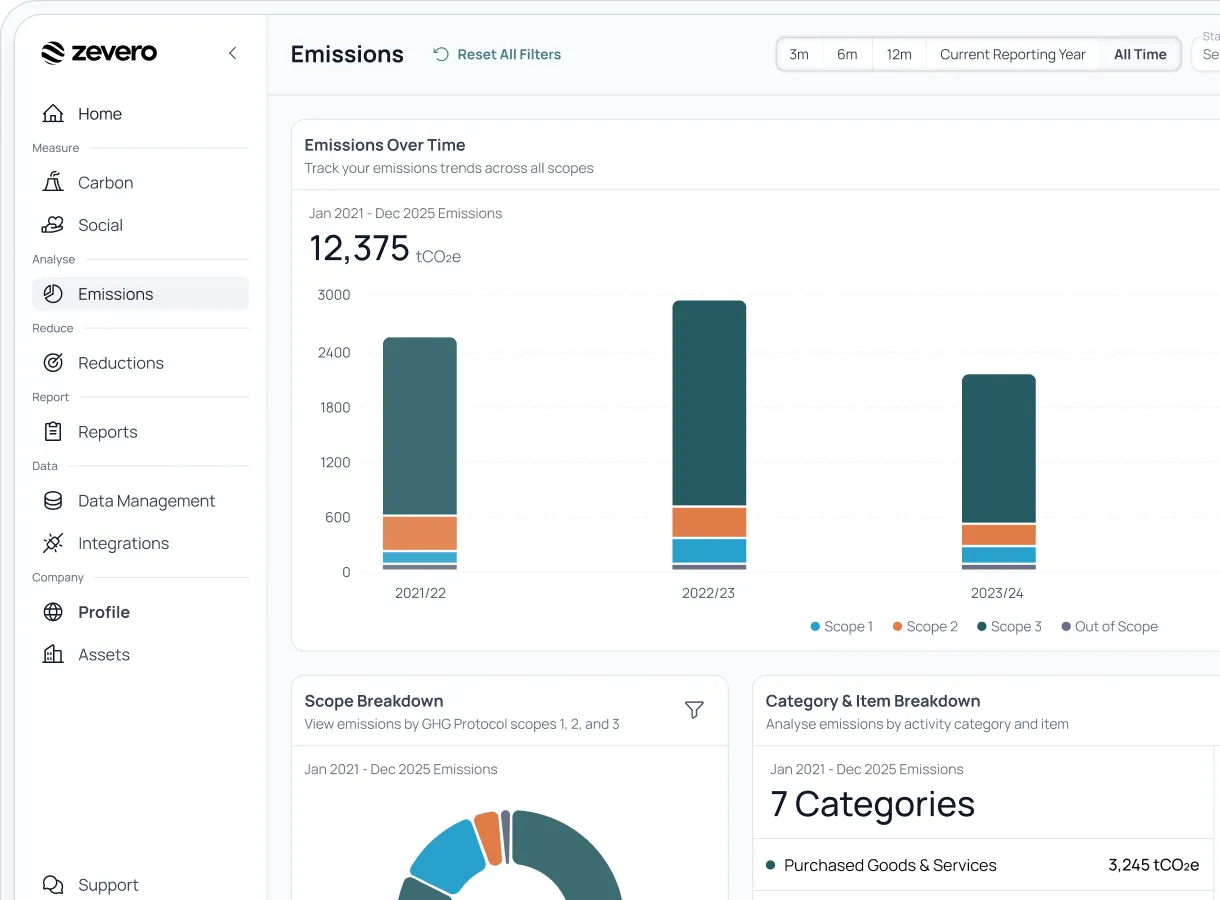
- Zevero is built to operationalise sustainability data, not just report on it. Its expert-led model turns one dataset into multiple outputs, aiming to reduce the time spent on measurement so more time goes into reduction.
- The right choice depends on what matters most right now. Turning data into action, sector fit, reporting coverage, and service continuity all shape which platform is the better fit.
Carbon accounting platforms increasingly compete on what happens after the data is collected. Some are built primarily to measure and report; others are built to turn that same dataset into a working reduction plan, so less time goes into tracking numbers and more time goes into acting on them. That distinction matters more than which platform has the longer feature list.
Plan A was acquired by Diginex in January 2026, bringing its carbon accounting and decarbonisation platform into a larger sustainability RegTech group. Its scientific credibility and certified methodology are genuine strengths. It's also a useful moment for any organisation evaluating Plan A to ask a practical question: how is the platform, service model, and roadmap expected to evolve as two businesses integrate.
This blog looks at how Plan A's platform works, the situations where organisations look for something different, and how it compares with Zevero and four other carbon accounting platforms.
What Plan A does and how its platform works
Plan A is a European carbon accounting and decarbonisation platform, now operating as part of Diginex following its acquisition in January 2026. Its software is GHG Protocol compliant and TÜV Rheinland certified, and Plan A itself holds B Corp certification.
Plan A's platform includes:
- Carbon accounting for measuring and analysing a corporate carbon footprint
- Carbon reporting to disclose sustainability progress through integrated reports
- Decarbonisation tools for emissions reduction, target setting, and forecasting
- A Scientific Advisory Board, including an architect of Project Drawdown and a former Bank of England senior advisor for sustainable finance, informing its methodology
- An AI assistant ("Gaia") built into the platform for sustainability guidance
Plan A reports 70% faster data management, 130+ days saved on carbon accounting, and a 20x improvement in reporting speed compared with manual processes. Its client base spans more than 1,500 organisations, including BMW, Deutsche Bank, Visa, Chloé, KFC, and Trivago, alongside smaller scale-ups such as Payhawk, Mollie, and Sorare. Pricing is not published; access is by scheduling a call with the sales team.
Reasons businesses look for a Plan A alternative
Plan A's science-led, decarbonisation-first positioning works well for organisations that want a certified platform backed by a credible scientific board. A few situations tend to push organisations toward a different kind of platform instead.
- Continuity of a named point of contact matters. Following the Diginex acquisition, organisations considering Plan A are evaluating a platform and team still in the process of integrating with a larger group, so it is less certain who an organisation will be working with in a year than with an independent, unchanged provider.
- The organisation wants a platform built primarily for its size, not headline enterprise case studies. Plan A's published results and marquee client list (BMW, Deutsche Bank, Visa) lean toward large enterprise, even though its client base does include smaller scale-ups.
- Sector-specific integration matters more than broad industry coverage. Plan A markets across software and IT, business services, fleet management, media, and fashion, without integrations built for a single vertical such as food and drink.
.png)
Top Plan A alternatives for carbon accounting
Zevero
Zevero is a global carbon management platform that pairs carbon accounting software with a named climate expert, with the depth of involvement scaling by plan.
Best suited for: action-focused mid-market organisations, particularly in food, drink, manufacturing, and consumer goods, that want a reduction roadmap and a stable, named point of contact.
Key features:
- Scope 1, 2, and 3 carbon accounting with automated data collection and emission factor matching
- A named climate expert on every plan, with the depth of involvement scaling from periodic review to an embedded partner on higher tiers
- Disclosure reporting across a range of regulations and voluntary standards spanning the UK, EU, and Asia-Pacific, including SECR, SSBJ, SBTi, B Corp, CDP, and ISSB
- Reduction roadmaps and decarbonisation planning built into the core service from the outset
- Industry expertise in food and beverages, manufacturing, and consumer goods sectors
Considerations: Zevero is a newer platform than Plan A, so organisations that specifically value Plan A's scale, longer track record, or existing enterprise relationships may still want to evaluate Plan A directly.
Normative
Normative is a carbon accounting platform built around independently evaluated methodology, with a named, GHG Protocol-certified Climate Strategy Advisor on every account.
Best suited for: organisations that need traceable, independently evaluated carbon accounting as the foundation of their reporting.
Key features:
- Automated carbon accounting with AI-powered data matching, drawing on a database of more than 349,000 emission factors
- Software and calculation methodology independently evaluated by TÜV SÜD against ISO/IEC 25051 and the GHG Protocol
- Regulatory reporting support for SECR, CSRD, SBTi, and CBAM built into the platform
- A named Climate Strategy Advisor on every account
Considerations: Setting reduction targets and building a decarbonisation plan is not included in Normative's standard plans; strategic reduction planning and value chain engagement are Premium-tier platform features rather than part of the core, entry-level service.
Greenly
Greenly is a French carbon accounting platform combining AI-powered automation with climate expertise, covering carbon accounting, life cycle assessment, supplier engagement, and broader ESG reporting in a single suite.
Best suited for: organisations that want a broad, all-in-one AI-automated platform covering LCA, ESG disclosure, and supplier engagement natively, similar in scope to Plan A's own combined carbon accounting and decarbonisation offering.
Key features:
- Automated Scope 1, 2, and 3 carbon accounting with bank-linking and a large emission factor library
- Life cycle assessment for product-level carbon footprints, built on bill-of-materials imports
- Regulatory reporting support for CSRD, EUDR, SBTi, and CDP
- AI agents covering data preparation, Scope 3 mapping, LCA modelling, and reporting support
Considerations: Greenly's methodology and default frameworks are built primarily around EU requirements, with UK-specific factors such as SECR treated as secondary rather than default.
Coolset
Coolset is a European ESG and supply chain compliance platform built for mid-market and enterprise organisations, combining Scope 1, 2, and 3 carbon accounting with compliance workflows for CSRD, EU Taxonomy, VSME, EUDR, and CBAM.
Best suited for: organisations that are primarily reporting and compliance-driven, rather than focused on taking active steps to decarbonise, and want a single platform covering carbon accounting alongside multiple overlapping EU compliance obligations.
Key features:
- Scope 1, 2, and 3 carbon accounting using a TÜV Rheinland-certified, GHG Protocol-aligned methodology
- CSRD, EU Taxonomy, and VSME reporting modules, with data reused across frameworks to avoid duplicate entry
- Supply chain compliance workflows covering EUDR and CBAM alongside carbon accounting
Considerations: Coolset's self-serve model is built around software rather than an assigned expert on every account, so organisations that specifically want a named point of accountability may need to weigh that against Coolset's more automated approach.
Position Green
Position Green is a Nordic-founded ESG and sustainability reporting platform for mid-to-large European organisations, combining carbon management, ESRS/CSRD reporting, and supply chain sustainability in one system. It has grown through acquisition, including sustainability reporting provider Greenomy and carbon management software provider Morescope.
Best suited for: mid-to-large organisations across Europe that want to consolidate ESG reporting, carbon management, and supplier sustainability workflows into a single platform, backed by in-house advisory support.
Key features:
- Scope 1, 2, and 3 carbon accounting alongside ESRS and CSRD reporting, with digital double materiality assessment
- Decarbonisation modelling, forecasting, and scenario analysis built into the platform
- Access to 100+ in-house sustainability advisors for hands-on guidance
- Investor-grade ESG reporting, including SFDR support for portfolio and investment monitoring
Considerations: Like Plan A, Position Green has expanded significantly through acquisition, so organisations evaluating it may want to confirm how recently acquired capabilities, such as Greenomy's CSRD tools, are integrated into the core platform.
Plan A vs Zevero: feature comparison
Carbon platform continuity checklist
When a provider has recently been acquired, it's worth asking a few practical questions about how the relationship will work day to day.
- Who will the organisation's named contact be in twelve months? Ask directly whether the account team, and the personalised service model, will remain the same post-integration.
- Which product roadmap takes priority? When two platforms merge, feature development can shift toward the acquirer's priorities; ask what's planned for the specific tools the organisation relies on.
- Does the platform specialise in a sector relevant to the business? Broad industry coverage without dedicated integrations can mean more manual setup for a specific vertical.
- What does the realistic onboarding timeline look like? Ask each vendor for a timeline based on comparable customers, and confirm whether that estimate has changed since any recent organisational changes.
.png)
How to choose the right Plan A alternative
The right choice depends on how much weight an organisation places on turning data into action, sector fit, reporting coverage, and service continuity.
- If the priority is spending less time measuring and more time reducing emissions, Zevero's expert-led model is built to operationalise sustainability data into a working reduction plan.
- If independently evaluated calculation methodology is the priority, Normative's TÜV SÜD-evaluated approach is built around that.
- If the organisation wants AI agents handling data work without needing enterprise scale, Greenly is the only platform on this list built around that kind of AI agent layer.
- If the organisation wants a single platform covering carbon accounting alongside overlapping EU compliance obligations, Coolset offers that without an assigned expert on every account.
- If the organisation wants to consolidate ESG reporting, carbon management, and supplier sustainability into one system, Position Green offers that for mid-to-large European organisations, backed by in-house advisors.
See how Zevero compares for your organisation
Measurement is only useful if it leads to action. Book a demo to see how Zevero's expert-led approach could help an organisation spend less time on data and more time on reducing emissions.
FAQs
When was Plan A's Scientific Advisory Board established, and what does it do?
Where is Plan A headquartered?
What does it mean that Plan A's software is TÜV Rheinland certified?
Does Plan A's AI assistant replace the need for expert guidance?
What does it mean that Plan A is B Corp certified?
Thanks for reading!
Plan A Alternatives for AI-Optimised Carbon Management
Add us as a preferred source

Related posts
.webp)
Read more

Blog
Aug 27, 2026
Greenly Alternatives for Carbon Management
Greenly Alternatives for Carbon Management
.webp)
Read more
Blog
Aug 27, 2026
Planet Mark Alternatives for Carbon Management
Planet Mark Alternatives for Carbon Management

Read more
Blog
Mar 10, 2025
Japan's SSBJ Standards: What Companies Need to Know
Japan's SSBJ Standards: What Companies Need to Know
See how Zevero can streamline your carbon reporting
Grow your business and reduce your impact