Industry News


On 26 February 2026, Japan's Financial Services Agency finalised a Cabinet Office Order making compliance with the Sustainability Standards Board of Japan (SSBJ) Standards legally mandatory for companies listed on the Tokyo Stock Exchange (TSE) Prime Market.This means the standards have moved from a proposal to enacted law.
This article explains what the SSBJ standards require, who is in scope and when, and what companies should be doing now to prepare.
What are the SSBJ standards?
The SSBJ was established by the Financial Accounting Standards Foundation (FASF) to develop Japan's corporate sustainability reporting standards. The framework comprises three standards, functionally equivalent to the ISSB's IFRS Sustainability Disclosure Standards (IFRS S1 and S2), adapted for Japan's regulatory context:
- Application Standard — Overarching principles for how the standards are applied, including the approach to materiality, reporting boundaries, and the relationship between sustainability disclosures and financial statements. Equivalent to IFRS S1.
- General Standard — General sustainability-related financial disclosures across governance, strategy, risk management, and metrics and targets. Requires companies to explain how material sustainability risks and opportunities connect to financial performance.
- Climate Standard — The climate-specific standard, equivalent to IFRS S2. Covers climate governance, climate-related risks and opportunities, scenario analysis, transition plans, and GHG emissions including disaggregated Scope 3 by GHG Protocol category. This is where the most significant new obligations sit for most companies.
The SSBJ standards were published in March 2025. The February 2026 Cabinet Office Order is what made compliance a legal requirement.
How this builds on Japan's existing reporting requirements
Since January 2023, all TSE Prime Market listed companies have been legally required to include sustainability information in their annual securities reports, covering the four TCFD pillars of governance, strategy, risk management, and metrics, and targets. Many companies have been doing this using TCFD, GRI, or their own internal frameworks, with flexibility in methodology.
The SSBJ mandate changes that, setting dramatically higher requirements than the existing previous obligation:
- Disaggregated Scope 3 emissions by GHG Protocol category (Category 1–15)
- Financial materiality as the lens for disclosure
- Connectivity between sustainability disclosures and financial statements
- Climate scenario analysis and transition plans
Japanese companies in scope are not starting from zero; they’ve been doing some form of mandatory sustainability disclosure for years. But the step up is significant. The key message is not "you need to start reporting" but "what you have been doing is no longer enough."
What the SSBJ standards require
The SSBJ framework consists of three standards that together set out what companies must disclose:
Governance: Board-level oversight structures for sustainability risks and opportunities.
Strategy: How climate and sustainability factors affect the company's business model, financials, and long-term planning.
Risk management: How sustainability risks are identified, assessed, and managed.
Metrics and targets: Scope 1, 2, and disaggregated Scope 3 emissions by GHG Protocol category; climate targets and progress; scenario analysis.
Unlike prior requirements, all disclosures must be grounded in financial materiality and connected to financial statements. This is a structural shift — sustainability reporting must now speak the same language as financial reporting.
Who is in scope for the SSBJ standards and when
The mandate applies to companies listed on the Tokyo Stock Exchange Prime Market, phased by market capitalisation. Market capitalisation is calculated as an average over the last five fiscal year-ends — not a single date — so some companies near the thresholds may be uncertain of their status.
Tier 1 — Approximately 69 companies
- Threshold: Average market cap ¥3 trillion or more
- First mandatory reporting period: Fiscal year ending 31 March 2027
- Mandatory assurance begins: Fiscal year ending 31 March 2028
The FY ending March 2027 is the first mandatory year and that fiscal year begins on 1 April 2026. Tier 1 companies will soon be inside their first mandatory reporting period. Data collection is not a future task.
Tier 2 — Approximately 110 additional companies
- Threshold: Average market cap ¥1 trillion or more
- First mandatory reporting period: Fiscal year ending 31 March 2028
- Mandatory assurance begins: Fiscal year ending 31 March 2029
Tier 2 companies appear to have more runway, but Scope 3 data collection typically takes 12 to 18 months to establish properly. Waiting until 2027 to begin leaves no margin.
Beyond the current mandate
Tier 3 companies (¥500bn–¥1tn market cap) are not yet included but are widely expected to follow. Foreign companies listed on the TSE Prime Market carry the same obligations as domestic companies—a point that is frequently overlooked. And any company that is a significant supplier to a Tier 1 or Tier 2 company should expect to receive Scope 3 data requests from those customers, regardless of its own mandate status.
Scope 3 and the safe harbour
The FSA has built an explicit liability safe harbour for Scope 3 disclosures and forward-looking information: companies will not be held liable for misstatements if they can demonstrate their reasoning process and internal procedures. Spend-based estimation is an acceptable starting point. But the safe harbour is conditional—companies that cannot show why they chose a given methodology, what data they used, and how they reviewed it have no protection. The requirement is not just a number; it is an auditable, human-readable documentation trail.
The two-step filing option
For the first two mandatory fiscal years, companies may file sustainability disclosures separately from their annual securities report, by the semi-annual report deadline of the following year. This provides some additional time to write up disclosures, but it does not reduce the data collection burden. The underlying data must still be collected within the standard reporting period. After two years, all disclosures revert to the annual report deadline.
Assurance: build audit-ready systems from day one
Mandatory limited assurance is required starting one year after each tier’s first mandatory disclosure date. For Tier 1 companies, that means assurance is required from FY ending March 2028. Assurance providers will scrutinise data lineage, methodology documentation, and internal controls—not just the final reported numbers. Companies that wait until after their first disclosure to think about assurance will find themselves retrofitting systems under pressure. The data infrastructure, review workflows, and documentation trails need to be in place from the outset.
Key actions for businesses
1. Assess the gap between your current reporting and SSBJ requirements.
Most companies in scope have been doing some form of sustainability reporting since 2023. The question is not whether you are reporting, but whether what you are reporting meets the SSBJ standard. Financial materiality, Scope 3 disaggregation, scenario analysis, and connectivity to financial statements are all areas where the gap is likely to be significant.
2. Establish category-level Scope 3 measurement and documentation.
SSBJ requires Scope 3 to be reported by individual GHG Protocol category (Category 1 through 15), not as a single aggregate figure. This requires category-level calculation, methodology documentation, and clear data sourcing.
3. Integrate sustainability and financial reporting.
SSBJ disclosures must be grounded in financial materiality and connected to financial statements. Sustainability and finance teams will need to work together more closely than most have done previously, with board-level engagement to match.
4. Prepare for assurance from the outset
Do not retrofit audit-readiness after the first report. Establish data source verification, reviewer sign-off workflows, and an audit log from the start. Assurance providers will want to see consistent methodology and comparative prior-year data — which means the methodology needs to be right in Year 1, not revised in Year 2.
Japan in the global context
Japan joins more than 30 jurisdictions adopting ISSB-aligned frameworks, including the EU, UK, and many others. For companies with international operations, this convergence matters: the data infrastructure built for SSBJ compliance should, with appropriate localisation, serve disclosure requirements in other jurisdictions too. A single, well-structured carbon data system is more valuable than parallel reporting silos.
How Zevero helps you comply with SSBJ Standards
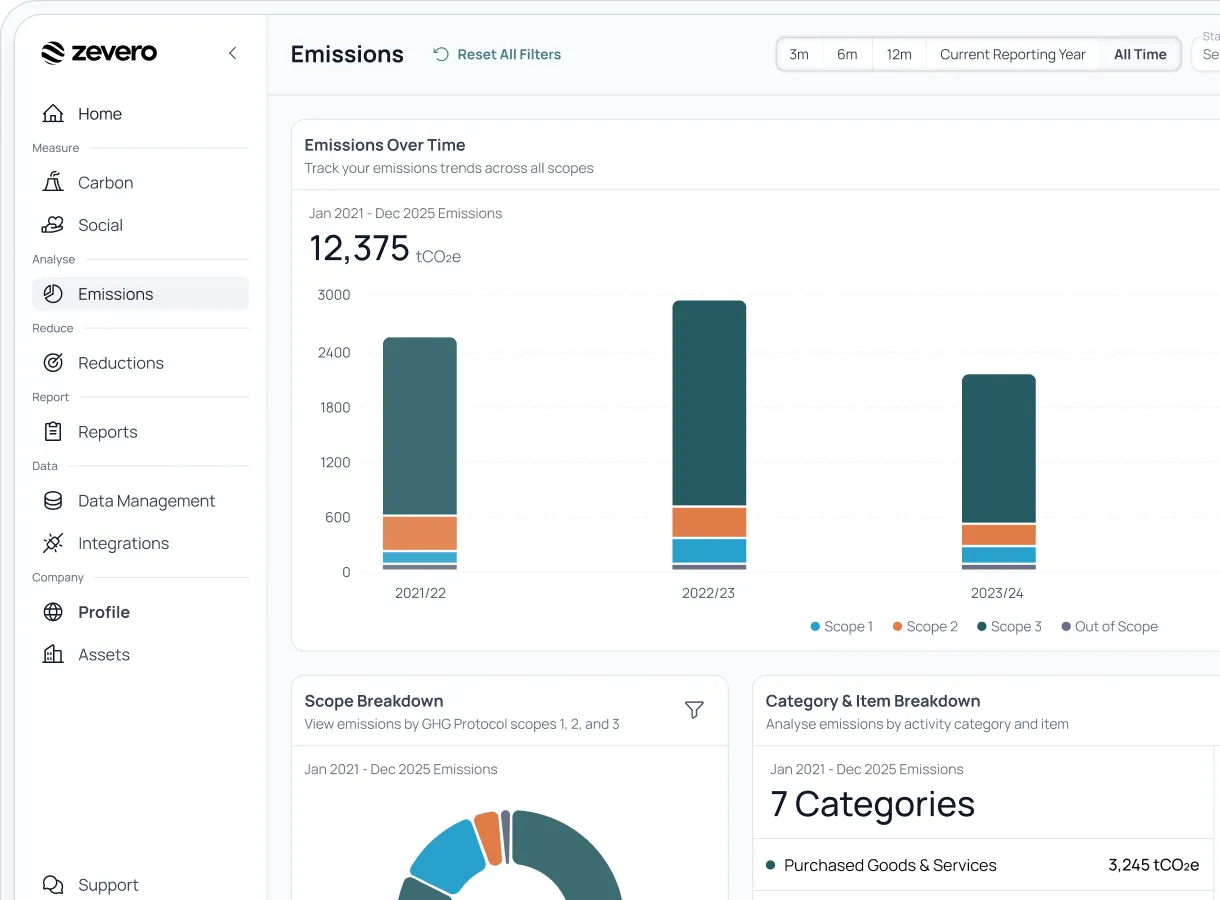
At Zevero, we help businesses navigate the step up from existing sustainability reporting to SSBJ compliance. Our platform is built to handle the specific requirements the standard introduces:
- Scope 3 measurement broken down by category, with methodology tagging and documentation support
- Exportable documentation trails designed for assurance review
- Regulatory mapping to SSBJ standards, so your team can work directly against the requirements that apply to you
- Multi-year data storage with version control, so methodology changes between years are documented rather than overwritten
If you need guidance on preparing for the SSBJ standards, speak with our team.

Related posts

Read more

Blog
Feb 26, 2025
The EU Omnibus Proposal: What It Means for Your Sustainability Reporting
The EU Omnibus Proposal: What It Means for Your Sustainability Reporting

Read more
Blog
Oct 3, 2024
Preparing for SGX’s New Climate Reporting Mandates: What You Need to Know
Preparing for SGX’s New Climate Reporting Mandates: What You Need to Know
Read more
Blog
Jan 2, 2025
California Climate Disclosure Rules: What SB 253 and SB 261 Mean for Your Business
California Climate Disclosure Rules: What SB 253 and SB 261 Mean for Your Business
See how Zevero can streamline your carbon reporting
Grow your business and reduce your impact