Education

Quick summary
- CDP is voluntary, but increasingly hard to avoid. A weak or missing score can affect investor and customer decisions even though disclosure itself isn't a legal requirement.
- The scoring deadline falls in the week of 16 September. Responses submitted after that date and before the week of 26 October still feed CDP's data analytics but receive no score.
- Reaching Leadership or higher requires a public response. Keeping a disclosure private caps the achievable score at B, regardless of data quality.
In 2026, CDP's Capital Markets Signatories, over 540 financial institutions representing more than $110 trillion in assets, are requesting over 43,000 organisations to disclose. Investors and supply chain partners increasingly use CDP scores to assess risk before signing contracts, extending credit, or making allocation decisions. That creates a real problem for companies that have never engaged with the process. A missing or weak score can quietly close doors long before climate targets ever come up in conversation.
For companies that have received a formal disclosure request, or are weighing up whether to disclose voluntarily, the scoring deadline on 16 September is the date that matters most in 2026.
What is CDP?
CDP is a global non-profit that runs one of the most widely used environmental disclosure systems in the world. Companies, cities, states, and regions use it to report data on climate change, water security, and forests, and that data is then shared with the investors, customers, or banks who requested it.
CDP disclosure is voluntary but companies may be asked to disclose by a customer or investor. Once a request is received, or a company opts in voluntarily, the requirement is straightforward: complete the relevant questionnaire and receive a score based on what's submitted. Since 2024, climate, water, and forests sit inside a single integrated questionnaire; one submission can cover all three themes. How well a company scores reflects the quality of its own data and management practices rather than compliance with a law.
What's new for CDP in 2026
Several changes are worth understanding before starting a 2026 response.
- Admin fees have risen by around five per cent globally in 2026. Three fee tiers are available: Essential, Foundation, and Enhanced, with Enhanced offering the widest range of benefits, including comparative analysis reports benchmarked against ten peer companies. Companies responding to a supply chain or bank request remain exempt from the fee.
- Small and medium-sized enterprises (SMEs) can achieve an A score for the first time in 2026. Previously, the SME questionnaire capped scores at B regardless of disclosure quality; Leadership is now scored, giving smaller businesses a genuine top rung to aim for. CDP is clear that an SME A isn't equivalent to a full corporate A, and recommends the full questionnaire for companies engaging closely with capital markets.
- Ocean, plastics, and biodiversity are unscored in 2026. Ocean-related disclosure is new this cycle and optional — companies with material ocean dependencies can opt in to report, but scores won't attach until a future cycle. Plastics and biodiversity follow the same pattern.
- Forests scoring has expanded to seven commodities. Cocoa, coffee, and rubber join cattle, palm oil, soy, and timber and are scored in 2026 for the first time. Companies sourcing any of the three new commodities, even indirectly, will need the same traceability and supplier engagement data that the original four have required.
.webp)
What companies need to disclose
The core of any CDP submission is emissions data across three scopes:
- Scope 1 emissions, arising directly from sources a company owns or controls.
- Scope 2 emissions, arising from purchased electricity and other energy.
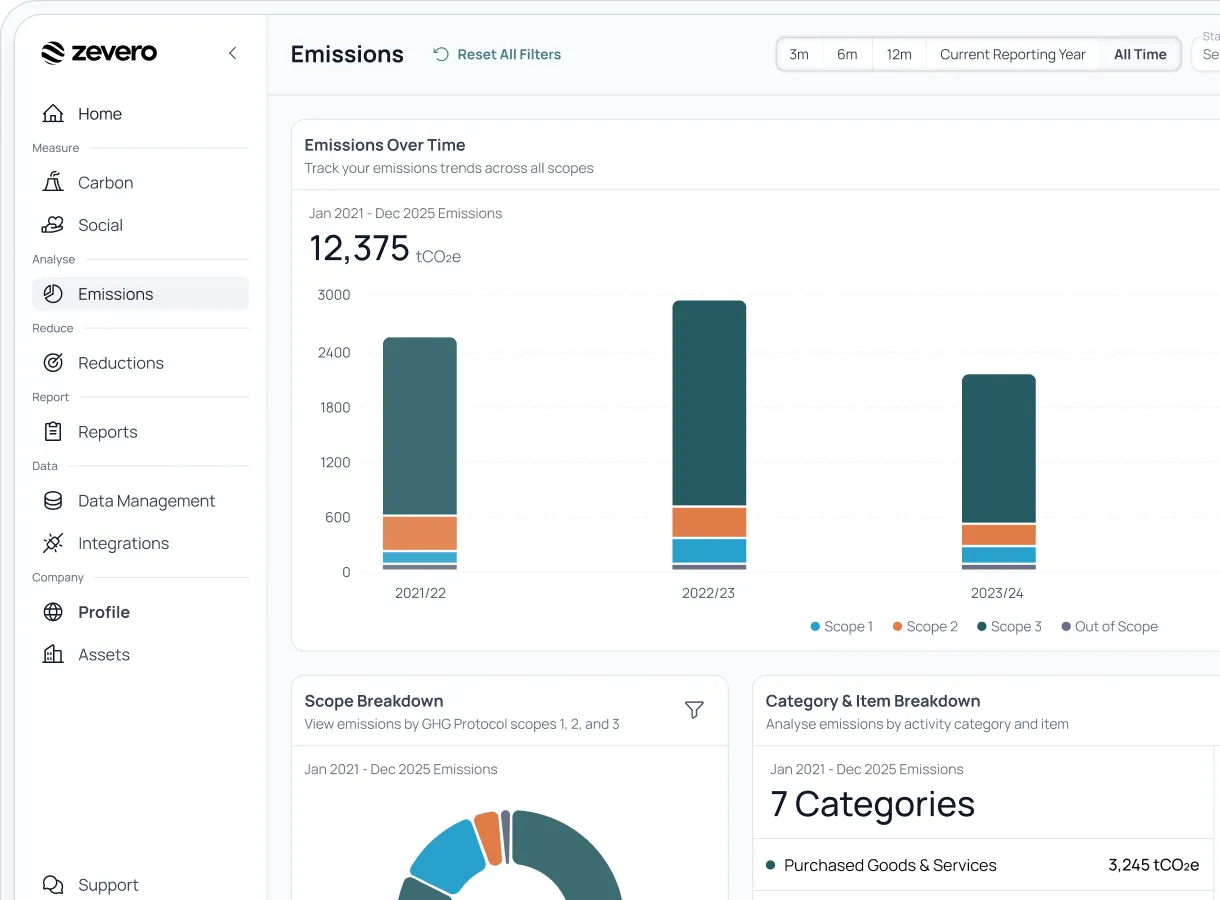
- Scope 3 emissions, covering everything else in the value chain, from purchased goods to employee travel. Scope 3 typically represents the largest share of a company's total footprint, often by a wide margin.
Water security and forests disclosures aren't automatic. They apply only where a company has been specifically requested to report on them, or has opted in during questionnaire setup.
CDP's climate questionnaire maps directly onto the International Financial Reporting Standards (IFRS S2) sustainability disclosure standard, the European Sustainability Reporting Standards (ESRS) E1 climate module under the Corporate Sustainability Reporting Directive (CSRD), and the GHG Protocol. In practice, this means one well-prepared disclosure can support several separate reporting obligations at once, rather than requiring a fresh data pull for each framework.
Sector matters too. Additional questions apply depending on activity: financial services, energy, materials-related sectors such as chemicals, metals, and steel, and transport all carry sector-specific climate questions, with further add-ons for water and forests depending on industry classification. Companies should check their questionnaire setup in the CDP Portal to see which modules apply, rather than assuming a generic response will cover it.
How CDP scoring works
Scores run from D- up to A, with each band reflecting a different stage of environmental maturity: disclosure, awareness, management, and leadership.
- Visibility depends on a company's own choice, up to a point. A response is always visible to whoever requested it, such as a customer or a Capital Markets Signatory, regardless of whether the company chooses to make it public more widely. That choice matters more than it first appears: CDP's own essential criteria require a public response to reach Leadership. A company that keeps its disclosure private is capped at a B, however strong the underlying data.
- Verification requirements tighten at each level. To reach Leadership, a company needs at least 95 per cent of its reported Scope 1 and 2 emissions verified by a third party, plus at least one verified Scope 3 category. The A List raises this further: full verification of Scope 1 and 2, plus verification of at least 70 per cent of at least one Scope 3 emissions category.
- Targets carry weight at the top level. Near-term emissions reduction targets, particularly those approved by the Science Based Targets initiative, contribute meaningfully to A List scoring.
Scores are released to disclosing companies and their requesters, and published publicly on CDP's website, in the same week: the week of 30 November. For companies whose customers, investors, or lenders check CDP scores as part of due diligence, that publication date carries real reputational weight.
Getting started with a CDP response
Whether a company is responding to a request for the first time or returning after a gap, three steps are worth taking now:
- Confirm what's actually being asked. Check the CDP Portal to see whether a formal request has been received, and which questionnaire modules, climate, water, or forests, apply. Not every company needs to respond to every theme.
- Get the underlying data in order before the response window opens. Scope 1 and 2 data should be measured and, ideally, verified; a Scope 3 baseline is the minimum needed for climate scoring. Data gaps discovered close to the September deadline leave little room to fix them.
- Decide on public or private disclosure early, and assign ownership. The public/private decision caps the achievable score, so it shouldn't be an afterthought at submission. A Submission Lead should be designated in the CDP Portal well ahead of the response window, with contributors added early.
How Zevero can help
A strong CDP response depends on reliable data and knowing where a disclosure is likely to fall short before submitting it, not after scoring. Zevero's ESG Reporting Tool now covers CDP, drafting answers question by question with evidence citations, and flagging data and coverage gaps before they affect a score. Expert review is built into all three service tiers.
- CDP Response Readiness Review. For companies that have been asked to disclose, or want to, and aren't sure where they stand. The platform runs the assessment against the current-year questionnaire and returns a readout of coverage gaps, evidence gaps, and data gaps, alongside a first-pass set of drafted answers and a prioritised roadmap to the deadline.
- Full CDP Response Delivery. For companies that know they're disclosing and want the workload taken off their plate. The platform drafts the full response scoped to the company's sector, with expert review and revision rounds through to a portal-ready submission.
- CDP Improvement Programme. For returning disclosers who want more than a drafted response. The response work runs on the platform as above, with an additional advisory layer: what's holding the current position back, why, and a prioritised path to closing it.
Every answer comes with evidence citations back to source documents. Speak to the Zevero team to find the right starting point for your CDP disclosure.
FAQs
Can a company edit its response after submitting, but before the scoring deadline?
What happens if a company is asked to disclose by a Capital Markets Signatory and doesn't respond?
Is there a size threshold for using the SME questionnaire?
How does a company know if water security or forests questions apply to it?
Thanks for reading!
CDP Reporting in 2026: A Practical Guide to Disclosure and Scoring
Add us as a preferred source

Related posts

Read more

Blog
Jun 12, 2025
CDP reporting: What to know and how to get started
CDP reporting: What to know and how to get started
See how Zevero can streamline your carbon reporting
Grow your business and reduce your impact