Education

.webp)
Quick summary
- Planet Mark and Zevero solve different problems. Planet Mark's certification and annual Measure, Engage, Communicate model is built for external recognition, while Zevero's platform and named expert are built for continuous tracking and reduction.
- The right alternative depends on what "alternative" means for the organisation. A continuous platform, a different certification, a broader ESG badge, or a consultancy relationship all solve different parts of the sustainability puzzle, and Planet Mark itself can sit alongside any of them rather than being replaced outright.
- Regulatory coverage and Scope 3 depth are worth checking closely. Confirm which frameworks are supported by default and how granular Scope 3 measurement is before committing to a certification programme or a platform.
A certification badge and a carbon accounting platform solve different problems, even though both sit under the same "sustainability software" umbrella. A badge tells clients and investors that a footprint has been independently checked. A platform tells the internal team what is driving that footprint and what to do about it next. Organisations often start with one and realise partway through the year that they actually need the other.
Planet Mark has built its reputation on the first of those two problems: independently verified certification, backed by an annual membership model. Its Measure, Engage, Communicate approach has helped it become one of the more recognised sustainability marks in the UK. But an annual certification cycle is a different commitment to a platform that tracks emissions continuously, and the right fit depends on which of those two problems an organisation is actually trying to solve.
This blog looks at how Planet Mark's certification model works, the situations where organisations look for something different, and how it compares with Zevero and four other carbon management options.
What Planet Mark does and how its certification works
Planet Mark is a UK-based sustainability certification and net zero advisory provider, operating as part of the Alcumus group. Rather than selling software as its primary product, Planet Mark sells membership in an annual certification programme, delivered through a model it calls Measure, Engage, Communicate.
The certification itself runs through four milestones:
- Planet Mark Certified – Business: the organisation measures its Scope 1 and 2 emissions to establish a net zero baseline, with a Scope 3 option available through the Advanced package
- Planet Mark Certified – Net Zero Committed: near-term and long-term net zero targets are set, alongside a bespoke Net Zero Transition Plan
- Planet Mark Certified – Net Zero Aligned: annual progress reports track performance against those targets
- Planet Mark Certified – Net Zero Achieved: long-term targets are met and residual emissions are neutralised through certified carbon removal offsets
Each year's verified footprint becomes the following year's baseline, which is designed to drive continuous improvement rather than a one-off measurement. Support includes:
- A data platform and toolkits for data collection
- Employee engagement programmes through the Planet Mark Academy
- Marketing assets for communicating certified progress
Its methodology aligns with the GHG Protocol and the Science Based Targets initiative's Corporate Net Zero Standard, and Planet Mark is recognised by the UNFCCC as a Cooperative Climate Initiative. More than 700 organisations currently hold Planet Mark certification.
Reasons businesses look for a Planet Mark alternative
Planet Mark's certification model works well for organisations that primarily want a recognised badge and a structured annual programme. A few situations tend to push organisations toward a different kind of platform instead.
- Emissions tracking needs to be continuous, not annual. Planet Mark's model is built around a yearly measurement and recertification cycle. Organisations that want to see emissions data update as the business changes throughout the year, rather than once at certification time, need a platform designed for ongoing tracking.
- The priority is a working carbon accounting system, not a certification badge. Planet Mark's own guidance on choosing a platform notes that a certification-first approach can come with a higher cost and less flexible software than a dedicated carbon accounting platform, particularly for full Scope 3 measurement.
- Recertification effort needs to shrink each year, not repeat. Because each certification level requires a fresh submission and verification cycle, organisations without an internal sustainability team can find the annual process repetitive rather than compounding.
- The organisation needs software that connects directly to source systems. Certification programmes are typically supported by data collection toolkits and drop-in sessions rather than direct integrations with accounting, ERP, or industry-specific systems.
.png)
Top Planet Mark alternatives for carbon management
Zevero
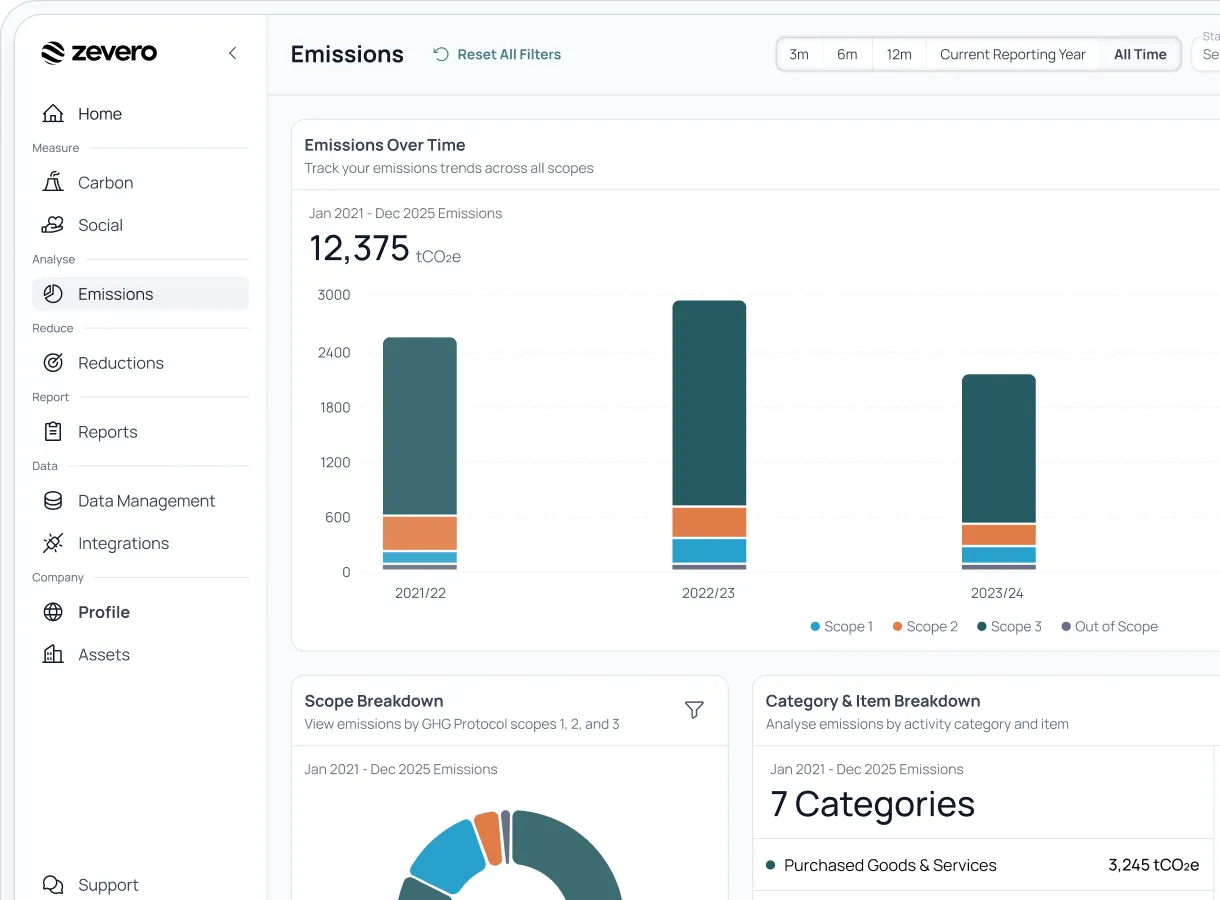
Zevero is a UK-based, AI-enabled climate platform that pairs continuous carbon accounting software with a named in-house climate expert, rather than an annual certification cycle. Instead of a badge earned once a year, Zevero is built to track emissions and reduction progress throughout the year, with the expert reviewing the output on an ongoing basis.
Best suited for: growing and mid-sized organisations, particularly in food and beverages, manufacturing, and consumer goods, that want a working reduction roadmap and continuous tracking rather than an annual recertification exercise.
Key features:
- Scope 1, 2, and 3 carbon accounting with automated data collection, refreshed continuously rather than at a single annual measurement point
- A named climate expert who reviews the data and shares responsibility for the output, in place of a data collection toolkit and drop-in sessions
- Regulatory disclosure reporting across 12 frameworks, including SECR, UK SRS, ISSB, SSBJ, SBTi, B Corp, and CDP
- Reduction roadmaps and decarbonisation planning built into the core service from the outset
- Industry expertise in food and beverages, manufacturing, and consumer goods sectors
Considerations: Zevero does not offer a public-facing certification mark in the way Planet Mark does, so organisations that specifically want an externally recognised badge for marketing or tender purposes may still value Planet Mark's certification alongside or instead of a continuous platform.
51 to Carbon Zero
51 to Carbon Zero (51-0) is a London-based climate technology company that combines an AI-powered carbon measurement platform with advisory services, following its 2025 acquisition of sustainability consultancy Green Element. It measures Scope 1, 2, and 3 emissions in real time and pairs that with Climate Success Managers who provide sector-specific guidance.
Best suited for: organisations, particularly in media, advertising, food and beverage, and automotive, that want continuous platform tracking combined with consultancy-style advisory support.
Key features:
- Real-time carbon measurement and reporting across Scope 1, 2, and 3, replacing lengthy annual reporting cycles
- Compliance-ready reporting for SECR, CSRD, CDP, and TCFD
- Advisory support from Climate Success Managers, strengthened by the integration of an established sustainability consultancy
- Sector-specific focus, with particular depth in media, advertising, and food and beverage supply chains
Considerations: 51 to Carbon Zero's sector depth is currently concentrated in media, advertising, and food and beverage, so organisations outside those areas should confirm support for their specific industry before committing.
Positive Planet
Positive Planet is a Manchester-based sustainability consultancy that works with businesses across measurement, reduction, training, compliance, and communication, delivered through hands-on consultancy engagements rather than software.
Best suited for: organisations that want a consultancy relationship with dedicated advisory support across a broad range of sustainability activities, not just carbon measurement.
Key features:
- End-to-end consultancy covering carbon measurement, reduction strategy, staff training, and compliance
- Direct advisory relationship rather than a self-serve platform
- Support across communication and stakeholder engagement alongside carbon work
Considerations: As a consultancy rather than a software platform, the data collection and reporting experience is less repeatable and automated than a dedicated carbon accounting tool, and pricing reflects the level of hands-on service provided.
Carbon Trust
The Carbon Trust is a global sustainability advisory firm that has spent over 20 years helping businesses, governments, and financial institutions plan and deliver their transition to net zero. Certification, through its Route to Net Zero Standard, sits alongside a broader set of advisory services including target setting, footprinting and reporting, and decarbonisation strategy.
Best suited for: organisations that want ongoing advisory support across their full net zero transition, with independently verified certification as one part of that relationship rather than the sole offering.
Key features:
- Advisory support across target setting, decarbonisation strategy, footprinting and reporting, and supply chain engagement, delivered by a global team of 350+ experts
- The Route to Net Zero Standard, a three-tier certification (Taking Action, Advancing, Leading) with independent verification at each stage
- More than 3,000 organisations globally supported with climate action planning
- An established client base including large enterprises such as Amazon, Kellogg's, GSK, and Virgin Media O2
Considerations: Carbon Trust's advisory model is built for organisations with the budget and internal resourcing to work with a global consultancy, so it may bring more scale and cost than smaller businesses need. Certification is also one output of a broader advisory engagement, rather than a lighter-touch option like Planet Mark's.
Seedling
Seedling is a UK-based carbon accounting platform built for SMEs, pairing software with a dedicated, named carbon expert assigned to every client from day one.
Best suited for: small and mid-sized businesses, and sustainability consultancies or accountancies, that want an easy-to-use platform with flexible pricing and hands-on expert support built in as standard.
Key features:
- Full-scope Scope 1, 2, and 3 GHG inventory measurement, with AI-assisted data input and expert review
- In-platform, SBTi-aligned target setting and a decarbonisation modelling tool
- Automated compliant reporting, including SECR, Carbon Reduction Plans, and B Corp Climate Transition Plans
- Its own certification recognising businesses with a verified, science-backed reduction plan
- A partner network of sustainability consultancies, accountancies, and agencies delivering carbon accounting services on its platform, used by more than 500 businesses
Considerations: Seedling's named-expert model is structurally close to Zevero's own approach, so the practical difference between the two often comes down to sector specialism, pricing, and which regulatory frameworks each platform prioritises by default rather than the underlying service model.
Planet Mark vs Zevero: feature and pricing comparison
Certification vs platform checklist
Moving from a certification-first model to a continuous platform, or the other way round, involves a different kind of transition than switching between two software tools. A few questions are worth answering before making that decision.
- Does the organisation need a badge, a platform, or both? Certification and continuous tracking answer different questions, and some organisations use both together rather than treating them as alternatives.
- How much does the annual cycle currently cost in staff time? Recertification each year requires a fresh data submission; compare that ongoing effort against the setup cost of a continuous platform.
- Which regulatory frameworks need default coverage? Confirm whether SECR, UK SRS, or CSRD are built into the core service or offered as a separate add-on.
- Is Scope 3 measurement detailed enough for the organisation's supply chain exposure? Certification programmes vary in how granular their Scope 3 categories are compared with dedicated accounting platforms.
- Does the organisation want a named expert or a self-serve platform? This shapes both the day-to-day experience and how much responsibility the organisation retains internally.
.png)
How to choose the right Planet Mark alternative
The right choice depends on whether the priority is external certification, continuous tracking, broader ESG credentials, or a consultancy relationship.
- If continuous tracking and a named point of accountability matter most, Zevero's platform-plus-expert model is built around ongoing measurement rather than an annual cycle.
- If continuous platform tracking combined with sector-specific advisory support is the priority, 51 to Carbon Zero pairs real-time measurement with Climate Success Managers.
- If a hands-on consultancy relationship across a wide range of sustainability activities is the priority, Positive Planet's advisory model offers that broader scope.
- If ongoing advisory support across the full net zero journey is the goal, the Carbon Trust pairs global consultancy expertise with certification as part of a broader engagement.
- If the priority is an easy-to-use platform with flexible pricing built for SMEs, Seedling pairs software with a named expert in a model close to Zevero's own approach.
See how Zevero compares for your organisation
Certification and continuous tracking both have a role to play, and the right combination depends on the organisation's regulatory priorities, supply chain, and internal resourcing. Book a demo to see how Zevero's approach to measurement and reduction could fit alongside your existing certifications.
Carbon data is costing UK businesses deals. See who’s missing out and why.
FAQs
How much does Planet Mark certification cost?
What happens if a certified member misses their reduction target?
Can an organisation use both a carbon accounting platform and Planet Mark certification?
Is 51 to Carbon Zero only suited to media and advertising businesses?
Does switching to a continuous platform mean giving up an existing Planet Mark certification?

Related posts
.webp)
Read more

Blog
Aug 27, 2026
Greenly Alternatives for Carbon Management
Greenly Alternatives for Carbon Management
.webp)
Read more
Blog
Oct 14, 2025
The UK Sustainability Reporting Standards (UK SRS) Explained
The UK Sustainability Reporting Standards (UK SRS) Explained
Read more
Blog
Aug 11, 2026
Carbon Management Software: 2026 Buyer’s Guide
Carbon Management Software: 2026 Buyer’s Guide
See how Zevero can streamline your carbon reporting
Grow your business and reduce your impact