Policy

.webp)
Quick summary
- V2.0 is an implementation framework, not just a target-setting tool. The standard follows a ten-step path that runs from company classification through to a board-approved transition plan, with governance, data quality and progress assessment built in throughout.
- Scope 1 and Scope 2 now require separate targets, each at 100% coverage. Companies choose from three method options for Scope 1 and two for Scope 2. The combined Scope 1 and 2 target and the Scope 2 intensity option have both been removed.
- Scope 3 coverage is significance-based, not percentage-based. Targets must cover every category that individually accounts for 5% or more of total Scope 3 emissions, with justified exclusions permitted for categories below that threshold.
The Science Based Targets initiative (SBTi) Corporate Net-Zero Standard V2.0 introduces the most significant changes to corporate target setting since the original framework was launched. While previous versions focused primarily on establishing science-based targets, V2.0 places greater emphasis on how companies deliver against them.
This shift reflects a broader change in expectations. Investors, regulators, customers and other stakeholders increasingly want to understand not only what companies plan to achieve, but also how they intend to achieve it. As a result, governance, implementation planning, data quality, and progress assessment now play a more prominent role throughout the target-setting process.
For organisations approaching SBTi target setting for the first time, the requirements can appear complex. However, the process follows a clear sequence. Companies begin by establishing their category and emissions baseline, then set targets across the relevant emissions scopes before developing the governance structures and implementation plans needed to support delivery.
What's Changed in Corporate Net-Zero Standard V2.0?
The defining change in V2.0 is the move from ambition-setting to implementation accountability. Rather than operating solely as a target-validation framework, the standard is now designed to sit inside business planning, investment decisions, procurement and operational activities.
Several other changes shape the target-setting process:
- Companies are now classified as either Category A or Category B, replacing the previous corporate andSME (small and medium-sized enterprise) split.
- Scope 1 and Scope 2 emissions must be covered by separate targets, each covering 100% of emissions within that scope.
- Scope 3 targets move from fixed coverage thresholds to a significance-based approach.
- Transition planning and governance become core requirements rather than supporting activities.
- Targets are built using the physical inventory, with market instruments reported separately.
- Validation becomes part of a structured five-year cycle that includes progress reporting, assessments and target renewal.
.webp)
.webp)
Companies submitting targets from 1 February 2027 to 31 January 2028 can choose to submit under either V1.3.1 or V2.0. From 1 February 2028, all new submissions must follow V2.0.
The Target-Setting Sequence at a Glance
The target-setting journey under V2.0 follows ten steps. Each step builds on the previous one, creating a structured pathway from emissions measurement through to target submission.
Step 1: Classify the Company
The process begins by registering with SBTi Services and confirming the correct company category, since the category determines which requirements apply. V2.0 sets the two categories by revenue, emissions, employee numbers and geography.
The two categories break down as follows:
- Category A: large companies in every country, plus medium-sized companies in high-income countries. Transition-plan disclosure, base-year assurance and Scope 3 target-setting are mandatory.
- Category B: small companies in every country, plus medium-sized companies in lower-income countries. The same obligations are optional rather than required.
Establishing the category first means the rest of the sequence can be scoped accurately.
Step 2: Select the base year and build the inventory
V2.0 uses a rolling base year. Rather than fixing on a historical year, companies take the most recent year for which comprehensive data is available and refresh it at each cycle. This anchors targets to the current emissions profile and frames each cycle as a continuation of the decarbonisation journey rather than a reset.
The inventory itself becomes more demanding. No exclusions from the inventory boundary are permitted, so it must cover every scope and every gas. Targets are then modelled on the physical inventory, which for Scope 2 means the location-based figure. Market instruments such as energy attribute certificates (EACs), which convey low-carbon electricity attributes, do not appear in that inventory. Instead, they are accounted for and reported separately as implementation actions. This separation between the physical inventory and market instruments runs through the rest of the standard.
Step 3: Prepare for assurance (Category A)
Category A companies bring the quality of their base-year inventory data up to a standard that can support limited assurance. Tackling this at the baseline stage, rather than once targets are set, avoids reworking the inventory data later in the cycle. Category B companies are encouraged to do the same but are not required to.
Step 4: Set separate Scope 1 and Scope 2 targets
V2.0 requires Scope 1 and Scope 2 to be addressed as distinct targets, each covering 100% of emissions in that scope.
For Scope 1, companies select from three options and can apply different options to different activities:
- Absolute emissions reduction, on a straight-line trajectory from the base year to the net-zero year.
- Emissions intensity reduction, available only where an SBTi sector pathway exists, such as steel, cement, primary chemicals, building operation, shipping and aviation.
- Asset transition, designed for long-lived capital stock that decarbonises in steps rather than a smooth line, set through either a science-based carbon budget, which defines a cumulative emissions limit for that asset portfolio, or science-based milestones, which set predetermined timelines for retiring or replacing emitting assets.
A long-term Scope 1 target is required only where the near-term target uses the intensity or asset-transition route.
For Scope 2, companies choose from two options:
- Low-carbon electricity alignment: increases the share of low-carbon electricity, which includes renewables and nuclear, in total consumption.
- Absolute emissions reduction: sets a straight-line trajectory based on the location-based inventory. Where a company has heat, steam or cooling emissions, those are also covered by this target type.
Category A companies with projected annual electricity consumption growth exceeding 20% over the target cycle must set an absolute emissions reduction target. Low-carbon electricity alignment becomes an optional addition rather than the primary target in this case.
The standalone emissions intensity option that existed for Scope 2 under earlier versions has been removed.
Step 5: Check Scope 3 coverage
V2.0 replaces the old fixed-percentage coverage threshold with a significance test. Scope 3 targets must cover every category that individually represents 5% or more of total Scope 3 emissions, across categories 1 to 14. Categories below that threshold, and certain activities where a company can demonstrate it has limited practical influence over the emissions involved, may be excluded, provided each exclusion is reported and justified. Scope 3 targets are required for Category A companies and strongly encouraged for Category B.
Step 6: Choose the Scope 3 target-setting approach
With the boundary defined, companies select how to demonstrate performance against it. V2.0 offers three routes:
- An overarching absolute emissions reduction target across the full target boundary.
- An overarching supplier or customer alignment target, measured by the growing share of tier 1 suppliers or customers that are themselves setting and progressing against science-based targets.
- Category- or activity-specific targets, for companies whose emissions concentrate in particular categories or high-emitting activities, with eligible methods varying by category.
Step 7: Plan implementation using the hierarchy
V2.0 does not stop at target-setting. The standard also specifies how companies act on their targets through a defined implementation hierarchy. Direct actions at the activity level come first, such as efficiency improvements, fuel switching and engaging specific suppliers or customers. Where emissions sit within shared systems such as electricity grids or supply networks, companies may act at the activity-pool level, taking action within the shared system itself, supported by market instruments that meet the standard's integrity criteria. Sector-level actions are permitted only where structural barriers, such as technology that is not yet available at scale, genuinely prevent sufficient action at the activity or activity-pool level. Companies must document any such barriers and show that broader action complements rather than substitutes for more direct measures.
Step 8: Develop the transition plan and governance
V2.0 makes board-level accountability for science-based targets mandatory, including oversight of implementation. Every company develops and maintains a transition plan, and Category A companies publish a disclosure of that plan within 15 months of completing Target Validation. The plan is built once the targets and implementation approach are defined, so that it reflects the company's actual route to meeting its targets. At validation, the SBTi confirms that the plan exists and contains the required elements; it does not assess the quality or feasibility of the plan itself.
Step 9: Consider optional recognition programmes
V2.0 includes two voluntary programmes that companies factor into their planning for the cycle ahead. The first recognises Scope 2 hourly matching, although companies with significant electricity use must report their hourly-matched share whether or not they pursue recognition. The second is the Ongoing Emissions Responsibility programme, launching in 2027, which recognises companies that take responsibility for ongoing emissions through eligible climate contributions. Participation is voluntary until 2035, when Category A companies become required to support eligible carbon removals covering at least 1% of ongoing emissions, rising to 100% by their net-zero year, including a growing share of long-lived removals. Both sit alongside the core targets as a complement to direct emissions reduction, never as a substitute for it.
Step 10: Use the readiness assessment (optional)
Before submitting, companies can opt to use the SBTi's readiness assessment, a technical-expert review that maps current targets and inventory data against the V2.0 requirements and identifies the gaps to close. It is an optional final check before a company submits its targets for validation.
.webp)
What happens after validation?
V2.0 replaces one-off validation with a continuous five-year cycle. Once targets are validated, companies report progress publicly each year, alongside their Scope 1 and Scope 2 emissions and any barriers to delivery. At the end of the cycle, companies complete an end-of-cycle assessment that measures performance against the targets. For Category A, the supporting data must be independently assured. They then submit targets for the following cycle, anchored to a refreshed base year. Where targets have not been fully met, higher emissions at the target year drive steeper reductions in the following cycle.
How Zevero can help
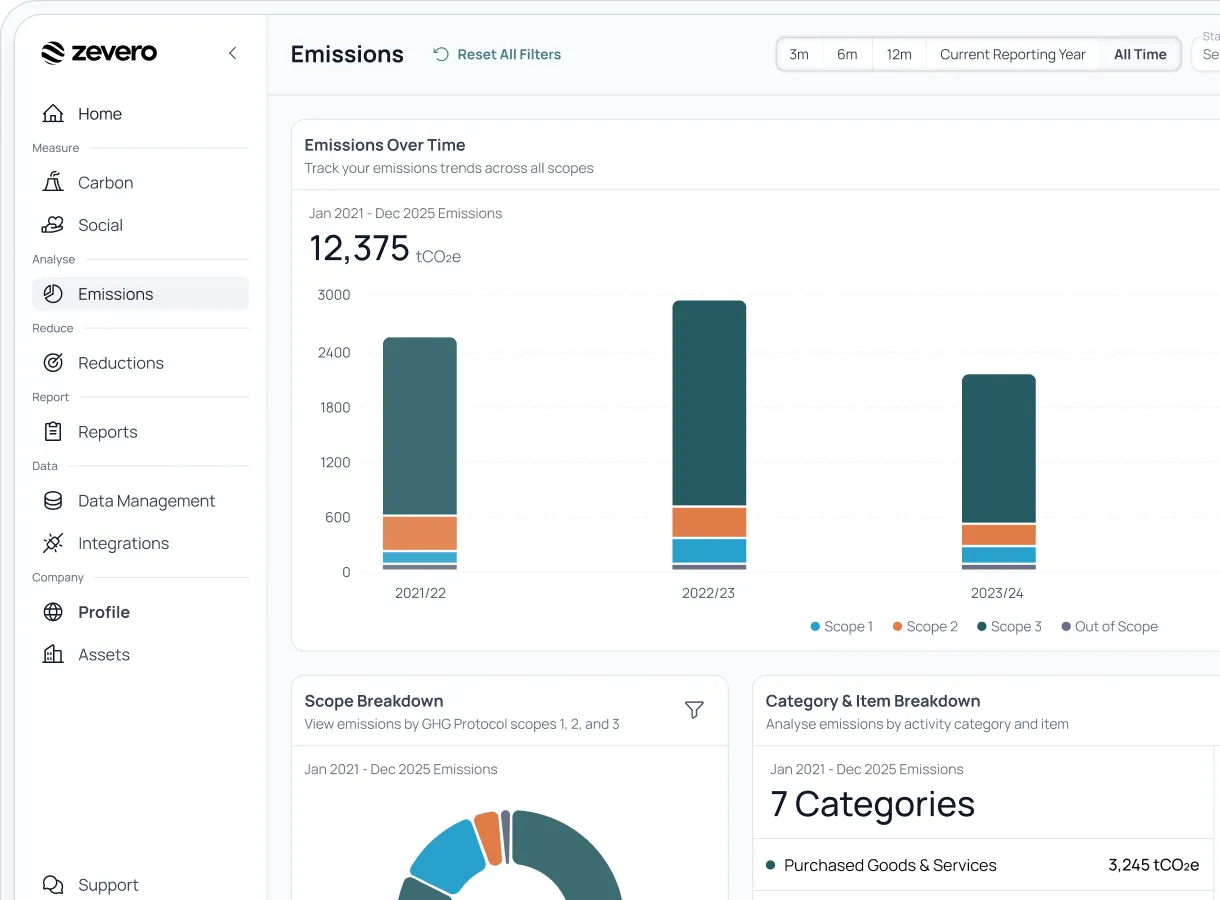
Setting targets under V2.0 starts with a complete emissions inventory and the right method for each scope. Zevero supports a full Scope 1, 2 and 3 inventory in line with the GHG Protocol, with category-level disaggregation that identifies which Scope 3 categories meet the 5% significance threshold covered in this guide. For companies weighing up the Scope 1, 2 and 3 method options, Zevero's target-setting support helps model which approach fits a company's asset profile, sector and emissions structure. For a fuller walkthrough of Zevero's approach to V2.0, see the SBTi Corporate Net-Zero Standard V2.0 guide. Book a demo to walk through target-setting methods suited to a company's scope 1, 2 and 3 profile.
A Complete Guide to the SBTi Corporate Net-Zero Standard V2.0
FAQs
Is a net-zero target mandatory under V2.0?
What happens if a company does not meet its targets?
Should a first-time company set targets now or wait for V2.0?
Do industry sector standards still apply under V2.0?
Thanks for reading!
How to Set SBTi Targets Under the Net-Zero Standard V2.0
Add us as a preferred source

Related posts

Read more

Blog
May 8, 2024
What are Scope 1, 2 and 3 Carbon Emissions?
What are Scope 1, 2 and 3 Carbon Emissions?

Read more
Blog
May 8, 2024
Location Vs Market-Based Carbon Reporting
Location Vs Market-Based Carbon Reporting
See how Zevero can streamline your carbon reporting
Grow your business and reduce your impact