Education

.webp)
Quick summary
- Normative leads with calculation traceability. Its software and methodology underwent an independent TÜV SÜD evaluation against GHG Protocol standards, and every account includes a named Climate Strategy Advisor, though the platform's strategic reduction planning and value chain engagement features sit in its Premium tier rather than Essential.
- Zevero and Normative share a named-expert model, but prioritise differently. Zevero builds reduction roadmaps and sector-specific delivery into its entry-level plan, while Normative's core strength is calculation traceability and an independently evaluated methodology, with reduction planning and value chain engagement as Premium platform features.
- The right choice depends on what matters most, not just the presence of an expert. Calculation traceability, reduction planning, sector fit, and company size all shape which platform is the better fit, and two platforms that both offer a named expert can still differ significantly in what that expert is there to do.
Some carbon accounting platforms compete on breadth: how many frameworks, how many integrations, how much of the sustainability workload they can absorb. Others compete on defensibility: can the number survive being challenged by an auditor, an investor, or a board member who wants to know exactly where it came from. Both are legitimate priorities, but they lead to different products.
Normative has built its reputation on the second of those two problems. Its positioning centres on traceable, audit-ready carbon accounting, supported by an independent TÜV SÜD evaluation of its software and calculation methodology, and a named climate expert on every account. That focus is a genuine strength for organisations whose main concern is defensibility. It also means some organisations may prioritise a different balance of calculation rigour, reduction planning, sector-specific support, and platform breadth.
That positioning is now worth reading in a new light. On 11 September 2026, Greenly announced the acquisition of Normative, in a deal reported at approximately €64 million, aimed at combining Normative's calculation methodology with Greenly's broader product suite and international reach. The comparison below reflects Normative's product and positioning as it currently stands; Greenly's own entry further down this page is worth reading alongside it, since the two companies are now under common ownership.
This blog looks at how Normative's platform works, the situations where organisations look for something different, and how it compares with Zevero and four other carbon accounting and sustainability platforms.
What Normative does and how its platform works
Normative is a carbon accounting platform that calculates Scope 1, 2, and 3 emissions using a proprietary calculation engine built on the GHG Protocol Corporate Standard and Corporate Value Chain (Scope 3) Standard. Its calculation methodology is independently evaluated by TÜV SÜD against ISO/IEC 25051 and the GHG Protocol, and every account is assigned a named, GHG Protocol-certified Climate Strategy Advisor.
Normative's platform includes:
- Automated carbon accounting with AI-powered data matching, drawing on a database of more than 349,000 emission factors across over 200 countries
- A Product Carbon Footprint (PCF) tool for product-level emissions reporting
- Supply chain engagement tools, including supplier surveys and connected supplier calculations
- Regulatory reporting support for SECR, CSRD, SBTi, and CBAM, built into the platform
- A named Climate Strategy Advisor on every account, plus optional consultancy add-ons covering SBTi target validation, CDP submissions, employee engagement, and benchmarking
Pricing is structured across two tiers, Essential and Premium, both available by quote rather than published. Premium adds enhanced data management, value chain engagement, and strategic reduction planning on top of Essential's calculation and reporting features. Normative reports a full carbon baseline, including Scope 3, typically completed within 8 to 12 weeks, alongside a 100% success rate across SBTi submissions and audits. Its client base includes Vodafone, Hertz, Hitachi Rail, Nordea, and Zurich.
Reasons businesses look for a Normative alternative
Normative's audit-first positioning works well for organisations whose main priority is defensible carbon data. A few situations tend to push organisations toward a different kind of platform instead.
- Reduction planning capability needs to be part of the core platform, not a package upgrade. Normative's Climate Strategy Advisors support reduction and target-setting guidance across both Essential and Premium accounts, but the platform's "Strategic reduction planning" and "Value chain engagement" features specifically sit in the Premium package. Organisations that want those platform capabilities without upgrading may prefer a platform where they are available at the entry tier.
- The organisation wants sector-specific software integrations. Normative's Climate Strategy Advisors bring sector expertise to every account, but the platform itself serves a broad range of industries without dedicated integrations built for any single sector.
- Broader ESG certifications matter alongside carbon. Normative's regulatory focus centres on SECR, CSRD, SBTi, and CBAM. Organisations pursuing certifications like B Corp, or wanting CDP and EcoVadis reporting built into the base platform rather than offered as a consultancy add-on, may prefer that coverage included by default.
%20(1).png)
Top Normative alternatives for carbon accounting
Zevero
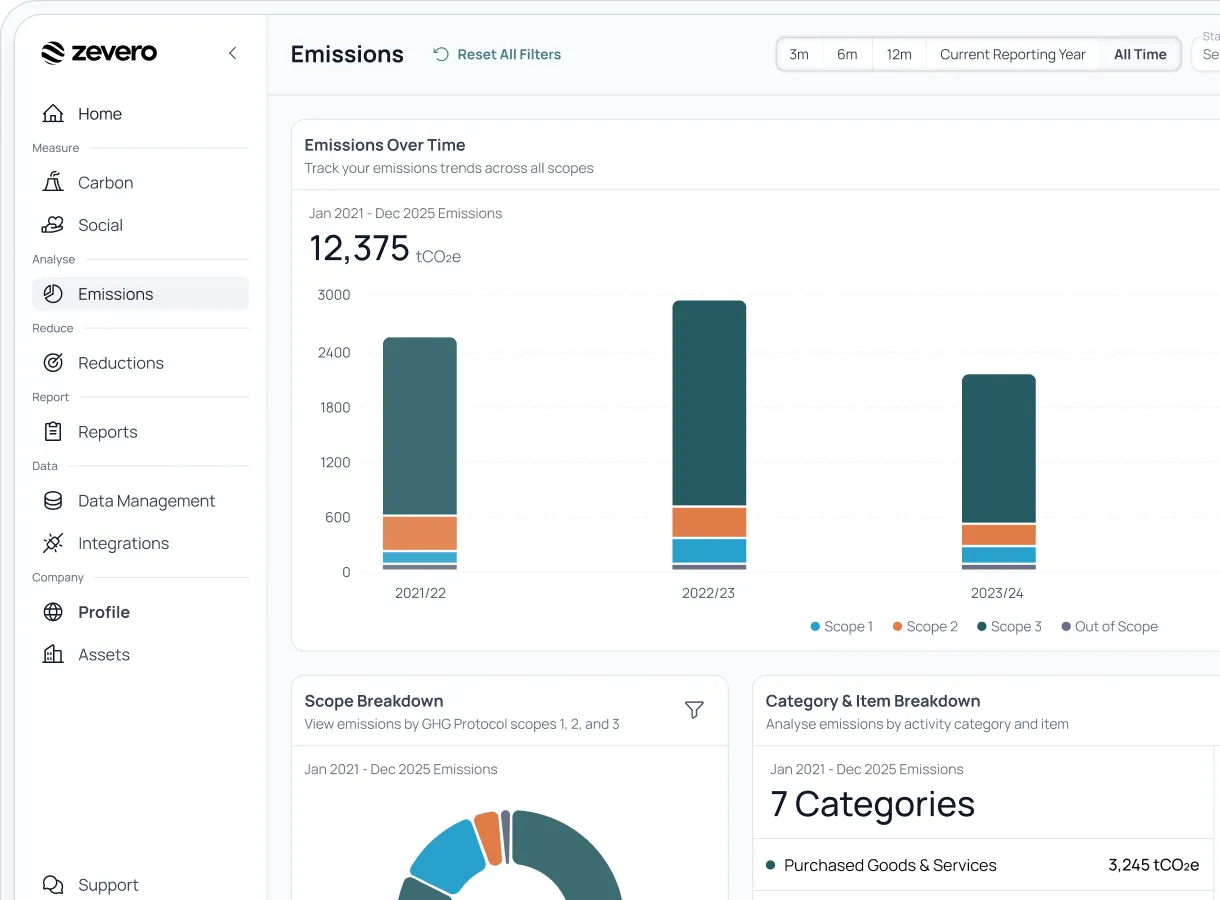
Zevero is a global carbon management platform that pairs carbon accounting software with a named climate expert, with the depth of involvement scaling by plan. Like Normative, it assigns a named person to every account rather than a shared helpdesk, but the emphasis shifts from audit defensibility toward reduction planning and sector-specific delivery from day one.
Best suited for: action-focused mid-market organisations, particularly in food, drink, manufacturing, and consumer goods, that want a reduction roadmap and named expert support built in as standard rather than tiered.
Key features:
- Scope 1, 2, and 3 carbon accounting with automated data collection and emission factor matching
- A named climate expert on every plan, with the depth of involvement scaling from periodic review to an embedded partner on higher tiers
- Disclosure reporting across a range of regulations and voluntary standards spanning the UK, EU, and Asia-Pacific, including SECR, SSBJ, SBTi, B Corp, CDP, and ISSB
- Reduction roadmaps and decarbonisation planning built into the core service from the outset
- Industry expertise in food and beverages, manufacturing, and consumer goods sectors
Considerations: Both Zevero and Normative lead with a named expert on every account, so the practical difference often comes down to emphasis: TÜV SÜD-evaluated calculation methodology (Normative), or sector-specific integration and reduction planning included from the entry tier (Zevero).
Greenly
Greenly is a French carbon accounting platform combining AI-powered automation with climate expertise, covering carbon accounting, life cycle assessment, supplier engagement, and broader ESG reporting in a single suite.
Best suited for: organisations that want a broad, all-in-one AI-automated platform covering LCA, ESG disclosure, and supplier engagement natively, rather than a narrower carbon-accounting-first tool.
Key features:
- Automated Scope 1, 2, and 3 carbon accounting with bank-linking and a large emission factor library
- Life cycle assessment for product-level carbon footprints, built on bill-of-materials imports
- Regulatory reporting support for CSRD, EUDR, SBTi, and CDP
- AI agents covering data preparation, Scope 3 mapping, LCA modelling, and reporting support
Considerations: Greenly's methodology and default frameworks are built primarily around EU requirements, with UK-specific factors such as SECR treated as secondary rather than default.
Plan A
Plan A is a European carbon accounting and decarbonisation platform, now operating as part of Diginex following its acquisition in January 2026. Its software is GHG Protocol compliant and TÜV Rheinland certified, and Plan A itself holds B Corp certification, backed by a Scientific Advisory Board that informs its methodology.
Best suited for: organisations that want a science-led carbon accounting and decarbonisation platform with certified methodology, particularly larger organisations already familiar with Plan A's enterprise client base.
Key features:
- Carbon accounting, reporting, and decarbonisation tools covering measurement, disclosure, and target setting in one platform
- Certified methodology (GHG Protocol compliant, TÜV Rheinland certified) backed by a Scientific Advisory Board
- An AI assistant ("Gaia") built into the platform for sustainability guidance
- A client base spanning more than 1,500 organisations, including BMW, Deutsche Bank, and Visa
Considerations: Plan A does not publish pricing, and organisations evaluating it are doing so shortly after its acquisition by Diginex, so it's worth asking how the service model and product roadmap are expected to evolve as the two businesses integrate.
Coolset
Coolset is a European ESG and supply chain compliance platform built for mid-market and enterprise organisations, combining Scope 1, 2, and 3 carbon accounting with compliance workflows for CSRD, EU Taxonomy, VSME, EUDR, and CBAM.
Best suited for: organisations that are primarily reporting and compliance-driven, rather than focused on taking active steps to decarbonise, and want a single platform covering carbon accounting alongside multiple overlapping compliance obligations.
Key features:
- Scope 1, 2, and 3 carbon accounting using a TÜV Rheinland-certified, GHG Protocol-aligned methodology
- CSRD, EU Taxonomy, and VSME reporting modules, with data reused across frameworks to avoid duplicate entry
- Supply chain compliance workflows covering EUDR and CBAM alongside carbon accounting
Considerations: Coolset's self-serve model is built around software rather than an assigned expert on every account, so organisations that specifically want a named point of accountability may need to weigh that against Coolset's more automated approach.
Sweep
Sweep is a sustainability data management platform aimed at large enterprises, built to centralise carbon, water, and waste data alongside broader ESG metrics across an organisation and its supply chain.
Best suited for: large enterprises managing sustainability data across multiple business units, systems, and supply chain partners.
Key features:
- Automated Scope 1, 2, and 3 emissions calculation, pulling data from existing ERP and finance systems
- Supplier engagement tools for collecting value chain emissions data
- Scenario modelling to test the impact of business decisions on carbon targets
- Reporting aligned with CSRD, SFDR, and other global disclosure frameworks
- AI-powered tools, including EcoPilot, for on-demand climate expertise and repetitive task automation
Considerations: Sweep's feature set is designed for large, complex organisations, so smaller businesses may find its capabilities go beyond what they currently need.
Normative vs Zevero: feature comparison
Carbon Platform Checklist: Audit vs Reduction
Since Normative and Zevero share a similar named-expert structure, the more useful comparison often comes down to what each platform prioritises by default rather than whether either includes expert support at all.
- Is reduction planning included as standard, or does it require a higher tier? Confirm whether decarbonisation roadmaps and value chain engagement come with the base package or require an upgrade.
- Which regulatory frameworks are built in, and which need a consultancy add-on? Some platforms bundle SBTi validation, CDP submission support, or B Corp preparation into consultancy services rather than the core product.
- Does the platform specialise in a sector relevant to the business? A platform with dedicated integrations for a specific industry can reduce onboarding effort compared with one built for broad, cross-sector coverage.
- What independent evaluation backs the methodology? Ask what assurance or evaluation has been performed on the calculation approach, and how transparent the calculation trail is if a number gets challenged.
- What does the realistic onboarding timeline look like? Full baselines, including Scope 3, typically take several weeks to a few months; ask each vendor for a timeline based on comparable customers.
.png)
How to choose the right Normative alternative
Weighing up the options usually comes down to a few things: how much an organisation values calculation traceability, reduction planning, sector fit, and platform breadth.
- If the priority is spending less time measuring and more time reducing emissions, Zevero's expert-led model is built to operationalise sustainability data into a working reduction plan, included as standard rather than a tier upgrade.
- If the priority is a broad, all-in-one AI-automated suite covering LCA, ESG reporting, and supplier engagement natively, Greenly's established feature set offers wide out-of-the-box coverage.
- If a science-led platform with certified methodology and a Scientific Advisory Board is the priority, Plan A offers that, though it's worth asking how its service model is evolving post-acquisition.
- If the organisation wants a single platform covering carbon accounting alongside overlapping EU compliance obligations, Coolset's coverage of CSRD, EU Taxonomy, VSME, EUDR, and CBAM offers that without an assigned expert on every account.
- If the organisation is a large enterprise managing sustainability data across many business units and supply chain partners, Sweep may be better suited to that scale of complexity.
See how Zevero compares for your organisation
Audit defensibility and reduction planning both matter. Book a demo to see how Zevero's expert-led approach could help an organisation spend less time on data and more time on reducing emissions.
FAQs
Does Normative use AI in its platform?
Does Normative support financial institutions specifically?
What optional consultancy services does Normative offer?
Does Normative offer a shorter engagement for a first carbon footprint only, without ongoing advisory support?
Does Normative offer full life cycle assessment (LCA), or just a product carbon footprint?
Thanks for reading!
Normative Alternatives for AI-Optimised Carbon Management
Add us as a preferred source

Related posts
.webp)
Read more

Blog
Sep 11, 2026
Plan A Alternatives for AI-Optimised Carbon Management
Plan A Alternatives for AI-Optimised Carbon Management
.webp)
Read more
Blog
Aug 27, 2026
Planet Mark Alternatives for Carbon Management
Planet Mark Alternatives for Carbon Management
.webp)
Read more
Blog
Aug 27, 2026
Greenly Alternatives for Carbon Management
Greenly Alternatives for Carbon Management
See how Zevero can streamline your carbon reporting
Grow your business and reduce your impact