Policy

Climate policy is no longer confined to environmental reporting. It is now directly shaping global trade, procurement decisions, and supply chain strategy. The Carbon Border Adjustment Mechanism (CBAM) is one of the best examples of this shift. For businesses importing into the European Union (EU), it introduces new reporting obligations, financial exposure, and a pressing need for reliable emissions data. This guide breaks down what CBAM means in practice, and what you should be doing about it now.
What is the EU Carbon Border Adjustment Mechanism?
CBAM is a regulatory tool implemented by the EU which places a carbon price on specific imported goods. This is done to encourage cleaner industrial production in non-EU countries. It is designed to mirror the carbon costs that EU manufacturers already face under the EU Emissions Trading System (EU ETS). Under the EU ETS, carbon prices have ranged from €60 and €80 per tonne in early 2025- a cost that non-EU providers have largely avoided, making CBAM a direct response to this competitive balance.
CBAM supports the EU’s broader climate targets and reinforces its commitment to reducing carbon emissions and preventing carbon leakage.
Why CBAM was introduced
CBAM was implemented with the main goal to address the carbon leakage problem. Carbon leakage occurs when companies move production to countries with weaker climate regulations to avoid carbon costs. This can:
- Undermine climate goals
- Shift emissions rather than reduce them
- Create unfair competition for EU businesses
CBAM is a core element of the EU’s Fit for 55 package, which aims to reduce net greenhouse gas emissions by at least 55% by 2030. By aligning carbon pricing across borders, the EU seeks to protect the credibility of its climate policy while encouraging greater transparency and cleaner production globally. The goal is not to restrict trade, but to ensure that climate ambition is not weakened by shifting emissions across jurisdictions.
How CBAM works
CBAM is introduced in phases to give businesses time to adapt. Understanding each phase is essential for importers and supply chain teams.
Phase 1: Transitional reporting period (October 2023 - December 2025)
The transitional phase began on 1 October 2023. During this period, CBAM applies to importers of specific carbon-intensive goods entering the EU, including:
- Iron and steel
- Cement
- Aluminium
- Fertilisers
- Electricity
- Hydrogen
In this phase, companies are required to report the embedded emissions in these goods on a quarterly basis. The first reporting deadline was 31 January 2024. There are no financial payments required during this phase. The purpose is to build reporting systems, test data collection processes and increase transparency across supply chains.
Phase 2: Definitive compliance period (January 2026-onward)
From 1 January 2026, CBAM moves into its definitive phase. This is when financial obligations begin. Importers will be required to:
- Purchase CBAM certificates
- Surrender certificates corresponding to the embedded emissions in their imports
- Maintain verified and documented emissions data
Updates to CBAM were also included as part of the EU Omnibus Proposal, which introduced alignments across several EU sustainability regulations. These updates signal that CBAM continues to evolve alongside the broader EU climate policy framework.
CBAM’s Pricing and the certificate mechanism
CBAM certificates are designed to reflect the carbon price paid by EU producers under the EU ETS. Their price is linked to the weekly average auction price of EU ETS allowances, ensuring that imported goods face a comparable carbon cost to products made within the European Union. From 2026, EU importers will be required to buy CBAM certificates equal to the embedded emissions of the goods they import. The number of certificates required is based on verified emissions data.
If a carbon price has already been paid in the country of origin, importers can deduct this amount from their CBAM obligation. However, this deduction is not automatic. Importers must provide clear documentation and verifiable evidence that a carbon price was paid. Without sufficient proof, the full CBAM cost will apply. This mechanism is designed to avoid double carbon pricing while creating a level playing field between EU and non-EU producers, supporting transparency and fairness in cross-border trade.
What CBAM means for your business
CBAM has operational, financial and strategic implications for businesses:
- Increased Emissions Transparency - Companies exporting to the EU must provide detailed, verifiable emissions data.
- Supply Chain Engagement - Procurement teams must engage suppliers to collect accurate embedded emissions data. For this - clear reporting frameworks, defined system boundaries and verified methodologies are needed.
- Financial Exposure - Carbon-intensive imports may face additional costs. This affects pricing strategy, selection of suppliers and long-term sourcing decisions.
- Competitive Advantage - Companies that invest early in accurate carbon accounting can reduce compliance risk, improve cost predictability and strengthen supplier relationships.
Key challenges & criticisms of CBAM
As climate regulation increasingly intersects with global trade, CBAM introduces operational, financial and geopolitical challenges. Understanding these challenges is important for sustainability leaders:
- High Data Intensity Requirements - Companies must report the exact carbon emissions embedded in imported goods. Many suppliers don’t have reliable emissions data, which makes reporting difficult. If accurate data is missing, default values may be applied which further increases costs.
- Extra Administrative Work - Importers must submit regular emissions reports. Managing CBAM certificates adds to the compliance and administrative work.
- Financial Uncertainty - CBAM certificate prices are linked to the EU price which can fluctuate. This makes it harder for businesses to predict long-term import costs.
- Trade Concerns - Some countries argue that CBAM could create trade tensions or unfair advantages, mainly for developing economies.
Despite these concerns, many regions are following CBAM closely. Similar policies may be introduced elsewhere. This implies that CBAM could become a part of a wider global shift toward carbon pricing in international trade.
How Zevero helps you prepare with confidence
CBAM is fundamentally a data challenge, and thus, the biggest compliance risk businesses face with CBAM is lacking the data infrastructure to support it. Without accurate, traceable and defensible emissions data, businesses risk higher costs, rejected submissions or reliance on conservative default values. Zevero supports organisations in building the systems needed for confident compliance.
Comprehensive missions tracking
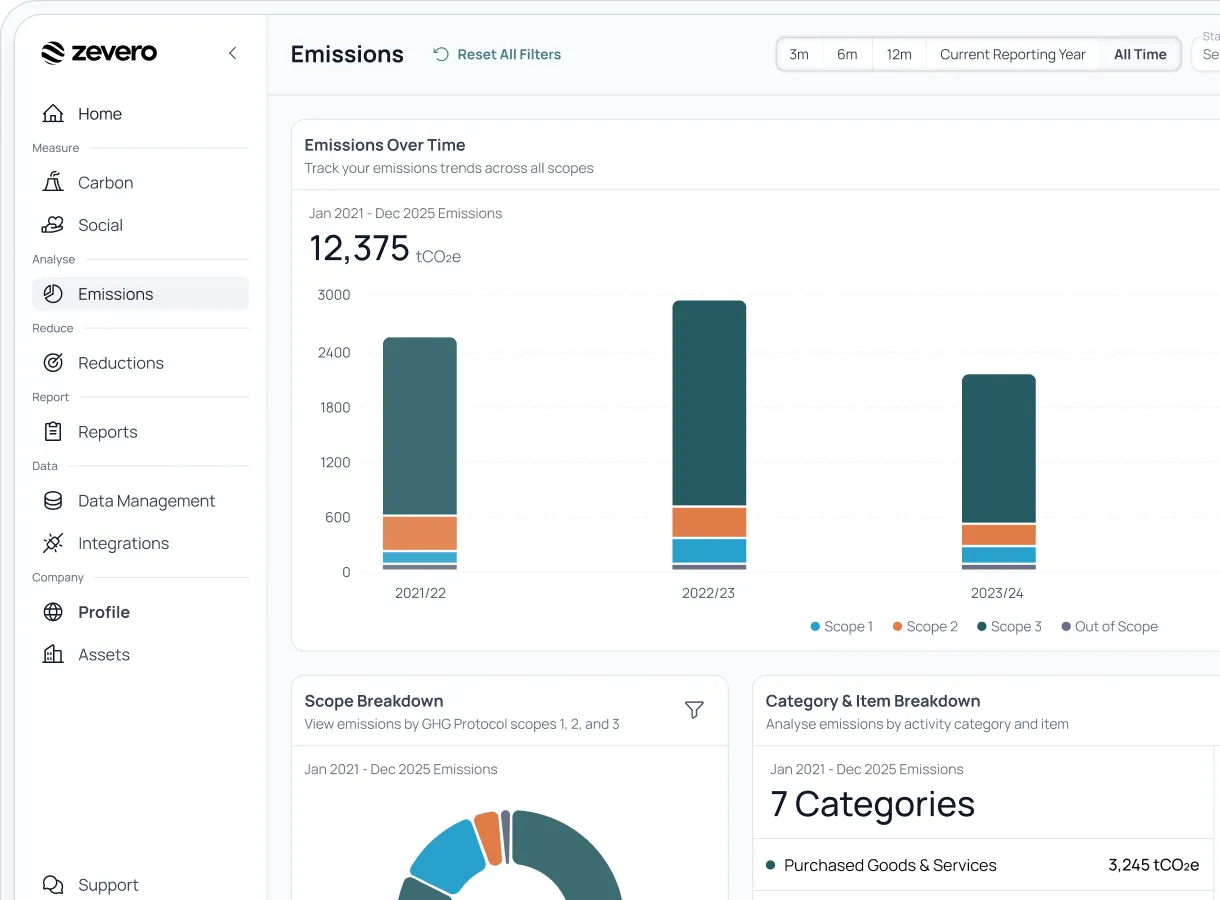
Zevero enables Scope 1, 2 and 3 emissions tracking across direct and value chain emissions, so that embedded emissions can be calculated accurately at the product level, not just estimated at a company-wide level. This is critical when reporting carbon intensity for specific imported goods under CBAM.
Centralised supplier data collection
Zevero provides a structured way to gather and manage supplier emissions data, so that procurement teams work from a single source of verified information rather than chasing spreadsheets across multiple suppliers and jurisdictions.
Consistent carbon accounting methodology
Our standardised, transparent carbon accounting methods are aligned with recognised frameworks like the GHG Protocol, so that if regulators or auditors question reported figures, businesses can demonstrate a clear, defensible, and standards-aligned approach.
Structured reporting outputs
Zevero supports structured reporting workflows and documentation, so that quarterly CBAM submissions can be prepared efficiently and certificate purchases are based on accurate emissions data rather than inflated default values.
With the definitive phase beginning in 2026, businesses that build robust emissions data systems now will face significantly lower compliance risk and avoid unnecessary carbon costs compared to those scrambling to retrofit systems later.
CBAM Readiness: What to Do Next
CBAM reflects a broader shift. Climate policy is shaping trade rules, supply chain decisions and financial risk exposure. Businesses that treat CBAM as a strategic transition rather than a compliance burden will be better positioned in a carbon-priced global economy.
Preparing for CBAM requires more than awareness. Book a CBAM readiness consultation with Zevero to evaluate your data infrastructure, supplier emissions visibility and reporting workflows.Build the systems you need now to reduce compliance risk and avoid unnecessary carbon costs from 2026 onwards.
Thanks for reading!
CBAM Explained: The EU Carbon Border Adjustment Mechanism
Add us as a preferred source

Related posts

Read more

Blog
Feb 26, 2025
The EU Omnibus Proposal: What It Means for Your Sustainability Reporting
The EU Omnibus Proposal: What It Means for Your Sustainability Reporting
Read more
Blog
Jul 22, 2026
CSDDD: What Can Businesses Do to Stay Ahead of the Curve?
CSDDD: What Can Businesses Do to Stay Ahead of the Curve?
.jpg)
Read more
Blog
Oct 28, 2025
The Digital Product Passport: A New Era of Transparency in the EU
The Digital Product Passport: A New Era of Transparency in the EU
See how Zevero can streamline your carbon reporting
Grow your business and reduce your impact