Policy

.webp)
Quick summary
- The transition is staggered company by company, not triggered on one industry-wide date. The first task is to establish an individual re-validation date from the company's earliest target year and its five-year review trigger.
- The most demanding changes to prepare for are concentrated in the inventory and targets. Separate Scope 1 and Scope 2 targets at full coverage, no inventory exclusions, a rolling base year, and the new transition-plan and end-of-cycle assessment requirements.
- Preparation can begin immediately. Building a complete, current inventory, separating scope data and adopting V2.0 innovations such as the implementation hierarchy ahead of formal re-validation all reduce the work later.
The publication of the Science Based Targets initiative (SBTi) Corporate Net-Zero Standard V2.0 has prompted a common question among companies that already hold validated science-based targets: does this mean those targets now need to be reset? The short answer is no. More than 11,000 companies hold validated targets under Version 1 of the Corporate Net-Zero Standard or the SBTi Near-Term Criteria, and those targets remain valid throughout their target cycle, subject to the five-year review provisions.
What V2.0 introduces is a clear point at which each company moves to the new standard, determined by its own target timeline rather than a single industry-wide deadline.
Do existing SBTi targets remain valid under V2.0?
The most important point for companies already in the SBTi system is that nothing is invalidated by the arrival of V2.0. Companies with existing validated targets are under no obligation to act straight away, although the changes introduced in Version 2.0 warrant early preparation so teams are familiar with the new requirements when the time comes to update targets.
In practice, a company continues to deliver and report against its current targets exactly as before. The transition to V2.0 happens at the company's next re-validation, not before. This makes the timing of that re-validation the first thing to establish.
When do companies need to re-validate SBTi targets?
A company's re-validation submission date depends on whichever of two triggers it reaches first: the target year or the mandatory five-year review.
Trigger 1: target year
When a company reaches the end of a target's timeframe, the re-validation submission is due at the end of the year following the target year. For example, a company with a 2026 target year has a new target submission due by 31 December 2027.
Trigger 2: mandatory five-year review (M5YR)
The mandatory five-year review, often shortened to M5YR, is the second trigger. Its trigger date falls at the end of the month, five years after either the initial validation publication of one or more targets, or the most recent complete update covering all of scope 1, 2 and 3. A company whose first targets were validated in March 2021, for instance, reaches its review trigger at the end of March 2026.
From that trigger date, two deadlines follow:
- The review itself must be completed, and the results submitted to SBTi Services, within six months of the trigger date.
- Where the review finds that new targets are required, those targets must be submitted for validation within twelve months of the trigger date.
Companies that prefer not to go through the review can avoid it by submitting a complete scope 1, 2 and 3 target update before the trigger date. A company nearing a target year, within 24 months of its trigger date, has a second option: requesting a waiver that bypasses the review entirely, allowing it to set new targets based on that target year instead.
A review does not always mean new targets are needed. If the existing targets still meet the applicable criteria, no immediate update is required, and the next deadline follows the standard schedule. If they do not meet the criteria, new targets are required, following the timeline and version rules set out above.
SBTi V1.3.1 or V2.0: which version applies?
The version a company uses at re-validation depends on when its submission falls within the transition window.
Submissions under Corporate Net-Zero Standard V1.3.1 remain open until 31 January 2028, after which V2.0 becomes mandatory for all new submissions. V2.0 validations, including re-validations, open on 1 February 2027. That creates three practical situations:
- A submission due before 1 February 2027 uses V1.3.1.
- A submission due between 1 February 2027 and 31 January 2028 can use either version.
- A submission due on or after 1 February 2028 uses V2.0.
Returning to the target year example above: a company with a 2026 target year, whose re-validation is due by 31 December 2027, falls inside the overlap window and can therefore choose either version.
Companies whose submission falls in 2026 will use V1.3.1 by default, since V2.0 validations do not open until 1 February 2027.
Confirm your SBTi category: A or B
Before preparing a V2.0 submission, a company needs to confirm which category it falls into, because the category determines its obligations. V2.0 replaces the previous corporate, SME and financial-institution classifications with two categories, A and B, set by emissions, financials and geographic location.
The distinction matters most for three requirements. Scope 3 target-setting, transition-plan disclosure and third-party assurance are mandatory for Category A and lighter or optional for Category B. Establishing the category early means the rest of the preparation can be scoped accurately. This matters most for the assurance workload, since third-party assurance typically takes the longest to arrange.
What changes when companies move to SBTi V2.0
When a company does re-validate under V2.0, several requirements differ from those it met under V1.3.1. The most significant for existing-targeted companies are the following.
- Separate Scope 1 and Scope 2 targets. V2.0 requires a separate target for each scope, each covering 100% of emissions, replacing the combined Scope 1 and 2 target set at 95% coverage under V1.3.1.
- A rolling base year. Rather than a fixed historical base year, V2.0 uses the most recent year of comprehensive data, refreshed at each cycle.
- A tighter inventory. V1.3.1 allowed up to 5% of combined Scope 1 and 2 emissions and up to 5% of Scope 3 emissions to be excluded. V2.0 permits no exclusions from the GHG inventory boundary, but Scope 3 target coverage retains a carve-out for emissions associated with activities over which a company lacks practical influence, as defined by the standard
- Significance-based Scope 3. For Category A companies, fixed coverage thresholds are replaced by a significance test that captures every category individually accounting for 5% or more of total Scope 3 emissions.
- Transition plan and governance. A transition plan becomes a requirement, with the SBTi validating that it exists and contains the required elements rather than judging its quality.
- End-of-cycle assessment. Progress is formally assessed against targets at the end of each cycle, a mechanism that did not exist under V1.3.1.
For Category A companies, third-party limited assurance of base-year data, low-carbon electricity calculations and target-setting metrics applies on top of the six changes above.
How to prepare for the SBTi V2.0 transition now
Although the move to V2.0 happens at re-validation, companies do not have to wait to benefit from parts of the new standard. Companies with validated targets can already use two V2.0 features: the implementation hierarchy, which guides delivery, and the best-efforts approach, which lets companies stay in the SBTi system as long as they act on their targets and report barriers openly.
The most useful preparation is groundwork the next cycle will be judged against regardless of version. A practical starting checklist:
- Establish the company's re-validation date by identifying its earliest target year and its M5YR trigger date.
- Build a complete, current emissions inventory with no excluded activities across all three scopes.
- Separate Scope 1 and Scope 2 data so each can carry its own target.
- Put board oversight and a transition-planning process in place ahead of the formal requirement.
- Confirm the likely company category, so the assurance and Scope 3 workload is understood early.
Companies that do this now face a far smoother re-validation when their trigger date arrives.
.webp)
How Zevero can help
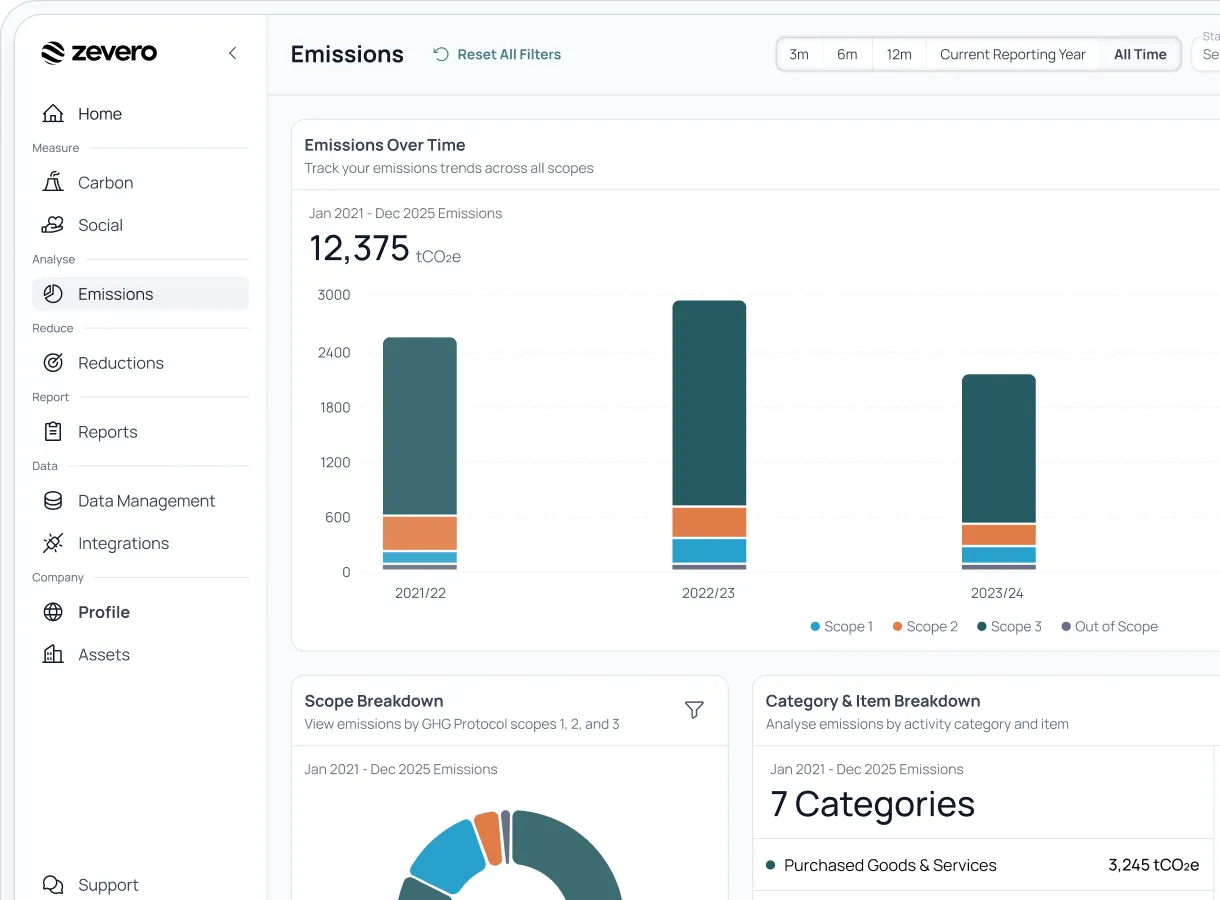
For companies with existing targets, the most useful first step is understanding the gap between current targets and V2.0 requirements. Zevero's readiness assessment reviews existing targets, GHG inventory and EAC contracts against V2.0 requirements, producing a prioritised action plan ahead of renewal. Zevero measures Scope 1, 2, and 3 emissions in line with the GHG Protocol to build the inventory that re-validation depends on. Start a gap analysis today to identify the next steps your business should take.
A Complete Guide to the SBTi Corporate Net-Zero Standard V2.0
FAQs
What happens to a combined Scope 1 and 2 target when a company moves to V2.0?
Does annual reporting change under V2.0?
Can a company adopt V2.0 before its re-validation is due?
Do existing long-term net-zero targets also remain valid?
Thanks for reading!
How to Move Existing SBTi Targets to the V2.0 Standard
Add us as a preferred source

Related posts

Read more

Blog
May 8, 2024
What are Scope 1, 2 and 3 Carbon Emissions?
What are Scope 1, 2 and 3 Carbon Emissions?

Read more
Blog
Dec 3, 2024
What Are Scope 3 Emissions and Why Do They Matter?
What Are Scope 3 Emissions and Why Do They Matter?
.webp)
Read more
Blog
Jul 29, 2026
How to Set SBTi Targets Under the Net-Zero Standard V2.0
How to Set SBTi Targets Under the Net-Zero Standard V2.0
See how Zevero can streamline your carbon reporting
Grow your business and reduce your impact