Policy

Quick summary
- Voluntary and environment-only. TR 149:2026, launched by Enterprise Singapore on 21 May 2026, is a voluntary maturity framework. It covers environmental impacts only, not the social or governance pillars of sustainability.
- Four levels, five dimensions, eleven domains. Organisations are assessed across four maturity levels (Essential, Bronze, Silver, Gold) and five dimensions made up of eleven domains. Operations cover greenhouse gas, energy, water, and material consumption specifically.
- Provisional for three years. The framework holds provisional status for three years, during which Enterprise Singapore will gather feedback to develop it into a full Singapore Standard.
In May 2026, Singapore introduced a new tool for organisations to assess their environmental performance. Rather than a disclosure mandate, TR 149:2026 is a structured framework for measuring sustainability maturity: how far an organisation has progressed in managing its environmental impact, and where the gaps remain.
Enterprise Singapore launched TR 149:2026 on 21 May 2026, at the Singapore Climate Transition Forum during Ecosperity Week. The framework was developed through the Singapore Standards Council, with A*STAR Singapore Institute of Manufacturing Technology (A*STAR SIMTech) and the Singapore Manufacturing Federation as partners. It gives organisations a common reference point for what they have measured, how they measured it, and where they sit on a defined maturity curve.
This blog explains what TR 149:2026 covers, how the maturity framework is structured, who it is designed for, what a business can start doing now and how Zevero supports the underlying data work.
What is TR 149:2026?
TR 149:2026 is a Technical Reference titled the Specification for Organisations to Progress towards Environmental Sustainability Excellence. It was built on A*STAR SIMTech's Green Compass framework. It draws on established international standards, including ISO 14001, ISO 14064-1 (greenhouse gas quantification), ISO 46001 (water efficiency), ISO 50001 (energy management), and the GHG Protocol's Corporate, Scope 3, and Product Standards.
The framework currently holds provisional status. It is available for application over a three-year period, during which Enterprise Singapore intends to gather feedback from organisations using it. That feedback will inform a future update, with the eventual aim of adopting TR 149 as a full Singapore Standard.
How the framework is structured
TR 149 assesses organisations against four maturity levels: Essential, Bronze, Silver, and Gold. Each level represents a step up in how systematically a business manages its environmental impact, moving from basic awareness towards embedded, measurable practice.
Maturity is assessed across five dimensions, made up of eleven domains in total:
- People Readiness: the competency and commitment of leadership and the workforce toward environmental sustainability.
- Structure: the governance, strategy, policies, and stakeholder engagement an organisation has in place to coordinate sustainability work across the business.
- Operations: resource use within the operational boundary an organisation defines, covering four domains: greenhouse gas emissions, energy, water, and material consumption. Each domain is assessed on measurement first, then on target-setting.
- Supply Network: how well an organisation tracks and sets targets for the environmental performance of its suppliers, including direct and sub-tier suppliers.
- Product Life Cycle: how well an organisation tracks, sets targets for, and communicates environmental sustainability data across a product's life cycle, from extraction to final disposal.
TR 149 covers environmental impacts only. It does not address the social or governance pillars of sustainability.
Who is TR 149 for, and why now
TR 149 is designed for organisations of any size and any industry sector, structured to accommodate businesses at different starting points. For organisations new to sustainability management, often SMEs, the framework offers achievable early milestones. For organisations that already work with ISO standards, often larger multinationals, it extends into more advanced territory: supply chain performance and product life cycle management.
Used well, the TR helps organisations align their environmental sustainability goals, strategies, and policies, and build a clearer picture of where their current efforts stand. The timing also reflects a broader shift in procurement behaviour across Singapore and the wider region: buyers increasingly want structured, comparable evidence of a supplier's sustainability performance, rather than self-reported claims that are difficult to verify or compare across suppliers.
Why it matters beyond Singapore
TR 149 sits alongside a wider pattern of national sustainability frameworks taking shape across the Asia-Pacific region. Singapore already has climate-related reporting requirements for listed companies, and other markets in the region, including South Korea and the Philippines, are developing their own disclosure standards aligned with the International Sustainability Standards Board (ISSB) baseline.
TR 149 is distinct from these. It is a maturity and capability framework, not a mandatory disclosure standard, and it should not be read as equivalent to ISSB-aligned reporting requirements. That said, a supplier's TR 149 maturity level may still carry weight with multinational buyers and exporters, even without a legal requirement behind it.
How to prepare
Three practical starting points, regardless of which maturity level an organisation is ultimately aiming for:
- Build a greenhouse gas baseline. Measuring Scope 1, 2, and 3 emissions accurately covers the largest and most technically demanding part of the Operations dimension, and provides a foundation that supports progress in other dimensions too.
- Review governance and reporting structures. Mapping current practices against the People Readiness and Structure dimensions helps identify gaps before a formal assessment does, and often surfaces quick wins in accountability and documentation.
- Start supplier conversations early. Since Supply Network forms part of the maturity assessment, early engagement with key suppliers on sustainability data and expectations reduces pressure if the organisation later chooses to seek external verification or certification.
%20(2).webp)
How Zevero can help
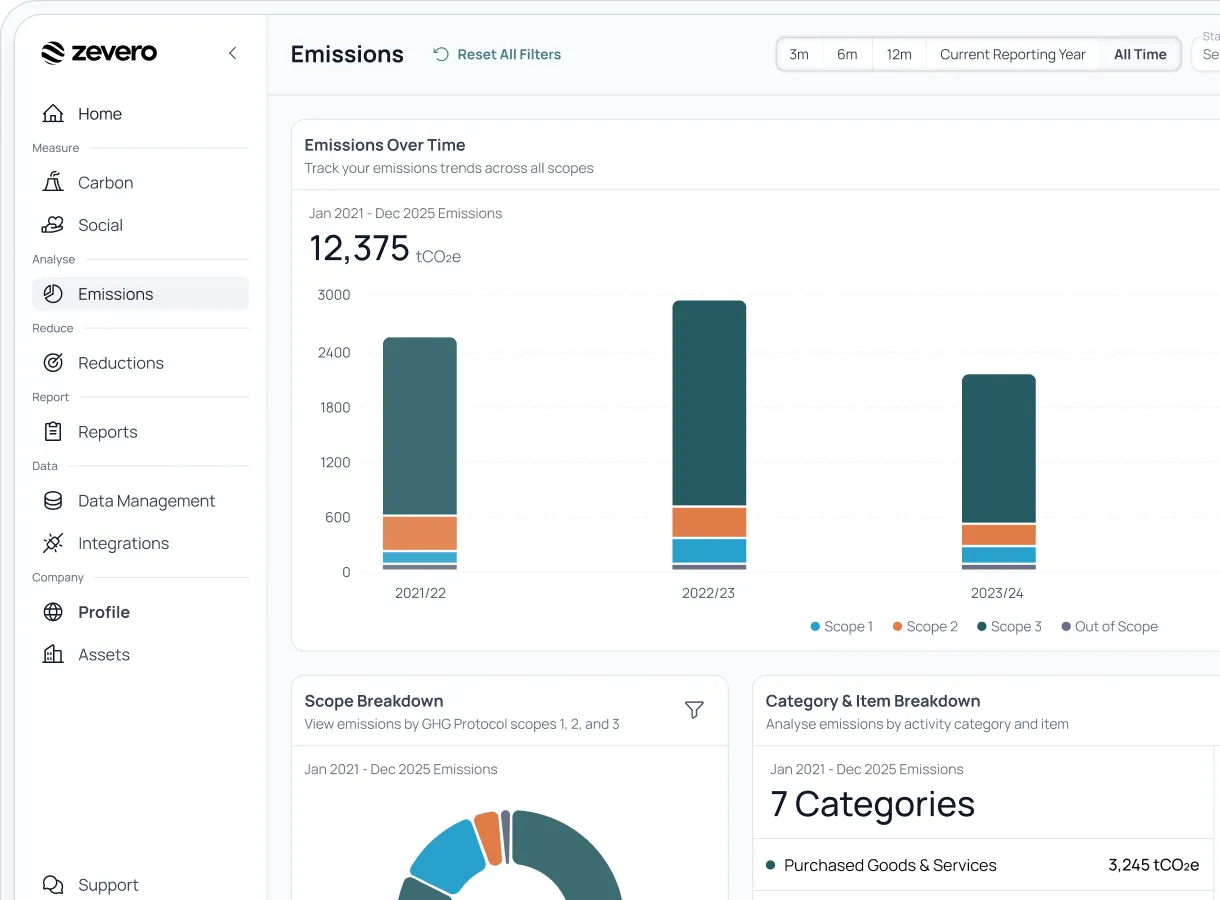
Zevero helps organisations turn TR 149's maturity framework into a practical measurement process, combining carbon accounting software with guidance from in-house sustainability experts.
- Corporate carbon footprinting. Measure Scope 1, 2, and 3 emissions using methodology aligned with the GHG Protocol and ISO 14064-1 – a key data foundation for the Operations dimension.
- Product carbon footprinting. For organisations working towards the Product Life Cycle dimension, measure emissions across defined lifecycle stages, from project scoping through to emission factor mapping and reporting.
Get in touch to see how Zevero can support a TR 149 self-assessment.
FAQs
Is TR 149:2026 mandatory?
Does TR 149 require third-party audit or certification?
Who defines the boundary of assessment under TR 149?
Is Enterprise Singapore liable for outcomes from using TR 149?
Can organisations outside Singapore use TR 149?

Related posts
Read more

Blog
Apr 17, 2026
An Introduction to Korea's Sustainability Reporting (KSDS)
An Introduction to Korea's Sustainability Reporting (KSDS)
Read more
Blog
Apr 13, 2026
Philippines Sustainability Reporting: A Guide to PFRS S1 and S2
Philippines Sustainability Reporting: A Guide to PFRS S1 and S2

Read more
Blog
Oct 3, 2024
Preparing for SGX’s New Climate Reporting Mandates: What You Need to Know
Preparing for SGX’s New Climate Reporting Mandates: What You Need to Know
See how Zevero can streamline your carbon reporting
Grow your business and reduce your impact