Industry News


The GHG Protocol Corporate Value Chain Scope 3 Standard underpins almost every sustainability reporting framework that matters. CSRD, ISSB, SSBJ, CDP, and SBTi all reference it. When it changes, everything built on top of it changes too.
On 31 March 2026, the GHG Protocol published its Phase 1 Progress Update — the first tangible output of a revision process led by a 65-member Technical Working Group spanning 20+ countries and 42 meetings since September 2024. The original standard has not been updated since 2011. A full public consultation draft is expected mid-2026, with a final revised standard targeted for late 2027. This post walks through six proposed changes, who they affect, and what companies should be doing now.
What is the GHG Protocol Scope 3 Standard?
Published in 2011, the GHG Protocol Scope 3 Standard defines how companies measure and report their value chain emissions across 15 categories, from purchased goods and services through to investments and the use of sold products. It is the baseline methodology on which most sustainability reporting frameworks globally are built.
The significance of this revision extends further than the standard itself. In September 2025, the GHG Protocol and ISO announced a formal partnership to co-develop harmonised international standards. The revised Scope 3 Standard is likely to also become the basis for a formal ISO standard, embedding it not just in regulatory requirements but in procurement and certification contexts worldwide.
Phase 2 of the revision is already underway, covering category-specific boundary updates and circularity. The Phase 1 Progress Update, described below, focuses on six cross-cutting changes that will reshape what rigorous Scope 3 reporting looks like.
Six proposed changes to the Scope 3 Standard
1. Data-type disaggregation per Scope 3 category
Today, companies report a single Scope 3 total per category, typically with a narrative description of their data sources. Under the proposal, each category must be broken down by the type of data used to calculate it, reported in absolute tonnes CO2e rather than percentages.
The classification system is still being finalised, but the proposed tiers distinguish between primary or activity-based data, spend-based or economic input-output (EEIO) estimates, and an unclassified bucket for companies unable to disaggregate. Two approaches are under consideration: one grouped by data specificity, and one structured as a matrix of data source crossed with calculation method.
Whatever form the final classification takes, the effect is the same: for the first time, the proportion of spend-based estimation within each Scope 3 category becomes publicly visible and directly comparable across companies. Organisations that have relied heavily on EEIO-based estimates will have that reliance clearly visible in their disclosures.
The GHG Protocol has also flagged that a similar disaggregation requirement may be extended to Scope 1 and Scope 2 in a future revision. Companies building data-type tagging infrastructure for Scope 3 should design it to cover all three scopes.
2. A 95% coverage floor
The current standard requires companies to account for all Scope 3 emissions and justify any exclusions, but sets no quantified threshold. The proposed revision changes that with a hard minimum: at least 95% of required Scope 3 emissions must be covered.
Required Scope 3 means the mandatory portions of Categories 1 to 15. Optional Scope 3 and the new Category 16 (covered below) are excluded from this calculation entirely.
Up to 5% of required emissions may be excluded, but exclusions must be quantified, disclosed, and justified — not described qualitatively. To validate that exclusions fall within the 5% cap, companies must quantify 100% of their required Scope 3, including what they choose to exclude. Hotspot analysis is explicitly endorsed as a permissible method for this.
There is one maintained exception: downstream emissions from intermediate products (Categories 9, 10, 11, and 12) where the end use is genuinely unknown may be excluded outside the 5% threshold.
The 5% figure is consistent with how SBTi and CDP already treat Scope 3 exclusions, so companies already reporting against those frameworks will find the concept familiar. The formal requirement is new; the logic behind it is not.
A standardised exclusion notation system is also proposed, requiring a uniform format for disclosing exclusions across all Scope 3 reports.
3. Corporate-level supplier allocation restricted to homogeneous suppliers
Allocating a supplier's corporate-level emissions across purchased goods is only permitted if that supplier is homogeneous, meaning it has relatively uniform emissions across its operations, such that a corporate average is genuinely representative of the specific product purchased.
For diversified suppliers, where GHG intensity varies meaningfully between business units, facilities, or product types, corporate-level allocation is no longer permitted. Companies must go further down the data hierarchy. The ideal is product-level cradle-to-gate emissions data, which measures emissions from raw material extraction to the factory gate for the specific product purchased and avoids allocation altogether. Where product-level data is unavailable, companies must move to activity, process, or production line level, then facility level, then business unit level.
This will directly affect many Category 1 inventories currently built on supplier corporate averages. Companies that have used corporate-level data from large, diversified suppliers will need to assess whether those suppliers meet the homogeneity test, and if not, identify where better data is available.
4. Required and optional Scope 3 reported separately
Required Scope 3 emissions and optional Scope 3 emissions cannot be combined into a single disclosure total. The distinction must be clearly labelled in all sustainability disclosures.
A new Category 16 is introduced, covering facilitated activities: value chain emissions arising from third-party activities that are enabled, initiated, or influenced by the reporting company's services, products, or infrastructure, where the company earns transactional income but does not own or operate the activity. Sub-categories include insurance contracts and claims payments (16.1), underwriting and issuance (16.2), other financial activities (16.3), and licensing activities (16.4). Category 16 is optional for most companies.
The exception is Category 16.5, covering the distribution of fuel and energy, which is required for oil and gas distributors.
The GHG Protocol is not providing calculation guidance for Category 16. Companies reporting under these sub-categories are directed to existing third-party standards, primarily PCAF Parts A, B, and C. This is the first time the GHG Protocol has referenced named third-party standards directly in its standard text.
5. Category 15 becomes mandatory for all companies, with a broader boundary
Category 15, covering investments and financed emissions, has historically been treated as applying primarily to financial institutions. The proposed revision makes it explicit: all companies with investments must include them. Non-financial corporates with equity stakes, bonds, or project finance are in scope.
The investment types covered under Category 15 are now explicitly listed, from equity with financial control (15.1) through minority stakes (15.3), corporate debt (15.4 and 15.5), project finance (15.6), retail debt (15.7), and sovereign debt (15.8) to mutual funds, ETFs, asset-backed securities, and other instruments (15.9 to 15.11). Financial activities including insurance, underwriting, and cash deposits, which were previously within Category 15, move to the new optional Category 16.
The calculation boundary also expands significantly. The current standard requires investee Scope 1 and Scope 2. The proposed revision mandates investee Scope 1, Scope 2, and required Scope 3 across all Category 15 investments, with no relevance test to pass. This closes a significant loophole that allowed exclusion of material emissions in high-impact sectors.
Companies must also disclose what percentage of their investment portfolio's carrying value has been included in financed emissions calculations. The proportionality formula for equity investments is updated to include both equity and debt in the denominator, aligning with PCAF Part A.
For most non-financial companies, the practical exposure here is limited. For those with significant investment portfolios, the implications are material.
6. Verification disclosure and data quality targets
Companies that verify any portion of their Scope 3 inventory must disclose that status using standardised labels: Verified, Partially verified, or Not verified. This is a required element, but only applies to companies that carry out verification. Companies that do not verify are not required to disclose that.
Setting data quality goals and tracking improvement year on year, using metrics such as the percentage of Scope 3 derived from primary data and the percentage of supply chain partners providing specific data, is recommended rather than mandatory. The standard leaves companies to set their own thresholds, but expects that targets are set and progress is tracked.
A related recommendation is that emission factors used should have no more than 5% cut-off or exclusions applied, and that regional emission factors should account for cross-border flows.
Who does this affect, and when?
The impact of the revision will not land uniformly. Three groups face meaningfully different timelines:
Companies with SBTi-validated targets face the clearest and most direct exposure. SBTi explicitly mandates GHG Protocol methodology, and the new SBTi Corporate Net-Zero Standard (CNZS v2), expected to take effect from 2026 to 2028, is being written to reference the revised GHG Protocol. Every company with a validated SBTi target will need to adopt the updated methodology at its mandatory five-year review. There are now over 10,000 companies globally with validated SBTi targets. The clock is already running.
Companies under mandatory reporting frameworks such as CSRD and the 30+ ISSB-aligned jurisdictions across Australia, Brazil, Chile, Hong Kong, Malaysia, Singapore, and others, are highly likely to be affected, but with a longer lag. These frameworks reference GHG Protocol-aligned methodology and will almost certainly incorporate the revisions, but not automatically or immediately. In practice, mandatory reporters are probably looking at 2029 to 2030 before the revised methodology is formally embedded in regulatory requirements. Investor expectations and best-practice reporting will move faster than regulation.
CDP reporters and others face a probable but less predictable timeline. CDP tracks GHG Protocol methodology and typically follows with a lag of one to two years on its own annual revision cycle. GRI, EcoVadis, and B Corp operate similarly: all reference GHG Protocol methodology to varying degrees but run their own update cycles independently.
The indicative timeline:

What should companies be doing now?
No immediate action is required as a direct result of this update. The standard is not finalised, and no framework has yet made the proposed changes mandatory. But the proposed revisions are substantive enough that companies with established Scope 3 programmes should use this moment to assess where they stand.
Three questions are worth asking now.
- Which Scope 3 categories do you currently exclude, and have you quantified those emissions? The proposed 95% coverage floor requires companies to quantify excluded emissions, not just justify them qualitatively. Organisations that have excluded categories without quantification will need to address this eventually. Understanding the gap now is straightforward; rebuilding an inventory under deadline pressure is not.
- What proportion of each Scope 3 category is currently spend-based? The data-type disaggregation requirement will make that split public, per category, in absolute tonnes. Companies that understand their own data quality profile today are better placed to manage the narrative and prioritise improvement before disclosure becomes mandatory.
- Are any Category 1 supplier allocations built on corporate averages from diversified suppliers? If so, those will need to move down the data hierarchy under the proposed homogeneous supplier restriction. Identifying which suppliers are affected, and what better data is available, is a useful exercise regardless of when the standard is finalised.
The GHG Protocol and ISO partnership raises the probability that the revised standard will also become a formal ISO standard. The methodology underpinning most Scope 3 programmes is going to look materially different by 2028. Companies that assess their programmes against the proposed changes now will be better positioned than those that wait for the final tex
Navigating Scope 3 changes starts with your data
The GHG Protocol revision is a signal about where the bar on Scope 3 reporting is moving, and it is moving in one direction. Data quality, coverage, and transparency requirements will increase. Companies that understand their current Scope 3 data profile, know where they rely on spend-based estimates, and can quantify their exclusions are far better placed than those that cannot.
Zevero helps businesses build exactly that foundation:
- Measure Scope 1, 2, and 3 emissions using methodology aligned with the GHG Protocol and ISO 14064-1, giving you the verified, auditable data that frameworks demand.
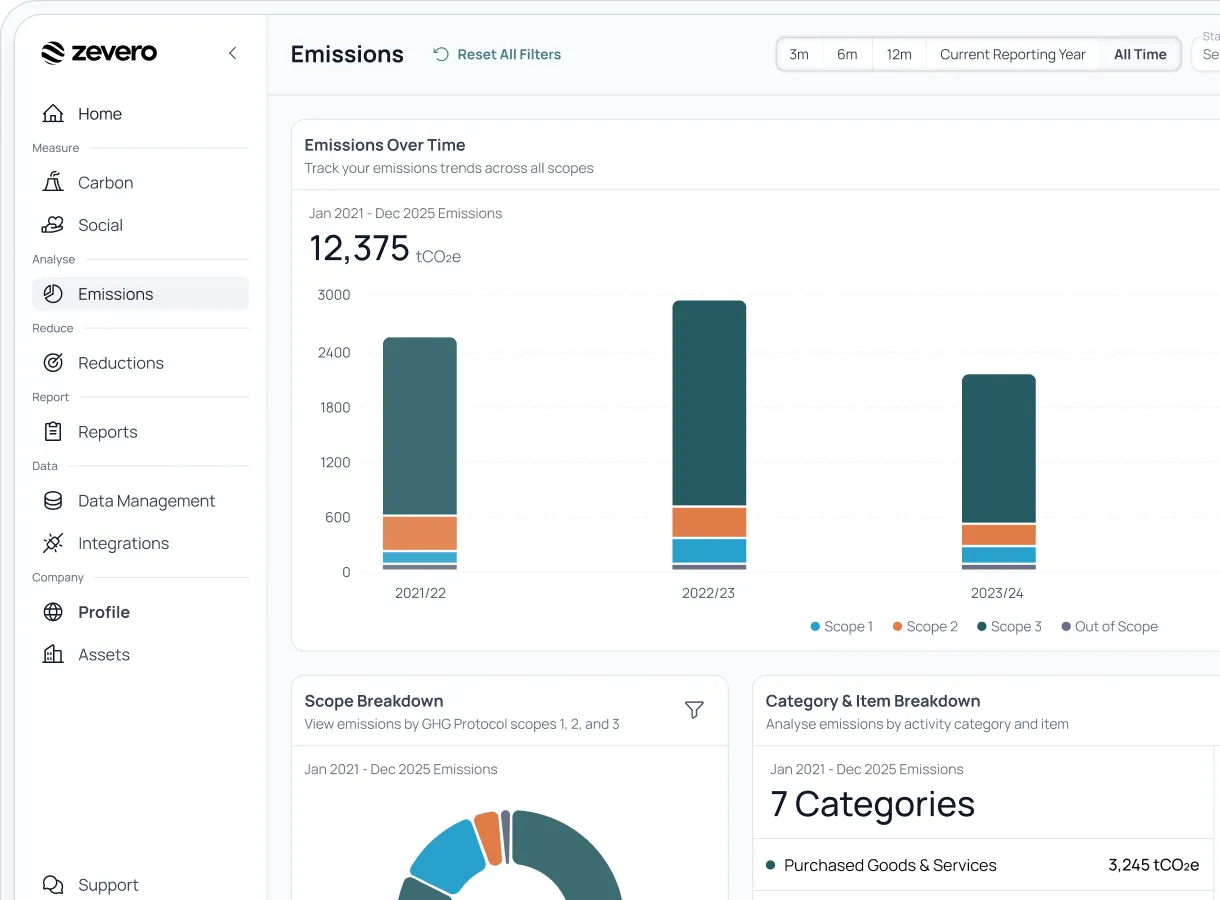
- Track data quality across your Scope 3 inventory so you know what proportion of each category is spend-based and where primary data improvements are needed most.
- Move from annual reporting to continuous monitoring, so your Scope 3 data is always current and decision-ready.
The earlier you build that capability, the better placed you are. See how Zevero can help you get there.
Thanks for reading!
The GHG Protocol Scope 3 Standard Revision: What to Expect
Add us as a preferred source

Related posts
Read more

Blog
Jul 22, 2026
GHG Protocol Scope 2 Updates: What It Means for Your Reporting
GHG Protocol Scope 2 Updates: What It Means for Your Reporting
See how Zevero can streamline your carbon reporting
Grow your business and reduce your impact