Policy

Quick summary
- South Korea published KSDS 1 and KSDS 2 on 26 February 2026. The standards are built on the ISSB's IFRS S1 and IFRS S2, making them interoperable with the global baseline.
- The FSC's finalised roadmap significantly expands mandatory sustainability reporting in South Korea. Reporting begins in 2028 for KOSPI-listed companies with assets above KRW 10 trillion (290+ companies). It then expands to companies above KRW 5 trillion in 2029 (3,100+ companies). A further drop to KRW 2 trillion is under consideration from 2030.
- Indirect pressure may arrive before the mandate does, and now at a much greater scale. Korean companies in Tier 1 will report on FY2027 data, generating disclosure requests toward suppliers and partners well ahead of the mandate reaching them directly.
In February 2026, South Korea took a significant step toward mandatory sustainability disclosure. On 26 February 2026, the Korea Sustainability Standards Board (KSSB) published the first set of Korean Sustainability Disclosure Standards (KSDS): KSDS 1 and KSDS 2. The day before, the Financial Services Commission (FSC) published a draft roadmap setting out who must report, and when. The FSC has since finalised this roadmap, significantly expanding the number of companies covered. South Korea joins Japan, Australia, Singapore, and the Philippines as part of a broader APAC shift toward mandatory, internationally aligned disclosure. For multinationals with exposure to Korean markets or supply chains, this is worth tracking now, not when the mandate lands.
This blog covers what the KSDS require, how they differ from the ISSB baseline, who falls into the first reporting tier, and what companies should be doing before the mandate is finalised.
What are the KSDS?
The KSDS are South Korea's national sustainability disclosure standards, built on the International Sustainability Standards Board's (ISSB) IFRS S1 and IFRS S2. KSDS 1 covers general requirements for sustainability-related financial disclosures. KSDS 2 covers climate-related disclosures specifically. Both require companies to report across four core areas: governance, strategy, risk management, and metrics and targets. The standards are designed to be interoperable with the ISSB baseline, meaning disclosures produced under KSDS should be recognisable and comparable to those produced under IFRS S1 and S2 in other markets.
Who needs to report, and when?
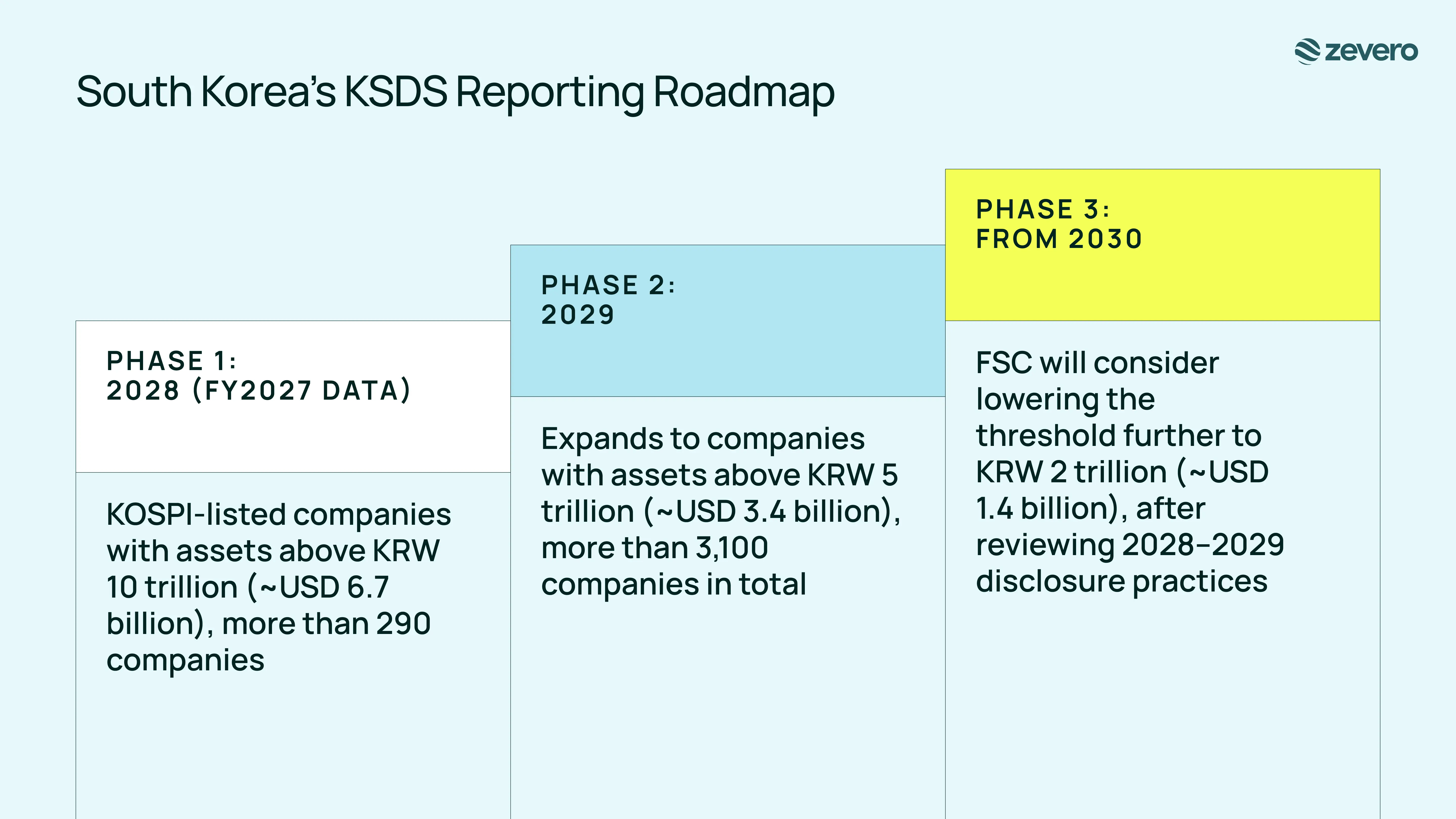
The FSC's finalized roadmap sets a phased rollout tied to company size:
- 2028 (reporting on FY2027 data): companies listed on KOSPI (Korea Composite Stock Price Index, South Korea's main stock exchange benchmark) with assets above KRW 10 trillion (approximately USD 6.7 billion), more than 290 companies.
- 2029: expands to companies with assets above KRW 5 trillion (approximately USD 3.4 billion), more than 3,100 companies in total.
- From 2030: after reviewing disclosure practices in 2028-2029, the FSC will consider lowering the threshold further to KRW 2 trillion (approximately USD 1.4 billion).
The FSC widened the scope from its original draft (which proposed a KRW 30 trillion threshold in 2028) in response to requests from institutional investors, citing the usefulness of sustainability data for investment decisions. This is notable given the contrasting direction of travel elsewhere: the EU has moved to narrow CSRD's scope, and the US has scrapped federal climate disclosure rules altogether
How do the KSDS differ from the ISSB baseline?
The KSSB based the standards on IFRS S1 and IFRS S2, while tailoring certain requirements to the domestic context. The key differences are:
- Scope 3 deferral: A three-year deferral on Scope 3 value chain emissions disclosure. The ISSB's own transitional relief was one year. This gives Korean companies more time to build supply chain data capability, but it does not remove the obligation permanently.
- Small business exemption: Small companies that are not high-carbon emitters are exempted from Scope 3 disclosure entirely, not just deferred.
- Climate-first focus: Non-climate sustainability disclosures under KSDS 1 remain optional for now. Companies can focus on climate reporting before broadening to wider sustainability topics.
- Assurance: Third-party assurance starts as optional, becoming mandatory from 2030.
- Publication timing: Companies are not required to publish sustainability disclosures simultaneously with their financial statements, unlike the ISSB baseline.
These are pragmatic design choices that reduce the initial implementation burden while keeping the direction of travel clear. The KSSB has stated its intention to gradually increase alignment with ISSB standards over time.
Transitional relief and voluntary filing
The finalised roadmap includes added protections to ease the transition. For the first three years, companies are exempt from damage compensation, administrative sanctions, or criminal punishment related to the content of their sustainability disclosures, though the FSC has said it will strictly pursue intentional greenwashing. Ahead of mandatory rules, the FSC is also encouraging voluntary filing through the Korea Exchange (KRX), which is updating its voluntary disclosure system to support KSSB-aligned reporting from companies not yet in scope.
Why this matters beyond Korea
For multinationals, the practical implication is not just about direct compliance. With the finalised roadmap covering over 3,100 companies by 2029, far more than the handful originally proposed – Korean companies in Tier 1 will begin reporting on FY2027 data, meaning their own suppliers and partners may face indirect disclosure pressure much sooner and much more broadly than the draft roadmap suggested. If your company supplies into Korean markets or has Korean counterparts in your value chain, their reporting requirements will start generating data requests upstream.
Korea's move is also part of a wider pattern. APAC is not adopting a single uniform framework: Japan, Australia, Singapore, and the Philippines have each developed national standards that align with, but are distinct from, the ISSB baseline. For multinationals operating across the region, a consistent internal data infrastructure is the most practical response to this patchwork of interoperable-but-distinct requirements.
How to prepare for KSDS reporting
The mandate is not live yet, but the standards are published and the roadmap is being finalised. Three practical steps worth taking now:
- Run a gap analysis against IFRS S1 and S2, which underpins the KSDS. Closing gaps against the global baseline covers most of what Korea will require.
- Establish your Scope 1 and 2 baseline before turning to Scope 3. The three-year Scope 3 deferral provides breathing room, but the underlying data work takes time.
- Check whether your Korean partners or customers fall into the first reporting tier. Indirect pressure from their disclosure requirements may arrive before your own mandate does.
- Check government support resources. The Ministry of Climate, Energy and Environment plans an integrated climate-risk platform and sector-specific Scope 3 guidance for 15 key export industries, alongside ESG management consulting programs, worth using as you build out reporting capability.
Whether you are preparing for a first filing or getting ahead of indirect pressure from Korean partners and customers, measuring your company's carbon footprint is the right place to start.
FAQs
Do the KSDS apply to foreign companies operating in South Korea?
Can companies report voluntarily under the KSDS before the mandate kicks in?
How does the three-year Scope 3 deferral work?
If my company already reports under IFRS S1 and S2, do we need to do anything differently for KSDS?
Thanks for reading!
An Introduction to Korea's Sustainability Reporting (KSDS)
Add us as a preferred source

Related posts
Read more

Blog
Apr 13, 2026
Philippines Sustainability Reporting: A Guide to PFRS S1 and S2
Philippines Sustainability Reporting: A Guide to PFRS S1 and S2

Read more
Blog
Mar 10, 2025
Japan's SSBJ Standards: What Companies Need to Know
Japan's SSBJ Standards: What Companies Need to Know

Read more
Blog
Oct 3, 2024
Preparing for SGX’s New Climate Reporting Mandates: What You Need to Know
Preparing for SGX’s New Climate Reporting Mandates: What You Need to Know
See how Zevero can streamline your carbon reporting
Grow your business and reduce your impact