Education

.webp)
Quick summary
- Greenly is EU-first by default. It is a well-established platform built around AI automation, broad integrations, and a large existing customer base, but it treats UK-specific compliance as secondary and positions expert support as a layer on top of software rather than the core of the offering.
- Zevero builds accountability and reduction into the core service. It pairs carbon accounting software with a named climate expert and builds reduction roadmaps into the service from the outset, alongside UK and EU regulatory coverage, making it a closer fit for growing and mid-sized businesses that want direct accountability.
- The right choice depends on priorities, not just features. Regulatory needs, company size, sector, and whether an organisation wants an all-in-one AI-led suite or a smaller, more hands-on partnership with a named expert all shape which platform fits best.
Carbon accounting has moved well beyond a once-a-year spreadsheet exercise. Regulators now expect emissions data that can withstand scrutiny, investors and customers ask for evidence rather than statements of intent, and internal teams are held to reduction targets that need a credible plan behind them. Meeting all of that with the same headcount is the real challenge most sustainability leads are wrestling with.
The platform chosen to support this work shapes how much of that load stays with the internal team. Some tools automate data collection and reporting and leave interpretation to the customer. Others pair the software with dedicated climate experts, so measurement, regulatory reporting, and reduction planning are handled as a shared effort rather than a solo one.
Greenly is one of the most established names in the space, with a large customer base and broad platform coverage. This blog explains what Greenly does, why organisations sometimes look elsewhere, and how it compares with Zevero and other carbon accounting and sustainability platforms.
What Greenly does and how its platform works
Greenly is a French carbon accounting platform that helps organisations measure emissions, manage ESG compliance, and build decarbonisation plans. It combines software with AI-powered automation and access to climate experts, aiming to reduce the manual effort involved in carbon accounting and sustainability reporting.
Greenly's platform includes:
- Carbon accounting across Scope 1, 2 and 3, with automated data collection and bank-linking to speed up onboarding
- Regulatory reporting support for frameworks including CSRD, ADEME's Bilan Carbone, SBTi, and CDP
- Life cycle assessment (LCA) for product-level carbon footprints, built on bill-of-materials imports
- Supplier engagement tools for collecting and enriching Scope 3 data across the value chain
- AI agents, including tools for data preparation, Scope 3 mapping, LCA modelling, and reporting support
Reasons businesses look for a Greenly alternative
Not every organisation's sustainability needs line up with Greenly's strengths. A few situations commonly prompt teams to compare alternatives.
- UK-specific compliance is a priority. Organisations reporting against UK frameworks such as SECR or the UK Sustainability Reporting Standards may want a platform where that coverage is built in from the start, rather than layered on top of an EU-first methodology.
- Reduction planning needs to be central, not optional. Some organisations want decarbonisation roadmaps and target-setting built into the core service, rather than treated as a separate workstream once measurement is complete.
- The business is still scaling. Growing and mid-sized organisations, particularly in sectors like food, drink, and consumer goods, may prefer a platform and pricing structure built around their size rather than one designed primarily for large enterprise clients.
- Direct accountability matters. Some teams prefer working with a named sustainability expert who takes shared responsibility for the output, rather than relying mainly on software and AI agents with expert support as an add-on layer.
.png)
Top 5 Greenly alternatives for carbon accounting
Zevero
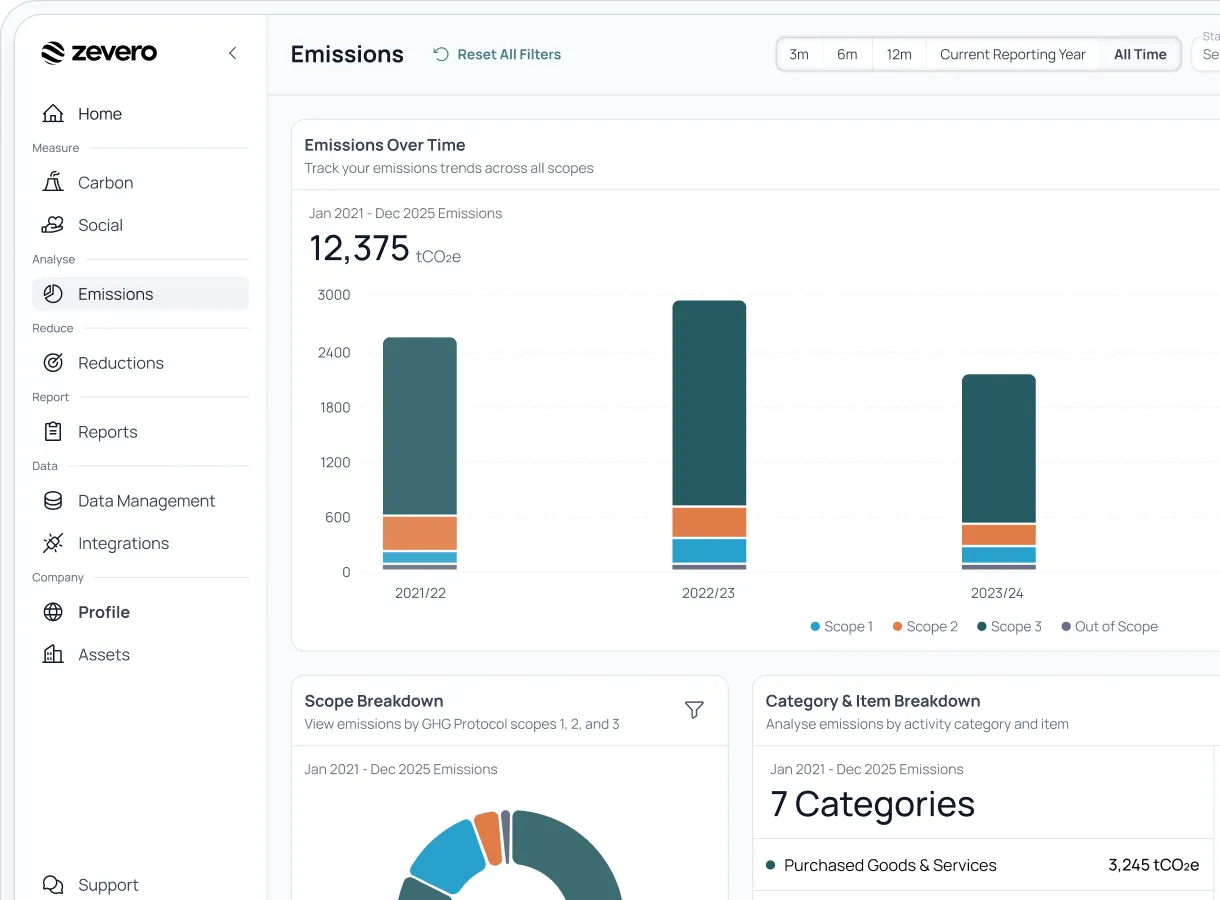
Zevero is a UK-based, AI-enabled climate platform that pairs carbon accounting software with in-house sustainability experts. Rather than positioning software as the primary product, Zevero assigns each customer a named climate expert who works alongside the platform, sharing responsibility for the accuracy of the output and the direction of the reduction plan.
Best suited for: growing and mid-sized organisations, particularly in food and beverages, manufacturing, and consumer goods, that want a reduction roadmap built in from day one rather than added on later.
Key features:
- Scope 1, 2, and 3 carbon accounting with automated data collection and emission factor matching
- AI-powered ESG disclosure reporting across CSRD, CDP, B Corp, and other frameworks, with expert review before submission
- Supports global frameworks spanning the UK, EU, and Asia-Pacific including SECR, SSBJ, SBTi, B Corp, CDP, and ISSB.
- Decarbonisation roadmaps and target-setting positioned as a core part of the service, not a separate add-on
- Industry expertise in food and beverages, manufacturing, and consumer goods sectors
Considerations:
- As a younger, smaller platform than Greenly, its integration library and self-serve feature set are still growing
- Organisations that want a single all-in-one suite covering LCA, ESG, and supplier engagement natively may find Greenly's broader feature set covers more ground out of the box
- Best suited to organisations that value a named point of accountability alongside software, rather than a primarily self-serve, AI-led model
Normative
Normative is a carbon accounting platform built around independently verified methodologies aligned with the GHG Protocol. It combines automated data collection with dedicated Climate Strategy Advisors, with a strong emphasis on calculation transparency and auditability.
Best suited for: organisations that need defensible, audit-ready emissions data as the foundation of their sustainability programme.
Key features:
- GHG Protocol-aligned carbon accounting with an independently verified calculation engine
- End-to-end calculation traceability
- Dedicated Climate Strategy Advisor support
- AI-assisted data categorisation
Considerations: Normative is primarily focused on carbon accounting rather than broader ESG reporting, supplier engagement, or sustainability workflow management, so organisations with wider requirements may need complementary tools.
Watershed
Watershed is a climate management platform used by large, ambitious sustainability programmes, including organisations such as Airbnb, Stripe, and Walmart. It combines carbon accounting, supplier engagement, and reduction planning with detailed emissions analytics.
Best suited for: large enterprises prioritising climate intelligence and long-term decarbonisation planning at scale.
Key features:
- Scope 1, 2, and 3 emissions accounting and reporting
- Supplier engagement and value chain emissions management
- Emissions hotspot analysis and reduction planning
- Reporting aligned with major disclosure frameworks, including support for California's SB 253 and SB 261
Considerations: Watershed is built for enterprise-scale operations, which may bring more complexity and cost than growing organisations require.
Persefoni
Persefoni is an AI-native carbon accounting and sustainability management platform built for enterprise-scale reporting, used by more than 10,000 teams including Xerox, Snowflake, Aramark, and Under Armour. It also runs a dedicated financial services product for financed emissions and portfolio company engagement.
Best suited for: large enterprises and financial institutions that need assurance-grade emissions data across multiple regulatory regimes, including a specific offering for portfolio-level reporting.
Key features:
- Scope 1, 2, and 3 carbon footprint measurement with calculation methods aligned to major carbon accounting standards
- Regulatory and investor-grade reporting covering CSRD, TCFD, SASB, PCAF, and California's SB 253 and SB 261
- Decarbonisation management, including net-zero target setting, reduction modelling, and Scope 3 supplier engagement
- Embedded AI tools (PersefoniAI), including a technical carbon accounting copilot and automated anomaly detection across large datasets
- A dedicated Financial Services product for financed emissions accounting and portfolio company engagement
Considerations: Persefoni's depth is built for large, complex organisations and financial institutions, which brings more infrastructure and cost than a smaller or mid-sized business is likely to need.
Sweep
Sweep is a sustainability data management platform aimed at large enterprises, built to centralise carbon, water, and waste data alongside broader ESG metrics across an organisation and its supply chain.
Best suited for: large enterprises managing sustainability data across multiple business units, systems, and supply chain partners.
Key features:
- Automated Scope 1, 2, and 3 emissions calculation, pulling data from existing ERP and finance systems
- Supplier engagement tools for collecting value chain emissions data
- Scenario modelling to test the impact of business decisions on carbon targets
- Reporting aligned with CSRD, SFDR, and other global disclosure frameworks
- AI-powered tools, including EcoPilot, for on-demand climate expertise and repetitive task automation
Considerations: Sweep's feature set and pricing are built primarily for medium to large enterprises, so smaller businesses may find its capabilities go beyond what they currently need.
Greenly vs Zevero: feature and pricing comparison
What to ask before switching carbon accounting platforms
Comparing feature lists is only part of the decision. Before committing to a carbon accounting platform, it is worth getting clear answers to a few practical questions.
- Who is accountable when the numbers are challenged? Ask whether a named expert reviews and stands behind the data, or whether responsibility sits mainly with the software and the internal team.
- Which regulatory frameworks are supported by default, and which require extra configuration? A platform's core methodology (EU-first versus UK-and-EU) affects how much setup work falls on the internal team.
- How is reduction planning handled? Ask whether decarbonisation roadmaps are part of the standard service or a separate, additional engagement.
- What does onboarding and migration involve? Moving historical emissions data, supplier records, and past reports to a new platform takes time; ask each vendor for a realistic timeline based on comparable customers.
- Does the platform fit the sector and company size? A platform designed for large enterprises may include more complexity than a growing organisation needs, while a platform built for smaller teams may lack depth for a large multi-entity business.
.png)
Getting clear, written answers to these questions from each vendor makes the comparison table easier to apply to a specific organisation's circumstances.
How to choose the right Greenly alternative
The right choice depends on how much weight an organisation places on regulatory reach, reduction planning, sector fit, and the level of direct expert accountability it wants.
- If UK compliance and a built-in reduction roadmap matter most, Zevero's combination of UK and EU regulatory coverage with a named climate expert is designed for that priority.
- If the organisation is in food, drink, or consumer goods and still growing, Zevero's sector-specific integrations and mid-market focus are likely to be a closer fit than a platform built primarily for large enterprise clients.
- If the priority is a broad, all-in-one AI-automated suite covering LCA, ESG reporting, and supplier engagement natively, Greenly's established feature set and integration library offer wide out-of-the-box coverage.
- If carbon accounting accuracy and auditability are the core requirement, specialist platforms such as Normative or Watershed offer different strengths depending on whether the focus is calculation verification or climate intelligence at scale.
- If assurance-grade emissions data across multiple regulatory regimes is the priority, including financed emissions reporting, Persefoni's enterprise-grade platform and embedded AI tools are built for that scale.
- If the organisation is a large enterprise managing sustainability data across many business units and supply chain partners, a platform such as Sweep may be better suited to that scale of complexity.
See how Zevero compares for your organisation
Every sustainability programme has different regulatory, sector, and reduction priorities. Book a demo with Zevero to see how a named climate expert and a built-in reduction roadmap could work for your organisation.

Join our newsletter to stay up to date on features and releases.
FAQs
Is Greenly a good fit for UK-based companies?
What is the main difference between Zevero and Greenly?
Does Greenly cover Scope 3 emissions?
Which platform is better suited to manufacturing, food, and beverage companies?
Is Zevero cheaper than Greenly?
Thanks for reading!
Greenly Alternatives for AI-Optimised Carbon Management
Add us as a preferred source

Related posts
.webp)
Read more

Blog
Jul 29, 2026
How to Set SBTi Targets Under the Net-Zero Standard V2.0
How to Set SBTi Targets Under the Net-Zero Standard V2.0

Read more
Blog
Jun 3, 2025
SECR Reporting: A Guide for UK Businesses
SECR Reporting: A Guide for UK Businesses

Read more
Blog
Mar 10, 2025
Japan's SSBJ Standards: What Companies Need to Know
Japan's SSBJ Standards: What Companies Need to Know
See how Zevero can streamline your carbon reporting
Grow your business and reduce your impact