Education

Quick summary
- Almost three months earlier. CDP's 2027 scoring deadline falls in the week of 21 June 2027, compared with 16 September in 2026, and the response window opens in the week of 12 April.
- Data readiness decides the outcome. Most of the effort goes into collecting, evidencing and verifying data before the response window opens, so teams that collect data through the year are best placed to meet a June deadline.
- March year-ends face the tightest squeeze. Many Japanese companies have about 12 weeks between closing their books and the scoring deadline, a period that also holds securities reports, AGMs and phased SSBJ requirements.
- A first response beats another "Did not disclose". Companies asked to disclose that did not respond can still submit a credible baseline in 2027, provided Scope 1 and 2 data and a Scope 3 screening are ready before April.
CDP has brought its 2027 disclosure cycle forward. The scoring deadline moves from 16 September 2026 to the week of 21 June 2027, and the response window opens in the week of 12 April, about two months earlier in the year than in 2026. Data that was due by late summer now needs to be collected, evidenced and verified by early summer.
Demand for CDP data is not slowing. In the 2026 cycle, CDP's Capital Markets Signatories, over 540 financial institutions representing more than US$110 trillion in assets, requested over 43,000 organisations to disclose. Investors and supply chain partners increasingly use CDP scores to assess risk before signing contracts, extending credit, or making allocation decisions. That creates a real problem for companies that have never engaged with the process. A missing or weak score can quietly close doors long before climate targets ever come up in conversation.
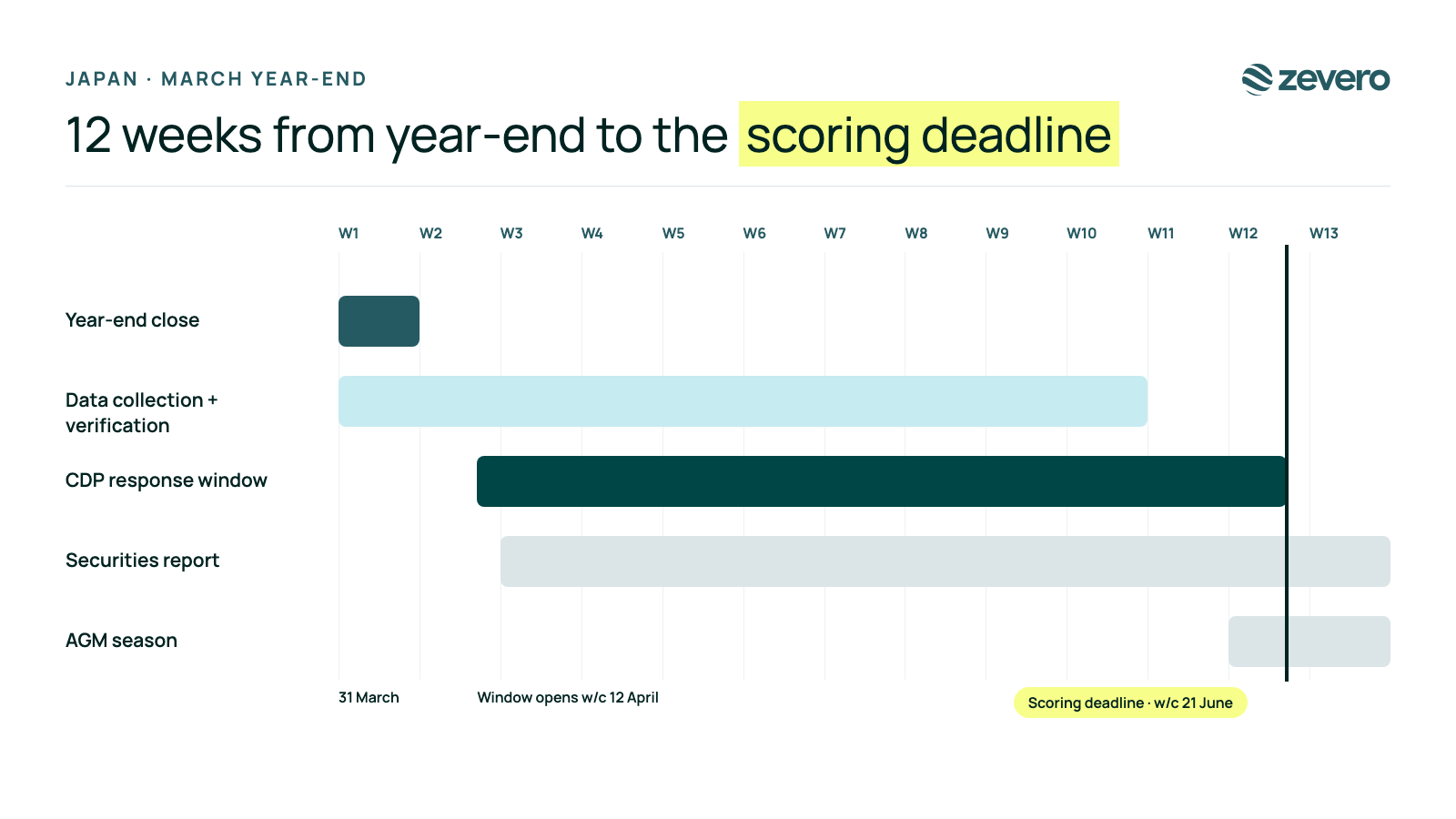
For companies with an April to March financial year, which includes most listed companies in Japan, the change is sharper still. Books close at the end of March, and the scoring deadline falls about 12 weeks later, during the same weeks as the annual securities report and the June AGM season. Teams that still compile emissions data in spreadsheets after year-end will find that window very tight.
Whether a company has received a formal disclosure request, was marked "Did not disclose" last cycle, or is weighing up disclosing voluntarily, the week of 21 June 2027 is the deadline to plan around. Planning backwards from it needs to start well before the response window opens in April.
This blog covers what has changed, how scoring works, what it means for companies globally, and how to prepare.
What is CDP?
CDP, formerly the Carbon Disclosure Project, runs one of the most widely used environmental disclosure systems in the world. Companies, cities, states, and regions use it to report data on climate change, water security, and forests, and that data is then shared with the investors, customers, or banks who requested it.
CDP disclosure is voluntary, but companies may be asked to disclose by a customer or investor. Once a request is received, or a company opts in voluntarily, the requirement is straightforward: complete the relevant questionnaire and receive a score based on what's submitted. Since 2024, climate, water, and forests sit inside a single integrated questionnaire; one submission can cover all three themes. How well a company scores reflects the quality of its own data and management practices rather than compliance with a law.
In June 2026, CDP announced it will become two independent organisations: a for-profit CDP, backed by the investment firm Permira, and a non-profit CDP Foundation. CDP has said its products, services and the 2026 cycle continue as planned during the transition.
What has changed in the 2027 CDP disclosure cycle
CDP has published the key dates for the 2027 cycle on its Disclosure Hub. According to CDP, stakeholders asked for an earlier response window so that scores and data can feed internal planning, annual reports and shareholder events within the same calendar year. The key dates for the 2026 cycle were not affected.
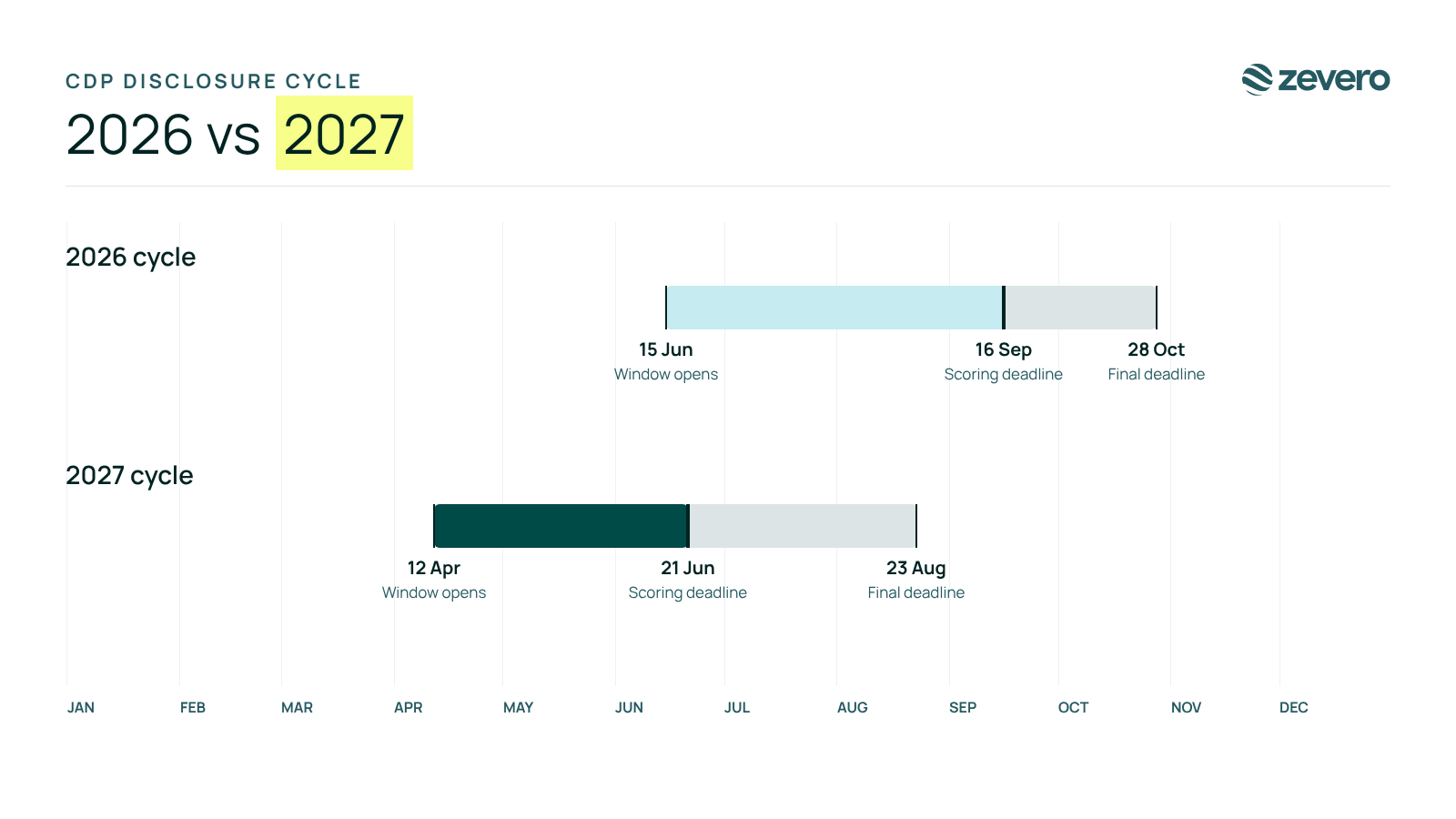
Responses can still be edited after the scoring deadline until the final response deadline, but those changes are not scored. After the final deadline, the questionnaire closes.
CDP describes the 2027 response window as one month shorter than in previous cycles. It expects the window to remain manageable because of an improved copy-forward function (which lets companies reuse earlier answers), a new AI-enabled response suggestion feature, and no major questionnaire changes currently expected. CDP has said it will share further updates, including any questionnaire changes, on its Disclosure Hub.
What companies need to disclose
The core of any CDP submission is emissions data across three scopes:
- Scope 1 emissions, arising directly from sources a company owns or controls.
- Scope 2 emissions, arising from purchased electricity and other energy.
- Scope 3 emissions, covering everything else in the value chain, from purchased goods to employee travel. Scope 3 typically represents the largest share of a company's total footprint, often by a wide margin.
Water security and forests disclosures aren't automatic. They apply only where a company has been specifically requested to report on them, or has opted in during questionnaire setup.
CDP's climate questionnaire is aligned with IFRS S2, the climate standard from the International Sustainability Standards Board (ISSB), and CDP reports a high degree of interoperability with the European Sustainability Reporting Standards (ESRS) E1 climate module under the Corporate Sustainability Reporting Directive (CSRD). In practice, one well-prepared dataset can support several frameworks, rather than collecting the same data again for each.
Sector matters too. Financial services, energy, materials (such as chemicals, metals and steel) and transport all carry sector-specific climate questions, with further water and forests questions depending on industry classification.
How CDP scoring works
Scores run from D- up to A, with each band reflecting a different stage of environmental maturity: disclosure, awareness, management, and leadership. The criteria below reflect CDP's 2026 methodology and may change for 2027.
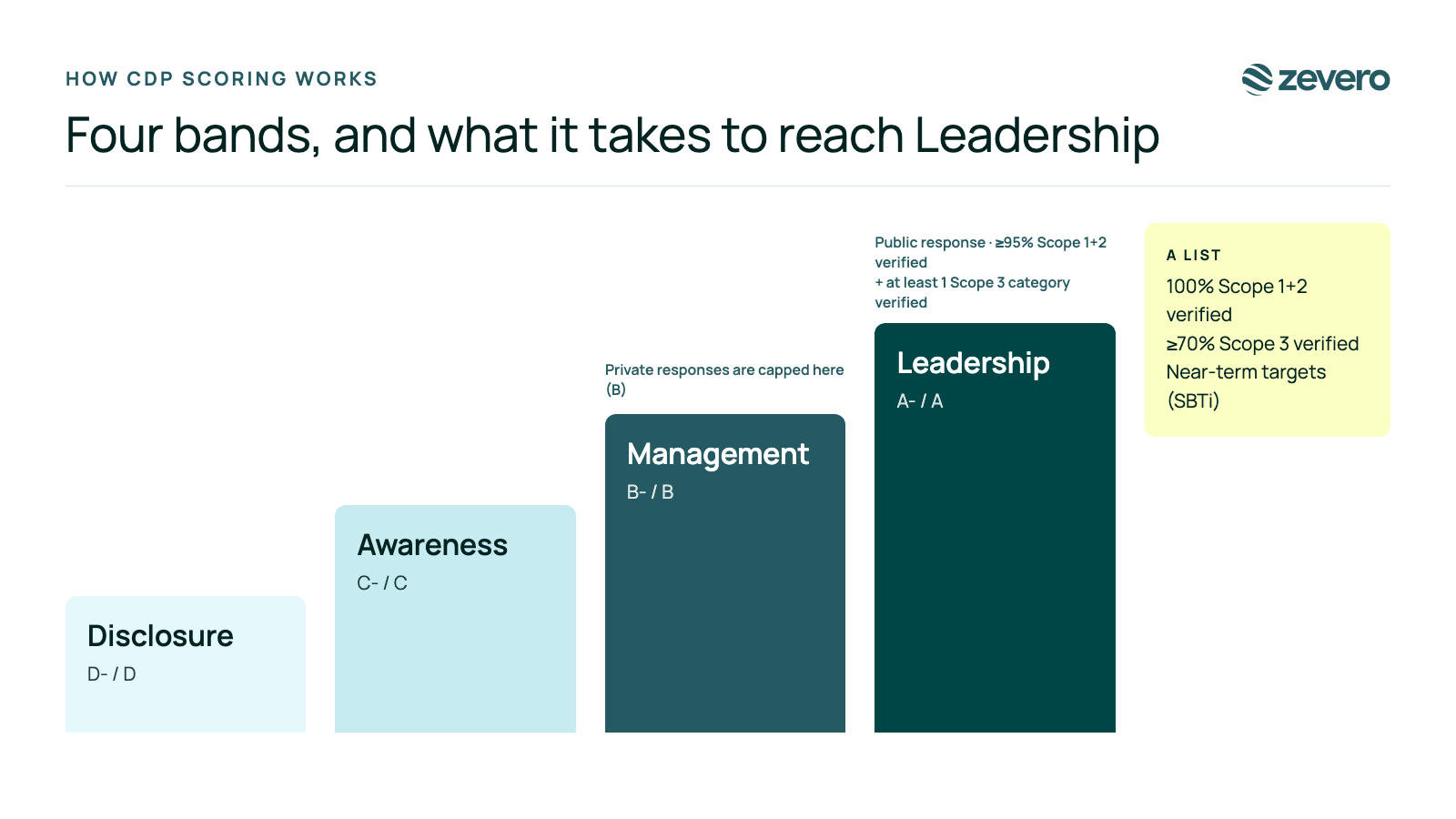
- Visibility depends on a company's own choice, up to a point. A response is always visible to whoever requested it, such as a customer or a Capital Markets Signatory, regardless of whether the company chooses to make it public more widely. That choice matters more than it first appears: CDP's own essential criteria require a public response to reach Leadership. A company that keeps its disclosure private is capped at a B, however strong the underlying data.
- Verification becomes a requirement at the top levels. To reach Leadership, a company needs at least 95 per cent of its reported Scope 1 and 2 emissions verified by a third party, plus at least one verified Scope 3 category. The A List raises this further: 100 per cent of Scope 1 and 2 emissions verified, plus at least 70 per cent of reported Scope 3 emissions.
- Targets carry weight at the top level. Near-term emissions reduction targets, particularly those approved by the Science Based Targets initiative, contribute meaningfully to A List scoring.
Score release moves earlier too. CDP aims to deliver scores to disclosing companies in September 2027 and to publish public scores in November, with exact dates still to be confirmed. For companies whose customers, investors or lenders check CDP scores as part of due diligence, the public release carries real reputational weight.
First-time responders and "Did not disclose" companies
If a Capital Markets Signatory or customer requested a response and none was submitted, CDP publishes a "Did not disclose" status for that company. Investors and buyers can see it, and it reads as non-engagement rather than a weak result.
For companies in this position, 2027 is a chance to reset, but with the deadline in June there is less time to start late. A first response does not need to reach Leadership. What it needs is:
- a complete Scope 1 and 2 inventory, with a documented methodology
- a first Scope 3 screening, even if some categories are estimated
- a named owner in the CDP Portal and a clear internal sign-off route
A credible first submission at Disclosure or Awareness level is a stronger signal than another "Did not disclose", and it gives a baseline to improve on in later cycles.
Why data readiness decides the 2027 response
Most of the work in a CDP response happens before the response window opens. It includes gathering activity data, applying emission factors, documenting methodology, evidencing governance and targets, and arranging third-party verification. Drafting the written answers is the smaller part of the task.
Spreadsheet-led processes come under strain here:
- Scattered data. Data sits across multiple files and owners.
- Weak version control. Versions are often tracked by file name rather than by audit trail.
- Unlinked evidence. The source behind each figure is often not attached to the figure itself.
As a result, verifiers can end up rebuilding calculations instead of checking them. The higher scoring levels also require third-party verification, which has to be complete before the June scoring deadline.
The alternative is to collect CDP data throughout the year rather than once a year. When activity data goes into a single system monthly or quarterly, with emission factors applied consistently and each figure linked to its source, the team spends year-end reviewing numbers instead of rebuilding them, and starts drafting in April with the data already in place.
Regional focus: what the earlier cycle means for Japanese companies
In 2025, CDP asked around 3,250 Japanese companies to disclose. About 1,400 submitted a scored climate response, including roughly 1,100 Prime Market companies, and 222 reached the A List. Around 1,700 were marked ‘Did not disclose’, including 384 Prime Market companies.
Most Japanese listed companies follow an April to March financial year. Under the 2027 timeline, a company reporting on the fiscal year ending March 2027 would have about 12 weeks between year-end and the June scoring deadline. The same weeks cover preparation of the annual securities report and the June annual general meeting (AGM) season.
The pressure is greatest for the largest Prime Market companies. Under the Financial Services Agency (FSA) roadmap, Prime Market companies with an average market capitalisation of ¥3 trillion or more must report under the Sustainability Standards Board of Japan (SSBJ) standards from the fiscal year ending March 2027, with companies between ¥1 trillion and ¥3 trillion following a year later. Mandatory third-party assurance starts one year after each group's first mandatory disclosure. For these companies, one verifiable emissions dataset that serves both SSBJ reporting and CDP avoids running two data exercises in the same quarter.
Companies that have not disclosed to CDP before, or that still rely on manual spreadsheets, face the steepest climb. Collecting data monthly or quarterly during the fiscal year, rather than after year-end close, is one of the most practical ways to bring a June response within reach.
Verification adds to the pressure. Verifiers need finalised data and a clear evidence trail, and many March year-end companies will be asking for assurance in the same few weeks.
Companies that book a verifier before year-end, and hand over evidence that is already linked to each figure, leave themselves time to fix anything the verifier raises before 21 June.
Getting started with a CDP response
Whether a company is responding to a request for the first time or returning after a gap, five steps are worth taking now:
- Confirm what's actually being asked. Check the CDP Portal to see whether a formal request has been received, and which questionnaire modules (climate, water or forests) apply.
- Get the underlying data in order before the response window opens. Scope 1 and 2 data should be measured and, ideally, verified; a Scope 3 baseline is also needed, since the higher scoring levels assess it. With the response window opening in the week of 12 April 2027, data gaps found after it opens leave little time to fix before the scoring deadline in the week of 21 June.
- Decide on public or private disclosure early, and assign ownership. The public/private decision caps the achievable score, so it shouldn't be an afterthought at submission. A Submission Lead should be designated in the CDP Portal well ahead of the response window, with contributors added early.
- Work back from the June deadline. Set an internal deadline ahead of it, with time built in for verification, internal review and sign-off.
- Book verification and build the evidence trail. Agree scope and timing with a third-party verifier before the response window opens, and keep a log linking each reported figure to its source document and emission factor.
How Zevero can help
With the scoring deadline moving to June, a strong CDP response depends on two things: emissions data that is ready earlier, and a response process that does not depend on spreadsheets passed between teams.
Getting the data ready. Zevero's corporate carbon footprinting measures Scope 1, 2 and 3 emissions with an audit-ready methodology aligned with the GHG Protocol and ISO 14064-1. Data can be collected through the year, so the figures are in place before the response window opens, and each one is linked to its source and emission factor for verification.
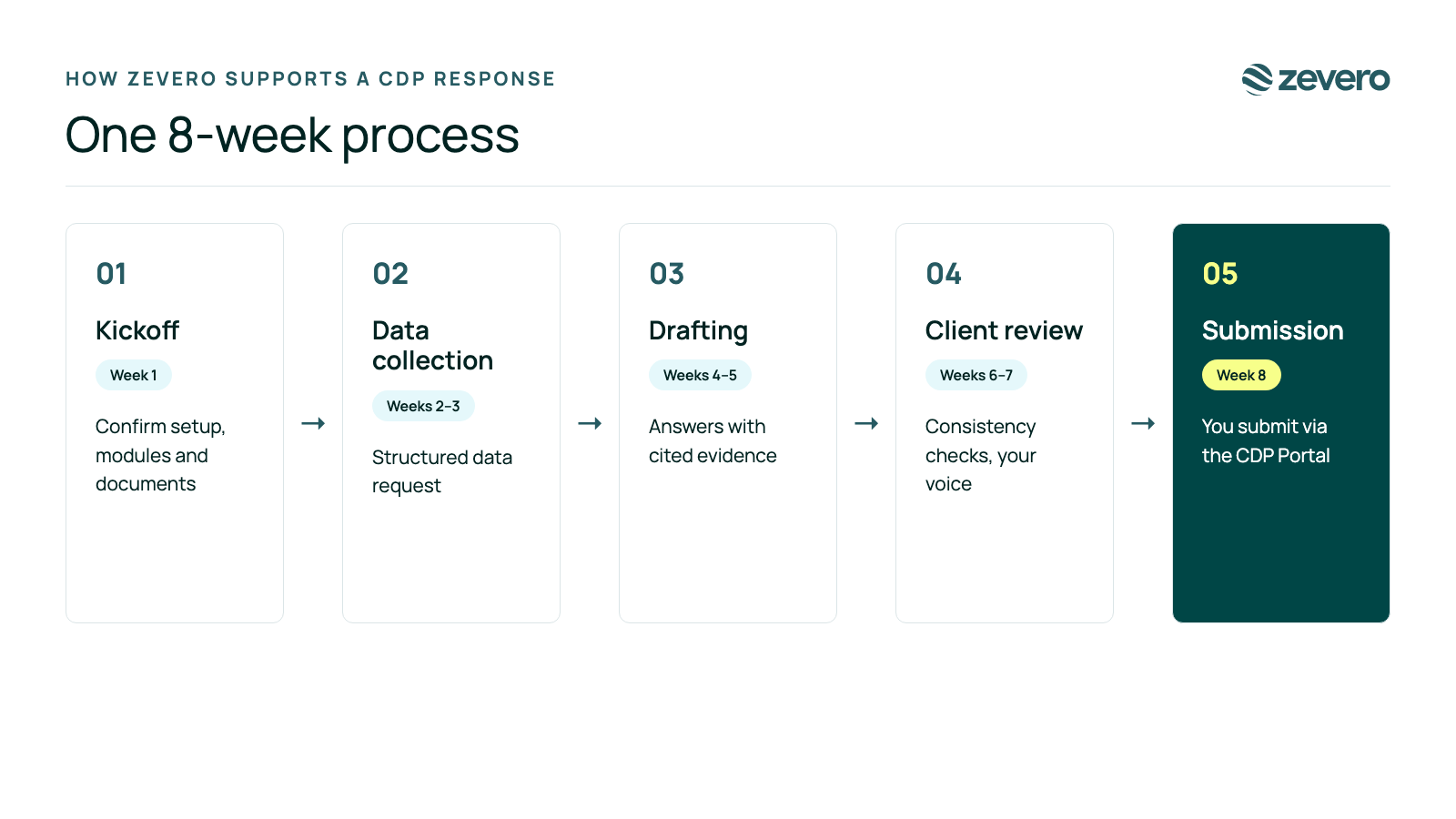
Drafting the response. Zevero supports CDP responses through a structured 8-week process:
- Kickoff. We confirm the questionnaire setup, the modules that apply and the documents needed, so drafting starts from a complete picture.
- Data collection (2 weeks). A clear data request sets out exactly what we need. Internal company data takes priority over public figures.
- Drafting (2 weeks). Answers are drafted question by question using Zevero's ESG Reporting Tool, and every "Yes" answer is backed by cited evidence.
- Client review (2 weeks). Your team reviews the draft, with consistency checks across answers and a pass to make sure the response reads in your company's voice.
- Submission. You submit through the CDP Portal, with an optional pre-submission review.
Preparing for verification. Because each reported figure is linked to its evidence, verifiers can work from an organised evidence pack rather than rebuilding calculations.
Get in touch to plan a CDP response ahead of the June 2027 deadline.
Zevero supports the preparation of CDP responses. Scores are determined solely by CDP, and Zevero does not guarantee a particular score.
FAQs
Can a company get more time if it cannot meet the scoring deadline?
What happens if a company is asked to disclose by a Capital Markets Signatory and doesn't respond?
Is there a size threshold for using the SME (small and medium-sized enterprise) questionnaire?
Does CDP charge a fee to respond?
Thanks for reading!
CDP 2027: What the Earlier June Deadline Means for Japan
Add us as a preferred source

Related posts

Read more

Blog
Jul 8, 2026
ESRS Simplified: Where Things Stand in 2026
ESRS Simplified: Where Things Stand in 2026

Read more
Blog
Mar 10, 2025
Japan's SSBJ Standards: What Companies Need to Know
Japan's SSBJ Standards: What Companies Need to Know
Read more
Blog
Jul 29, 2026
How to Set SBTi Targets Under the Net-Zero Standard V2.0
How to Set SBTi Targets Under the Net-Zero Standard V2.0
See how Zevero can streamline your carbon reporting
Grow your business and reduce your impact