Education

Quick summary
Key Takeaways
- EPDs are not just reporting outputs. The data inside them can inform product decisions, substantiate reduction claims, and support CSRD Scope 3 disclosures.
- Product-level accountability is the new baseline. Driven by ESPR, CPR, and CSRD, EPDs are increasingly a commercial requirement, not just a compliance one.
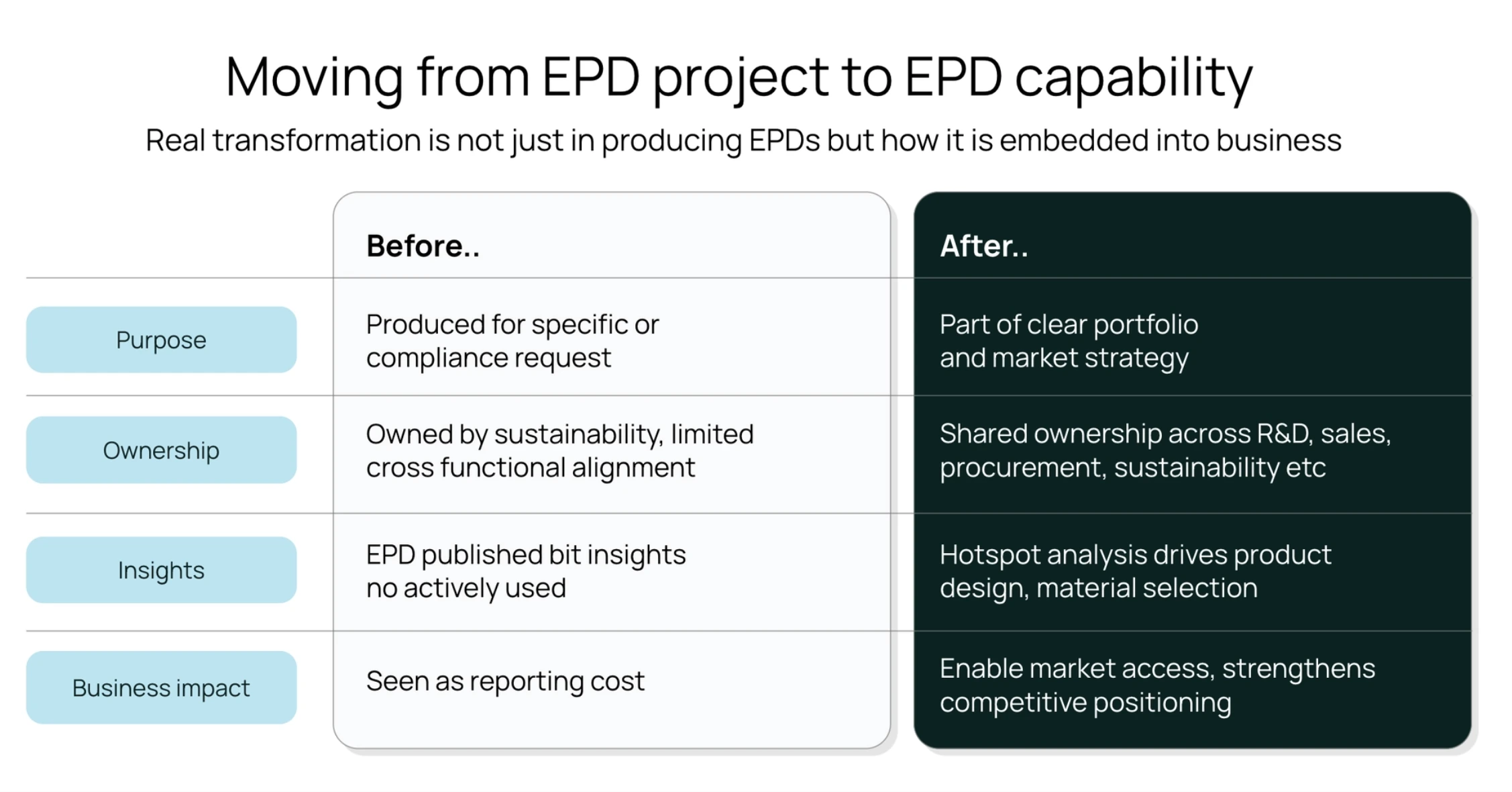
- The shift that matters is from reactive publication to embedded capability. That means shared ownership, queryable data, and a process that supports versioning and improvement.
- The window to build scalable EPD infrastructure is open now. Early movers gain both market access and process maturity before requirements intensify around 2028 to 2030.
When it comes to Environmental Product Declarations (EPDs), most organisations treat publication as the finish line: the tender has been satisfied, the certification box ticked, the customer request answered. Once the document is filed, attention moves on. What gets filed alongside it, largely unrecognised, is a serious data asset.
An EPD is the output of a full life cycle assessment, covering more than 30 environmental indicators, verified by a third-party, and is grounded in granular data about how a product is made, what it contains, and its impact on the environment across its life cycle.That data has commercial, strategic, and regulatory applications that most organisations never reach, because they stop at publication. That makes it one of the most rigorous sources of product-level sustainability data available, but in most organisations, it sits untouched in a PDF.
Why EPDs usually stop at publication
Across the built environment and manufacturing sectors, EPD publication has become a transaction rather than a starting point. Ownership stays with the sustainability team, insights go unused, and the business sees it as a reporting cost rather than a strategic asset. This is partly structural. The standard EPD process takes six to twelve months and costs approximately €10,000 per EPD, spanning data collection, LCA modelling, third-party verification, and publication with a programme operator. When that investment is tied to a single compliance trigger, there is little incentive to treat the output as a living data asset.
It is also a framing problem. EPDs are routinely understood as reporting outputs, something produced to demonstrate compliance, when the more accurate framing is that EPDs are levers for strategic outcomes. The underlying data can inform product development, substantiate reduction claims, feed Scope 3 disclosures, and strengthen competitive positioning. None of that happens automatically. It requires a deliberate shift from EPD as a project to EPD as organisational capability.
EPD data: The business value most organisations miss
Across the world, sustainability reporting is shifting from company-level disclosure to product-level accountability. Regulations including ESPR and the revised Construction Products Regulation are accelerating this shift, as is procurement pressure, with contracts increasingly being awarded to companies that provide EPDs.
Against that backdrop, there are three ways that product-level environmental data delivers value:
Product decisions and R&D
An EPD's underlying LCA data shows precisely where environmental impact concentrates in a product, including which input materials, manufacturing processes, and life cycle stages. That information is directly actionable for product development teams. When the data is queryable rather than locked in a PDF, it becomes possible to compare product versions, benchmark against industry standards and competitors, and identify where reformulation or material substitution would have the greatest effect.
Hotspot analysis drives product design and material selection. Organisations using digital EPD platforms can run side-by-side comparisons of internal product lines, track how environmental performance changes between versions, and present credible improvement evidence to customers. That capability transforms EPD data from a compliance output into an R&D input.
Credible reduction claims
Without a verified baseline, reduction claims are difficult to defend. With EPD data, particularly when EPDs are versioned over time, improvements become measurable and auditable. A version-to-version comparison provides evidence that a product’s environmental performance has genuinely changed, not just been restated. That matters for marketing claims, customer disclosures and the substantiation requirements now attached to green claims regulation across multiple markets.
Sustainability strategy and reporting
EPDs are one of the few sources of structured, third-party-verified product data that can do meaningful work inside a broader sustainability programme. For CSRD reporters, EPD data is directly applicable to Scope 3 disclosures, specifically the product performance and supply chain impact dimensions that are consistently the most data-intensive part of the requirement.
There is also a forward-looking dimension. Digital Product Passports are emerging as the next requirement under ESPR, and the data infrastructure required to produce EPDs well is the foundation for DPP readiness. Industry signals point in one direction: Digital Product Passports are gaining importance and are expected to become more critical than EPDs themselves for harmonised products. Organisations that build scalable EPD programmes now are building toward that requirement, not just meeting today's.

What separates a scalable EPD approach from a one-off
When evaluating your current EPD approach, the distinction that matters most is not which programme operator you use or how quickly you can produce a document. It’s whether your organisation treats EPDs as a capability instead of a project. Three questions reveal where most organisations stand.
- Is your data accessible? Most EPD data lives in PDFs. A scalable approach holds it in a platform where it can be queried, compared across products, and connected to other sustainability systems.
- Do you have the expertise to act on it? Producing an EPD and interpreting one are different skills. The data needs someone who can identify hotspots and translate findings into product and procurement decisions.
- Does your process support versioning? Products change. EPDs need to reflect that, and improvements need to be evidenced over time, not just asserted.
If the answer to any of those is no, your current approach is set up for publication–not for long-term value. Technology has reduced the operational barrier significantly. With automated LCA and EPD creation, the standard 6-12 month timeline compresses to 6-12 weeks, with the same five-stage process but far less manual effort in the middle steps and pre-verified infrastructure cutting verification time.
How to get more value from EPDs you already have
If your organisation has published EPDs currently sitting in a document folder, these are the four most valuable steps to take now.
- Audit what you have. Are the EPDs current? EPDs are typically valid for five years, but products change faster than that. Are they methodologically comparable across your portfolio, or were they produced at different times under different PCR interpretations? Are they accessible in a format your sales and procurement teams can actually use, or does every request require manual effort?
- Connect the data to your carbon accounting. Product-level environmental data should not sit in a separate system from your overall footprint. EPD data is directly applicable to Scope 3 calculations, if it is not currently feeding into them, that gap is worth closing.
- Use EPDs actively in commercial conversations. EPDs are becoming the shared language of product sustainability. Teams that can present product-level data, compare performance against competitor products, and publish documentation to procurement databases are operating at a different level than those presenting a static PDF on request.
- Turn one-off EPDs into a programme. Analysis suggests peak market demand for EPDs will arrive between 2028 and 2030. That means the window to establish scalable EPD infrastructure ahead of then is open now, and first movers who build the process early gain both market access and the maturity to handle volume as requirements increase.
Ready to put your EPD data to work?
The organisations getting the most from their EPD data are not necessarily those with the most EPDs. They are the ones that have stopped treating EPD publication as the end of the process and started treating the underlying data as an active part of their sustainability and commercial strategy.
Zevero helps organisations make that shift:
- Turn EPD data into Scope 3 inputs. Product-level environmental data connected to your carbon accounting, not sitting in a separate system.
- Track and evidence product improvement. Version-to-version comparisons that make reduction claims measurable and defensible, not just asserted.
- Report with confidence. Audit-ready outputs aligned with CSRD and other global frameworks, grounded in verified product-level data.
- Get expert support. Our advisory team works alongside sustainability, product, and procurement functions to ensure EPD insights drive decisions, not just disclosures.
Ready to see what your EPD data could be doing? Speak to our team.
FAQs
What data does an EPD contain?
Can EPD data be used for CSRD reporting?
What is the difference between an EPD and a Digital Product Passport?
How long does it take to produce an EPD?
What are the main challenges organisations face when rolling out EPDs at scale?

Related posts

Read more

Blog
Jul 25, 2025
What is an EPD? A guide to Environmental Product Declarations
What is an EPD? A guide to Environmental Product Declarations
%20(1).jpg)
Read more
Blog
Sep 22, 2025
Unlocking Funding Support to Build EPD Capabilities in Singapore
Unlocking Funding Support to Build EPD Capabilities in Singapore

Read more
Blog
Dec 3, 2024
What is a Life Cycle Assessment (LCA) and Why Does It Matter?
What is a Life Cycle Assessment (LCA) and Why Does It Matter?
See how Zevero can streamline your carbon reporting
Grow your business and reduce your impact