Education


Quick summary
- The boundary defines what a PCF figure actually means. Two suppliers can calculate the carbon footprint of the same product and arrive at completely different numbers (both correctly) if they have used different lifecycle boundaries.
- Always declare the system boundary of a PCF you produce, and always specify the boundary you expect when requesting data from suppliers. An undeclared boundary is the most common reason PCF figures cannot be compared or used.
If two suppliers submit a product carbon footprint (PCF) for the same component and the numbers do not match, the most likely explanation is not that one of them has made an error. It is that they have drawn the boundary in different places. The boundary is everything in PCF work. It determines which lifecycle stages are included in the emissions figure, which are excluded, and therefore what the number actually means. Two companies can calculate the PCF for the same product and arrive at completely different figures (both correctly) if they have not agreed on where the boundary sits.
The two most common lifecycle boundaries in PCF calculation are cradle to gate and cradle to grave. Understanding the difference between them shapes what your PCF tells you, who it is useful for, and how it can be compared to other figures in the market.
What does cradle-to-gate mean?
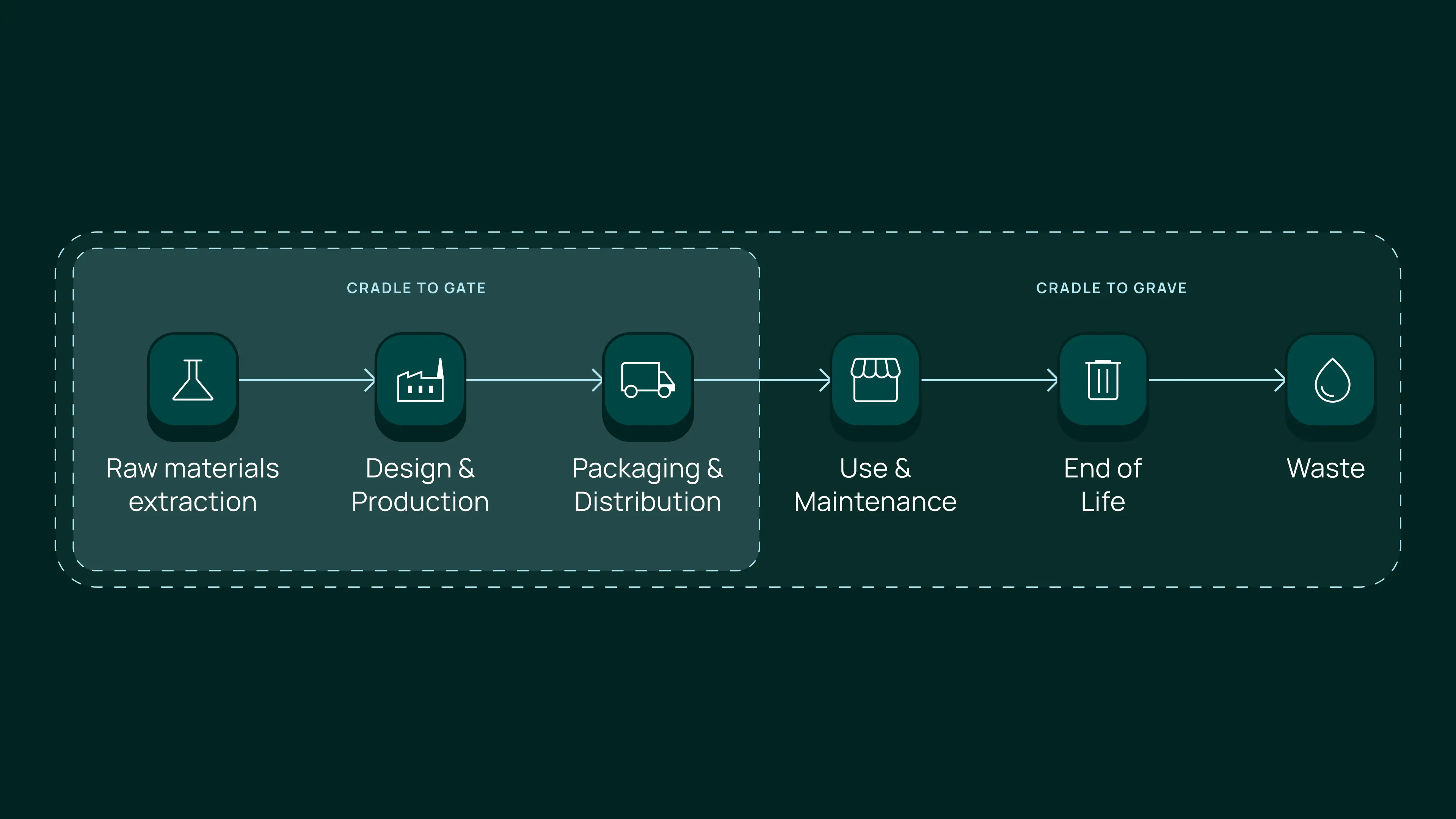
Cradle-to-gate is a partial lifecycle view, examining a product's journey from the cradle, the extraction of raw materials, to the gate, the point at which the product is ready to be shipped. This means transport to the customer, the use phase, and end of life are all excluded.
Cradle-to-gate provides actionable data on materials, energy, and inbound transport, and is the most common scope for PCFs, particularly in supply chain contexts. The reason is straightforward: a supplier can only measure, control, and verify what happens within their own operations and upstream supply chain. What a customer does with the product after it leaves the factory gate is outside their knowledge and outside their control.
This makes cradle-to-gate the standard approach when buyers ask suppliers for a PCF as part of a Scope 3 data request. It is also the mandatory minimum scope for Environmental Product Declarations (EPDs), though many EPDs include additional lifecycle stages beyond this.
What does cradle-to-grave mean?
Cradle-to-grave is the full lifecycle view, covering every stage of a product's life: raw material extraction, processing, manufacturing, transport and distribution, the use phase, and end of life—whether that is disposal, recycling, or incineration. This makes it better suited for consumer-facing claims, producing a certified product label, or comparing two finished products on a like-for-like basis.
Cradle-to-grave is the approach a full lifecycle assessment (LCA) typically takes. It provides the most complete picture of a product's total climate impact, which matters most when the use phase or end of life generates significant emissions. A washing machine, for example, produces most of its lifetime emissions during use, not during manufacturing. A single-use plastic bottle generates emissions at disposal that a cradle-to-gate calculation would miss entirely. For products like these, stopping at the factory gate misses the emissions that matter most.
Why the boundary matters for product carbon footprints
The most common source of confusion in PCF work is undeclared or mismatched boundaries. When a procurement team requests a PCF from a supplier without specifying the boundary, the supplier may respond with a cradle-to-gate figure without either party realising they are talking about different things. The buyer may be expecting a full lifecycle number for sustainability reporting purposes. The supplier has provided a manufacturing-to-gate figure. Neither is wrong, but they measure different things, and presenting them side by side without context is misleading.
Regardless of methodology, any PCF figure should include an explicit declaration of its system boundary. In practice this is frequently omitted, which is how mismatched figures end up sitting side by side in sustainability reports or supplier databases without anyone flagging the incompatibility.
The boundary also has a direct bearing on how Scope 3 categories work in practice. An intermediate product (where the final use of that product is unknown) will normally be evaluated cradle-to-gate; whereas a final product should be evaluated cradle-to-grave. When a buying company calculates its Scope 3 Category 1 emissions from purchased goods and services, it is typically working with cradle-to-gate PCF figures from its suppliers. The downstream emissions from those products sit in other Scope 3 categories, not in Category 1.
Understanding where your boundary sits, and making it explicit, is what makes PCF data usable rather than just technically complete.
How to choose the right approach
The right boundary depends on who is asking and what the data will be used for.
Use cradle-to-gate if:
- You are a supplier responding to a B2B PCF or Scope 3 data request
- You are producing an EPD for a material, component, or intermediate product
- You are scoping your upstream Scope 3 emissions across a product portfolio
- The downstream use of your product is unknown or varies significantly by customer
Use cradle-to-grave if:
- You are assessing a finished consumer product where the use phase generates material emissions
- You are making a consumer-facing environmental claim or applying for a certified product label
- You are conducting a like-for-like comparison between two finished products
- You are setting a science-based reduction target that requires full lifecycle coverage
What this means if you are building a PCF programme
Getting the scope right from the start is not a housekeeping decision. It determines the quality and comparability of every PCF figure in your programme.
The most common problem companies encounter when building out a PCF programme is inconsistent scoping across their supplier base. One supplier provides a cradle-to-gate figure, another provides a full lifecycle number, a third provides a figure covering only their own manufacturing operations, excluding upstream raw material emissions entirely. All three land in the same supplier database without boundary labels. The result is a dataset that looks comprehensive but cannot be meaningfully compared or aggregated.
The fix is simple in principle and harder in practice: define the boundary you expect before you collect data, communicate it explicitly to suppliers, and build your data collection process around verified, labelled figures rather than unlabelled numbers.
Zevero works with companies to build that consistency in from the start. Generate Product Carbon Footprints with figures that are comparable, traceable, and useful for procurement tenders, Scope 3 reporting, and regulatory compliance.
FAQs
Which approach should suppliers use when responding to a PCF request?
What is an EPD and how do I know which boundary it uses?
How often does a PCF need to be recalculated?
Can a supplier provide both a cradle-to-gate and a cradle-to-grave figure for the same product?
Thanks for reading!
Cradle to Gate vs Cradle to Grave: What It Means For Your Product Carbon Footprint
Add us as a preferred source

Related posts
.jpg)
Read more

Blog
May 20, 2025
Product Carbon Footprint vs. Corporate Carbon Footprint: What’s the Difference?
Product Carbon Footprint vs. Corporate Carbon Footprint: What’s the Difference?

Read more
Blog
Dec 23, 2024
PCF vs LCA: The Key Differences Explained
PCF vs LCA: The Key Differences Explained

Read more
Blog
Jul 25, 2025
What is an EPD? A guide to Environmental Product Declarations
What is an EPD? A guide to Environmental Product Declarations
See how Zevero can streamline your carbon reporting
Grow your business and reduce your impact