Policy


Quick summary
- The FCA rules apply to listed companies only, but UK SRS S2 requires them to prioritise measured, supplier-specific Scope 3 data, so they are likely to request that data from suppliers.
- Listed companies must make UK SRS disclosures or explain why they have not, with optional relief of one year for Scope 3 and two years for wider S1 disclosures.
- Suppliers that hold a documented Scope 1 and 2 baseline before customers ask will respond faster and with better data.
On 30 September 2026, the Financial Conduct Authority (FCA) published final rules that link UK-listed companies to the UK Sustainability Reporting Standards (UK SRS). The rules apply to accounting periods starting on or after 1 January 2027, with first reports due in 2028.
The rules do not apply to suppliers directly. They do change what listed companies need from their suppliers. Scope 3 emissions, which include emissions from purchased goods and services, form part of the climate disclosures listed companies must make or explain.
This blog covers what UK SRS is, what the FCA requires, how suppliers are affected and how to prepare.
What is UK SRS?
UK SRS is a pair of sustainability disclosure standards published by the UK government on 25 February 2026. UK SRS S1 covers general sustainability-related financial disclosures, and UK SRS S2 covers climate-related disclosures. Both are UK versions of IFRS S1 and IFRS S2, the international standards issued by the International Sustainability Standards Board (ISSB).
The standards are available for voluntary use, and regulators decide who must report against them. For listed companies, that regulator is the FCA. The UK Sustainability Reporting Standards guidance on GOV.UK holds the published standards.
What the FCA rules require of listed companies
The FCA's policy statement PS26/19 replaces its existing climate disclosure rules, which follow the Task Force on Climate-related Financial Disclosures (TCFD), with rules based on UK SRS. The table below summarises the main points.
Comply or explain means a company either makes a disclosure or publishes a statement explaining why it has not. A company that uses transitional relief only needs to state that it is doing so, with no further explanation.
Why suppliers are affected
Emissions are grouped into three scopes. Scope 1 covers direct emissions from owned sources, and Scope 2 covers emissions from purchased electricity, heat and steam. Scope 3 covers all other indirect emissions across a company's value chain, including those from suppliers.
UK SRS S2 requires companies to consider all 15 Scope 3 categories in the Greenhouse Gas (GHG) Protocol Corporate Value Chain (Scope 3) Standard, and to disclose which categories their measure includes. For many listed companies, supplier activity can make up a large part of their Scope 3 footprint.
Supplier emissions are counted mainly in these upstream Scope 3 categories:
The FCA rules do not require suppliers to report, so the effect is indirect. UK SRS S2 expects Scope 3 figures to include estimates, but it requires companies to prioritise higher-quality data where it is available. Listed customers are therefore likely to ask suppliers for emissions data. The standard names four data characteristics to prioritise:
What suppliers can expect from 2027
Listed customers may start asking suppliers for emissions data during 2027. The one-year Scope 3 relief covers a listed company's first reporting period, which begins on or after 1 January 2027. Scope 3 becomes comply or explain for periods beginning on or after 1 January 2028, which gives listed companies until then to build their supplier data. The table sets out the key dates.
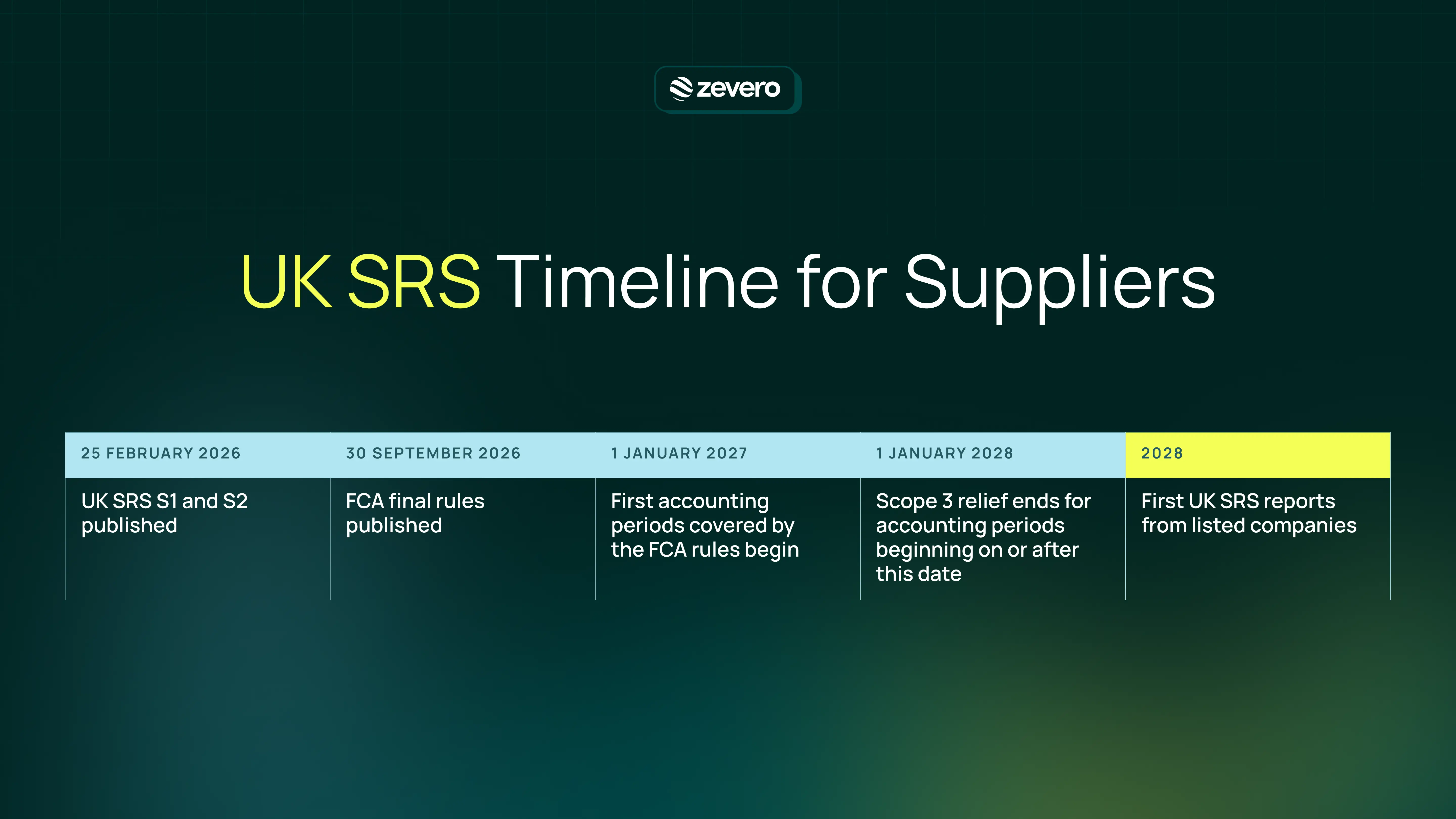
Exact dates depend on each company's financial year. A company with a calendar year starts its first UK SRS period on 1 January 2027, and Scope 3 becomes comply or explain for the year starting 1 January 2028. A company whose financial year starts on 1 April begins on 1 April 2027, and Scope 3 becomes comply or explain for the year starting 1 April 2028.
The FCA rules do not set a format for supplier requests, so customers may ask in different ways. Requests are likely to cover:
- Annual Scope 1 and Scope 2 emissions
- Emissions linked to the goods or services supplied
- The method and data sources behind the figures
- Reduction targets and progress against them
How suppliers can prepare
Suppliers can answer data requests more easily if a few steps are in place before the first request arrives.
- Map the emissions sources. List the facilities, vehicles, purchased energy and activities that produce Scope 1 and Scope 2 emissions.
- Set a baseline year. Choose a full year with complete data and use it as the reference for later reporting.
- Document the method. Record the emission factors, data sources and assumptions behind each figure, so a customer or auditor can trace it.
- Pull data from existing systems. Finance, procurement and operations records usually hold the activity data needed, such as fuel use, electricity and purchased materials.
- Check Scope 3 relevance. Identify which of the 15 Scope 3 categories apply to the business, starting with purchased goods and services.
- Set a reduction target. Customers may ask suppliers how they plan to cut emissions, particularly where the customer has its own targets.
How Zevero can help
Zevero, a carbon management platform, helps suppliers turn customer data requests into a structured process through four services.
- Measure your corporate carbon footprint, includingScope 1, 2, and 3 emissions using methods aligned with the GHG Protocol and ISO 14064-1,
- Use AI-powered ESG reporting to convert existing documents and data into reports aligned with CDP and ISSB, the international standards the UK SRS is based on.
- Find emissions hotspots, build a reduction roadmap, and set targets aligned with the Science Based Targets initiative (SBTi). Suppliers then have an answer ready when customers ask how they plan to cut emissions.
- Conduct a gap analysis to compare your current data and processes with the data listed customers are likely to request under UK SRS.
Get in touch to see how Zevero can support supplier emissions reporting.

UK SRS Decoded: What It Means and How to Prepare
FAQs
Does UK SRS apply to private companies?
How does UK SRS differ from CSRD?
Does SECR still apply?
Which GHG Protocol standards apply to supplier data?
What if a supplier's reporting year differs from the customer's?
Thanks for reading!
What UK SRS Means for Suppliers to Listed Companies in 2027
Add us as a preferred source

Related posts
Read more

Blog
Oct 14, 2025
The UK Sustainability Reporting Standards (UK SRS) Explained
The UK Sustainability Reporting Standards (UK SRS) Explained
Read more
Blog
Jul 29, 2026
How to Set SBTi Targets Under the Net-Zero Standard V2.0
How to Set SBTi Targets Under the Net-Zero Standard V2.0

Read more
Blog
Feb 12, 2025
What is CSRD? How the Corporate Sustainability Reporting Directive Impacts Businesses Worldwide
What is CSRD? How the Corporate Sustainability Reporting Directive Impacts Businesses Worldwide
See how Zevero can streamline your carbon reporting
Grow your business and reduce your impact