Policy

Quick summary
- Consultation is open until 25 October 2026. ACRA released the proposed SFRS S1 and S2 for public consultation on 27 July 2026, with feedback closing 25 October 2026.
- SFRS S2 is mandatory, SFRS S1 is voluntary. SFRS S2 (climate) is proposed as mandatory, while SFRS S1 (general sustainability) stays voluntary, reflecting Singapore's climate-first approach.
- Obligations are phased by company tier. STI constituents are already reporting in FY2025, while large non-listed companies start from FY2030.
On 27 July 2026, the Accounting and Corporate Regulatory Authority (ACRA) released Singapore Financial Reporting Standards (SFRS) S1 and S2 for public consultation. The consultation closes on 25 October 2026.
This matters because it turns a roadmap into a standard. Singapore's mandatory climate reporting regime was first announced in 2024 and revised in 2025, but until now, companies have been working from a timeline rather than a finished disclosure framework. SFRS S1 and S2 are the actual standards companies will report against, and the consultation is the last opportunity to shape their final form before they are locked in.
How Singapore got here
Singapore's approach to climate reporting has developed in stages.
- In 2022, ACRA and the Singapore Exchange Regulation (SGX RegCo) set up a Sustainability Reporting Advisory Committee to plan phased climate reporting and assurance requirements.
- In early 2024, the government announced that listed and large non-listed companies would be required to report climate information aligned with the standards issued by the International Sustainability Standards Board (ISSB).
- In May 2025, ACRA set up an Interim Sustainability Standards Committee to develop Singapore's own sustainability disclosure and assurance standards in line with international standards.
- In August 2025, ACRA and SGX RegCo revised the reporting timeline. Listed companies were split into three tiers with staggered obligations, and the start date for large non-listed companies moved from FY2027 to FY2030, giving smaller and less-resourced companies more time to build reporting capabilities.
- On 27 July 2026, the Committee released the proposed SFRS S1 and S2, turning the roadmap into a disclosure standard that companies can prepare against directly.
What SFRS S1 and S2 actually are
- SFRS S1 is Singapore's general sustainability disclosure standard, based on IFRS S1. It covers sustainability-related risks and opportunities beyond climate, including nature and biodiversity, human capital, and broader governance topics, wherever these could reasonably be expected to affect a company's cash flows, access to finance or cost of capital over the short, medium and long term. It is proposed as voluntary.
- SFRS S2 is Singapore's climate disclosure standard, based on IFRS S2. It requires companies to report on climate-related risks and opportunities specifically: physical risks such as extreme weather, transition risks such as policy and market shifts, greenhouse gas emissions across Scope 1, 2 and, where mandatory, Scope 3, and how climate resilience has been tested against different scenarios. It is proposed as mandatory.
Both standards are structured around the same four disclosure areas, drawn from the Task Force on Climate-related Financial Disclosures (TCFD) framework that underpins ISSB reporting globally: governance, strategy, risk management, and metrics and targets.
This split, climate mandatory and everything else voluntary, reflects the climate-first approach ACRA has taken since 2024. Rather than mandating both standards together, as some jurisdictions have done, Singapore is prioritising climate disclosure first and treating broader sustainability reporting as a voluntary next step for now.
How the proposed standards differ from the ISSB Standards
Singapore isn't adopting the ISSB Standards unchanged. The Interim Sustainability Standards Committee has proposed several adjustments to fit the local climate-first approach:
- Structure. The climate-relevant parts of SFRS S1 will sit as an appendix within SFRS S2, so SFRS S2 works as a standalone standard covering all climate disclosure requirements. Companies with mandatory climate reporting obligations will only ever need to refer to SFRS S2, without cross-referencing a separate S1 document.
- Timing of reporting relief. The ISSB Standards allow companies to publish their sustainability disclosures later than their financial statements in their first year of reporting. Singapore won't carry this relief over: companies will need to report their climate disclosures at the same time as their financial statements from the outset, with no first-year exception.
- Climate-first relief. The ISSB Standards also include a relief that lets companies report only on climate in their first year, before extending to the wider S1 disclosures afterwards. Singapore doesn't need this either, because SFRS S1 is voluntary from the start. Companies were never going to be reporting both standards together in year one, so the relief has nothing to apply to.
- Scope 3 relief. The one-year relief in the ISSB Standards has been extended into an ongoing relief. Companies outside the mandatory Scope 3 group continue to benefit for as long as Scope 3 remains voluntary for their tier, not just in year one.
- Statement of compliance. Companies must make an explicit and unreserved statement of compliance with SFRS S2, to support accountability.
- SASB references. Made voluntary rather than something companies must consider, giving more flexibility while the SASB materials continue to evolve.
Who reports and when
Requirements depend on company type and, for listed companies, market capitalisation.
*A large non-listed company is one with annual revenue of $1 billion or more and total assets of $500 million or more, assessed over the two preceding financial years.
Large non-listed companies can be exempted if two conditions are both met: their immediate, intermediate or ultimate parent company already prepares climate or sustainability reports using ISSB-based or equivalent standards, and the subsidiary's activities are included in that parent's publicly available report. This is worth checking closely. Companies that assume they fall under the FY2030 start date sometimes qualify for the exemption instead, simply because a parent entity elsewhere is already reporting on their behalf.
One point worth noting: SFRS S2 sets the Scope 3 disclosure requirement, but the ongoing relief built into the standard means ACRA and SGX RegCo can phase Scope 3 into mandatory status through separate legislation or listing rule changes, without needing to amend SFRS S2 itself.
What counts as "other ISSB-based climate disclosures"
Beyond GHG emissions, companies need to report on how they manage climate-related risks and opportunities across the four pillars mentioned earlier:
- Governance – the board and management processes used to oversee and manage climate-related risks and opportunities.
- Strategy – the actual and potential impacts of climate risks and opportunities on the business model, strategy and financial planning, including resilience under different climate scenarios.
- Risk management – the processes used to identify, assess, prioritise and monitor climate-related risks.
- Metrics and targets – the performance data and targets used to track progress, including GHG emissions figures and any climate-related targets the company has set.
Companies that have already reported under the Corporate Sustainability Reporting Directive (CSRD) or similar regimes will find this structure familiar.
What's being asked in the consultation
The consultation is open to companies, investors, assurance providers and professional bodies until 25 October 2026. It is a genuine opportunity to influence the detail of the final standards, not a formality before a decision that has already been made. Companies affected by the standards, particularly around thresholds, exemptions or the Scope 3 timeline, have a real window to raise concerns before the standards are finalised.
Support measures announced alongside the standards
ACRA has paired the new standards with a mix of new and existing support to help companies prepare:
- Sustainability Assurance Body of Knowledge. ACRA paired the release of the proposed standards with this new resource, aimed at building a pipeline of qualified sustainability assurance providers ahead of the FY2029 and FY2032 assurance deadlines.
- Existing training support. The Sustainability Reporting Body of Knowledge guides training providers on sustainability reporting curricula, and SkillsFuture Green Workplace courses are subsidised by up to 90%.
- Sustainability Reporting Grant. Offered jointly by the Economic Development Board and Enterprise Singapore, the grant remains available to help cover the cost of preparing initial reports, though application deadlines were updated following the August 2025 timeline change.
What to prepare now
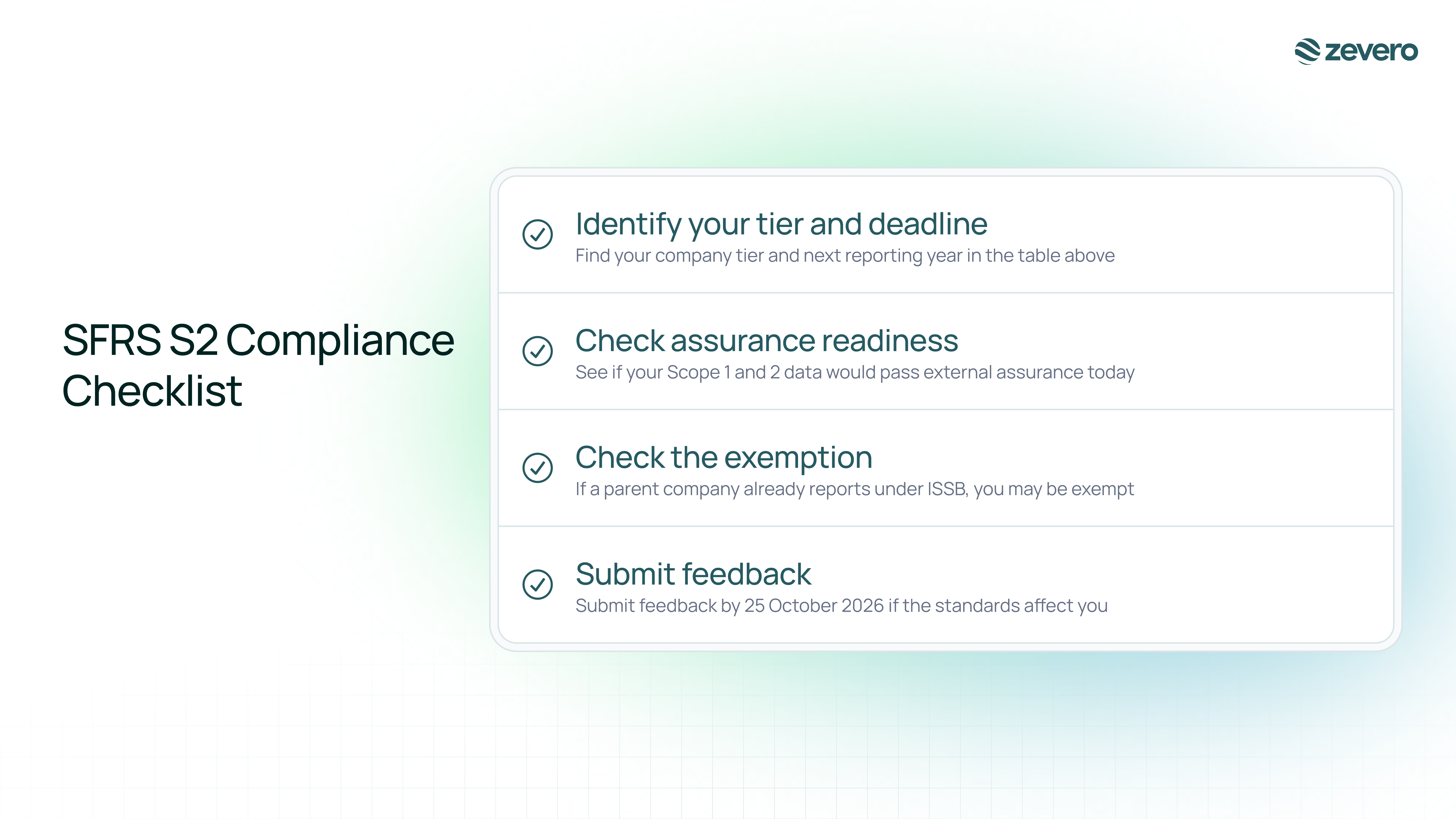
- Identify your tier and deadline. Work out which company tier you fall into and the exact financial year your next obligation lands, using the table above.
- Check your assurance readiness. Confirm whether your Scope 1 and 2 data collection would hold up under external assurance, even if your assurance deadline is still years away. Assurance-ready data takes longer to build than most companies expect, and starting early avoids a scramble closer to the deadline.
- Check the exemption criteria. If your company sits under a reporting parent, check the large non-listed company exemption criteria carefully. It may remove an obligation you'd otherwise be planning for.
- Consider submitting feedback. If the standards affect your company materially, submit feedback before the consultation closes on 25 October 2026.
How Zevero can help
Zevero supports companies preparing for SFRS S2, helping them structure their emissions data, close measurement gaps, and build audit-ready Scope 1 and 2 data ahead of the FY2029 and FY2032 assurance deadlines. Whichever tier your company falls into – an STI constituent already reporting, one of the non-STI listed tiers, or a large non-listed company planning ahead of FY2030, the earlier your data foundations are in place, the smoother the transition will be. If you're checking whether the reporting-parent exemption applies to your business, or want to know where your data gaps sit before the consultation closes, get in touch.
FAQs
What happens after the consultation closes on 25 October 2026?
How can companies submit feedback on the proposed standards?
Will SFRS S1 ever become mandatory?
Does SFRS S2 replace Singapore's Carbon Tax Act reporting?
If a company already reports under CSRD or another ISSB-aligned framework, does it still need to report under SFRS S2?

Related posts
Read more

Blog
May 8, 2026
A Guide to Singapore’s BCA Green Mark Certification
A Guide to Singapore’s BCA Green Mark Certification

Read more
Blog
Jan 13, 2025
Driving sustainability with A*STAR, SkillsFuture Singapore, and Zevero
Driving sustainability with A*STAR, SkillsFuture Singapore, and Zevero

Read more
Blog
Feb 12, 2025
What is CSRD? How the Corporate Sustainability Reporting Directive Impacts Businesses Worldwide
What is CSRD? How the Corporate Sustainability Reporting Directive Impacts Businesses Worldwide
See how Zevero can streamline your carbon reporting
Grow your business and reduce your impact