Education

Quick summary
- Green Mark certification is mandatory for new buildings in Singapore and existing buildings undergoing major retrofit. For other existing buildings, it remains voluntary but buildings without it are increasingly disadvantaged in Singapore's commercial property market through lost rent premiums and occupancy rates.
- The carbon data Green Mark requires and the emissions data SGX reporting demands are the same data. Building energy consumption feeds both operational carbon for Green Mark and Scope 1 and Scope 2 for SGX disclosures. Companies should build one data infrastructure that serves both, not two separate processes.
- The MEI regime for energy-intensive existing buildings came into force in Q3 2025, and the new GMI scheme applies to interior fit-out projects from November 2025. Both represent extensions of Green Mark obligations beyond the core buildings scheme.
Singapore's built environment accounts for over 20% of the country's carbon emissions. For the companies that own, occupy, or develop buildings in Singapore, that figure translates into a growing set of regulatory obligations. The BCA Green Mark certification scheme sits at the centre of Singapore's strategy for decarbonising its building stock, and it is becoming harder to treat as a standalone facilities concern separate from corporate sustainability reporting.
From FY2025, all SGX-listed companies must disclose Scope 1 and Scope 2 greenhouse gas (GHG) emissions under Singapore Exchange Regulation (SGX RegCo) requirements aligned with IFRS S2. For sustainability managers and facilities leads at Singapore-based corporations, understanding where Green Mark and ESG reporting obligations overlap is an opportunity to build one data infrastructure that serves both.
What is the BCA Green Mark?
The BCA Green Mark Certification Scheme was launched in January 2005 by the Building and Construction Authority (BCA), Singapore's government agency responsible for the safety, quality, and sustainability of the built environment. It is Singapore's primary green building rating system, designed to evaluate a building's environmental impact and performance across energy efficiency, water use, indoor environmental quality, and other sustainability criteria.
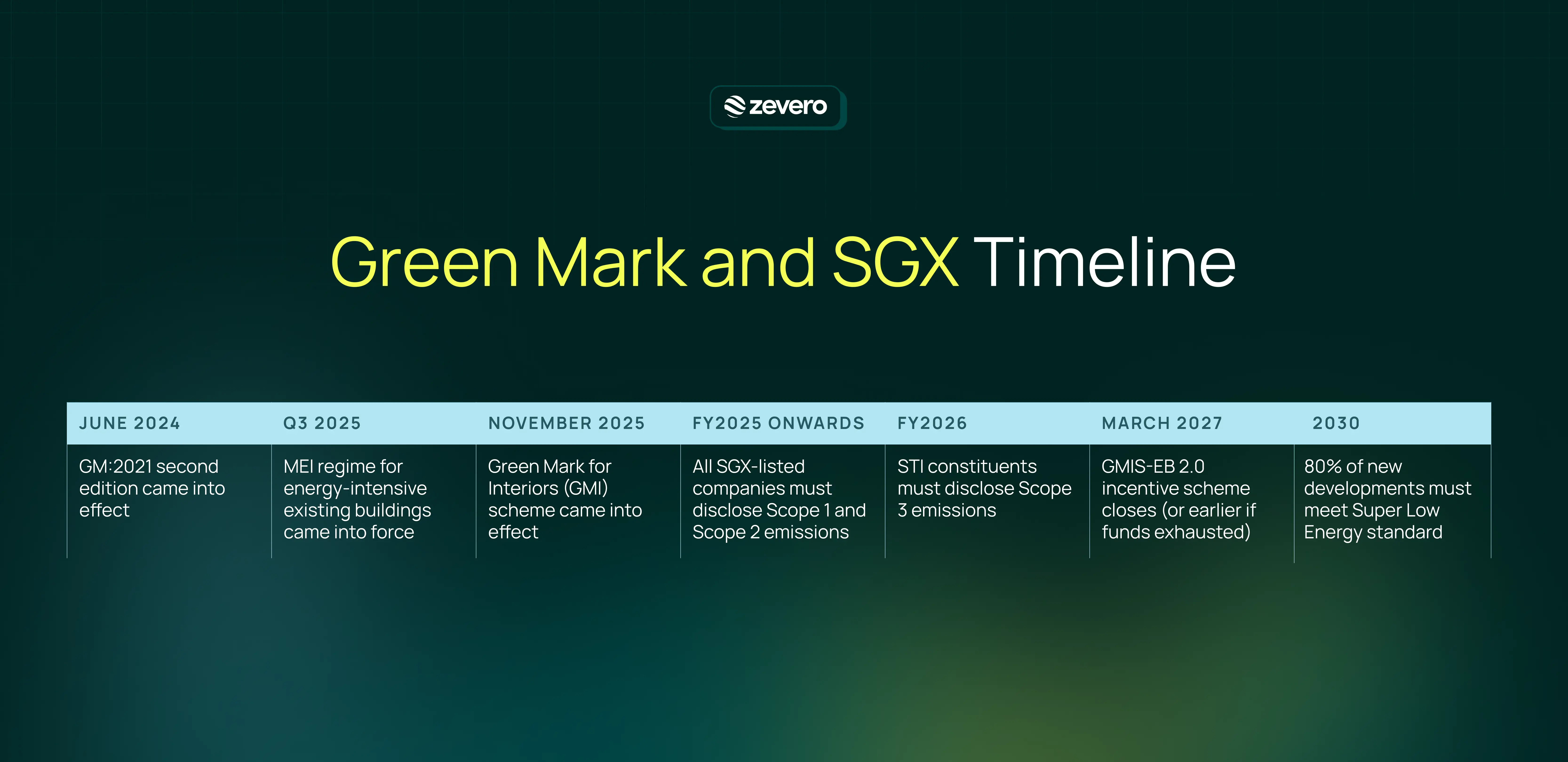
The scheme has been updated several times since its launch. The current version is the second edition of Green Mark 2021 (GM:2021), came into effect on 1 June 2024 as its second edition, superseding the first edition which applied from November 2021 to December 2023. GM:2021 restructures the assessment framework around two broad categories: Energy Efficiency, which is the only prerequisite, and a set of sustainability sections covering whole-life carbon (the total carbon impact of a building across its full lifecycle including construction materials), health and wellbeing, resilience, intelligence, and maintainability.
As of November 2025, a new scheme applied to interior spaces: the Green Mark for Interiors (GMI), which harmonises five previous user-centric schemes into a single framework. All projects applying for Green Mark certification on or after that date are assessed under GMI if they involve interior fit-out works. Companies fitting out office or retail spaces in Singapore need to assess whether their projects fall under GMI rather than the main buildings scheme.
The Green Mark's increasing importance
Green Mark Certification sits within Singapore's broader national sustainability strategy. The Singapore Green Building Masterplan sets out the government's "80-80-80 by 2030" targets: 80% of Singapore's buildings greened by gross floor area (GFA), 80% of new developments meeting the Super Low Energy (SLE) standard from 2030, and 80% energy efficiency improvement for best-in-class buildings over 2005 levels. As of December 2025, close to 66% of Singapore's buildings have been greened. These targets drive where mandatory requirements apply and where voluntary certification sits. The key distinction is between new buildings and existing ones.
For new buildings, Green Mark Certification is mandatory for developers and owners of all new building works with a gross floor area (GFA) of 2,000 m2 or more under the Building Control (Environmental Sustainability) Regulations 2008. Sites sold under the Government Land Sales (GLS) programme are subject to higher mandatory standards, currently requiring Green Mark Platinum SLE as a minimum. The 2030 deadline is set by the SGBMP to align Singapore's building stock with its net zero commitments. It is a phased approach under the Building Control (Environmental Sustainability) Regulations: GLS sites have been subject to mandatory SLE requirements since 2010, with minimum standards for private sector new developments progressively raised through each Green Mark scheme update.
For existing buildings, mandatory requirements apply when buildings undergo major retrofitting works. A Mandatory Energy Improvement (MEI) regime implemented in late 2025 requires owners of energy-intensive buildings to appoint a qualified energy auditor to carry out an energy assessment, with results feeding into building performance improvement requirements. For buildings not undergoing major works, Green Mark Certification remains voluntary. However, a recent market analysis showed that Green Mark buildings in Singapore's CBD commanded rents up to 12% higher than non-Green Mark properties, with consistently higher occupancy rates, making the commercial case for certification increasingly compelling.
How Green Mark Certification works
Green Mark Certification assesses buildings across two categories: Energy Efficiency and Sustainability. Energy Efficiency is the mandatory prerequisite: all projects must demonstrate energy performance improvement against 2005 baseline levels. The three pathways require improvements of 50%, 55%, or 60%, with the 60% threshold constituting the SLE standard. The Sustainability sections, covering whole-life carbon, health and wellbeing, resilience, intelligence, and maintainability, are optional but contribute to the overall Green Mark score and determine which rating tier is achieved.
The scheme operates on four rating tiers: Certified, Gold, GoldPLUS, and Platinum. However, Gold applies only to existing buildings seeking recertification or those that have not undergone major retrofit works. For new buildings, three tiers apply: Certified, GoldPLUS, and Platinum. Platinum typically requires a score of 90 points or above. SLE is an additional designation a building can earn on top of a standard rating tier, or pursue as a standalone track if energy efficiency is the primary goal. A building can hold both a standard rating and the SLE designation, for example Platinum SLE, or pursue SLE independently without seeking a standard rating tier. Projects achieving at least 10 points in any sustainability section receive a badge on their certificate recognising that performance.
The typical certification process takes approximately four to six months, depending on the building's readiness and documentation completeness. For projects receiving a provisional letter after 1 April 2025, the Green Mark Certificate is issued with three years validity from the issuance date. Recertification is required at the end of that period to maintain certified status.
The carbon data requirement
GM:2021 uses the term operational carbon to refer to the greenhouse gas emissions associated with the energy used to run a building. Energy Efficiency is the only mandatory prerequisite in the scheme. Buildings must demonstrate energy performance improvement through one of three pathways, with actual energy consumption data used to calculate the building's operational carbon footprint. At GoldPLUS and Platinum tiers, buildings must also address whole-life carbon, which extends beyond operational emissions to cover the embodied carbon locked into construction materials.
For existing buildings pursuing recertification or operating under the MEI regime, a single point-in-time calculation is not sufficient. Ongoing energy monitoring and performance data are required for verification, meaning building operators need continuous, auditable emissions records maintained across the certification cycle.
Green Mark and SGX reporting
The carbon data required for Green Mark Certification and the emissions data required under Singapore's climate disclosure frameworks draw on the same underlying information. For companies navigating both obligations, understanding where they overlap prevents double work and makes compliance more manageable.
SGX Listing Rules require all listed issuers to disclose Scope 1 and Scope 2 emissions from their financial year commencing on or after 1 January 2025. For Straits Times Index (STI) constituents, the top 30 SGX-listed companies by market capitalisation, Scope 3 disclosure is mandatory from FY2026. The energy consumption, fuel use, and refrigerant data that building operators collect for Green Mark purposes is the same data that feeds Scope 1 and Scope 2 calculations for SGX reporting.
There are two practical implications. Companies that have already built robust energy monitoring and carbon data infrastructure for Green Mark purposes have a significant head start on SGX emissions disclosure. Companies approaching SGX reporting for the first time should assess whether the building-level data already being collected can be structured to serve both obligations, rather than building separate data collection processes for each.
Managing the data behind Green Mark Certification
For Singapore-based companies navigating both Green Mark and SGX obligations, Zevero brings building energy and emissions data together in one place:
- Centralise building energy and emissions data across Singapore property portfolios, so the operational carbon data Green Mark requires feeds directly into Scope 1 and Scope 2 disclosures without duplication
- Structure Scope 1 and 2 data to meet SGX requirements, with methodology aligned to GHG Protocol and IFRS S2, and audit-ready documentation built into the process
- Connect building-level data to the broader corporate carbon footprint, so energy performance at asset level feeds corporate-level emissions reporting
For companies pursuing higher-tier Green Mark Certification, the whole-life carbon section of GM:2021 requires product-level environmental data from construction materials. Zevero supports companies in producing verified Environmental Product Declarations that feed directly into whole-life carbon calculations, contributing points toward GoldPLUS and Platinum certification.
FAQs
Does Green Mark certification apply to tenants as well as building owners?
What financial incentives are available for Green Mark certification?
What happens if a building's Green Mark certification lapses?
Does Green Mark certification affect access to green finance in Singapore?
How does Green Mark interact with LEED or other international green building standards?

Related posts

Read more

Blog
Oct 3, 2024
Preparing for SGX’s New Climate Reporting Mandates: What You Need to Know
Preparing for SGX’s New Climate Reporting Mandates: What You Need to Know
Read more
Blog
Mar 25, 2026
How to Get More Value from Your EPD Data
How to Get More Value from Your EPD Data
Read more
Blog
Jul 25, 2025
What is an EPD? A guide to Environmental Product Declarations
What is an EPD? A guide to Environmental Product Declarations
See how Zevero can streamline your carbon reporting
Grow your business and reduce your impact