Policy


Quick summary
- Mexico has two mandatory sustainability reporting frameworks: NIS and CNBV. The CINIF NIS applies to entities using NIF, including private companies. The CNBV Resolution applies to listed issuers and requires full alignment with IFRS S1 and S2. Listed companies are subject to both.
- First reports are due in 2026 covering 2025 data. No comparative period or external assurance is required in the first cycle, but limited assurance becomes mandatory for listed issuers in 2027.
- The two frameworks differ structurally. NIS disclosures sit in the notes to financial statements with no materiality assessment. The CNBV Resolution requires a standalone sustainability report based on what is material to the business.
Mexico is one of Latin America's largest economies and a significant node in global supply chains, particularly for companies with operations in the US or Europe. In 2025, Mexico became the first country in North America to mandate sustainability reporting. But unlike most jurisdictions that have adopted a single framework, Mexico has two running in parallel: one covering a wide range of companies including private ones, and a separate, more stringent requirement for publicly listed issuers. Most coverage of this topic treats them as one thing. This blog does not.
First reports under both frameworks are due in 2026, covering 2025 data. The baseline year is already underway. For companies with operations, subsidiaries, or supply chain exposure in Mexico, this is not a future consideration.
Mexico's dual reporting framework
Two separate instruments, published by two separate bodies, apply to different populations of companies. A listed company is subject to both. A private company is subject to only one.
The CINIF NIS
CINIF, the Consejo Mexicano de Normas de Información Financiera y Sostenibilidad (Mexico's Council for Financial Information Standards and Sustainability), published the first two Mexican Sustainability Reporting Standards, NIS A-1 and NIS B-1, on 13 May 2024. They entered into force on 1 January 2025.
Who it applies to
The NIS applies to any entity that prepares financial statements under Mexico's NIF (Normas de Información Financiera – Mexican Financial Reporting Standards). This includes private companies and Mexican subsidiaries of foreign multinationals using NIF. Entities using IFRS Accounting Standards or US GAAP are not required to provide NIS disclosures.
What it requires
The NIS framework comprises two standards that work together. NIS A-1 establishes the conceptual framework and foundational principles for sustainability disclosures, including the quality requirements all disclosures must meet. NIS B-1 builds on this foundation by setting out the 30 IBSOs (Indicadores Básicos de Sostenibilidad – Basic Sustainability Indicators) that entities must report, covering three categories:
Environmental (16 indicators): Scope 1, 2, and 3 greenhouse gas (GHG) emissions, reported in carbon dioxide equivalent (CO₂e), energy consumption including renewables, water use and discharge, waste generated and reused, biodiversity near operations, and dependence on ozone-depleting substances.
Social (6 indicators): Gender pay gap, training hours, occupational accidents, and equal opportunity and health and safety policies.
Governance (8 indicators): Board composition including percentage of women, independent supervisory body, code of ethics, data privacy policy, risk management policy, and sustainability strategy.
For quantitative indicators, both absolute and relative values are required. For example, total Scope 1 emissions in tonnes CO₂e and emissions per unit of revenue must both be disclosed. Scope 3 emissions and sustainable investment disclosures may be deferred from the 2026 report, but companies using this relief must say so explicitly; it is not a permanent exemption.
How NIS differs from IFRS
Three differences are worth making explicit for companies familiar with IFRS S1 and S2:
- There is no materiality assessment. All 30 IBSOs must be reported regardless of their relevance to the business. Even if a value is zero, it must be disclosed.
- Disclosures sit in the notes to the annual financial statements. There is no separate sustainability report under the NIS.
- The NIS are not a full adoption of IFRS S1 and S2.Governance, risk management, and sustainability-related financial disclosures are not yet required. CINIF has committed to issuing climate-specific NIS in a future phase, treating the current standards as a stepping-stone toward fuller IFRS alignment.
The CNBV Resolution
The CNBV (Comisión Nacional Bancaria y de Valores – Mexico's National Banking and Securities Commission) published modifications to its general securities provisions, the CUE (Circular Única de Emisoras), on 28 January 2025 in the DOF (Diario Oficial de la Federación – Mexico's official government gazette). The Resolution became effective on 29 January 2025.
Who it applies to
The Resolution applies to entities whose securities are registered with the RNV (Registro Nacional de Valores – Mexico's National Securities Registry), supervised by the CNBV. It covers both domestic and foreign issuers. The regulation applies to an estimated 86% of the market capitalisation of Mexico's main equity index. Federal entities, municipalities, and financial institutions are currently exempt. Mexico's banking regulators are evaluating equivalent requirements for financial institutions.
Foreign issuers may comply using home-country standards, provided they document how their home-country framework meets the same requirements as IFRS S1 and S2.
What it requires
Securities issuers must submit a sustainability information report prepared in accordance with the IFRS Sustainability Disclosure Standards issued by the International Sustainability Standards Board (ISSB), comprising IFRS S1 General Requirements for Disclosure of Sustainability-related Financial Information and IFRS S2 Climate-related Disclosures.
Unlike the NIS, this is a principles-based framework, meaning companies disclose based on what is material to their business rather than following a fixed list of indicators, structured around four disclosure pillars: governance, strategy, risk management, and metrics and targets. IFRS S2 specifically requires disclosure of climate-related risks and opportunities (both physical and transition), scenario analysis, Scope 1, 2, and 3 emissions, and targets and transition plans.
Key structural difference from the NIS
Listed issuers must produce a standalone annual sustainability report, separate from their financial statements, published at the same time as those statements. There is no fixed indicator list. Companies disclose what is material to their business.
Who needs to comply, and with which framework?
- Preparing financial statements under NIF? The CINIF NIS applies. This covers most Mexican entities including private companies and subsidiaries of foreign multinationals using NIF.
- Listed on Mexico's RNV or BMV (Bolsa Mexicana de Valores – Mexico's stock exchange)? The CNBV Resolution applies in addition to the NIS. Full IFRS S1 and S2 compliance and a standalone sustainability report are required.
- Foreign company with a separately listed Mexican subsidiary? The CNBV Resolution applies to that subsidiary independently. Foreign issuers may use home-country standards if equivalence with IFRS S1 and S2 is documented.
- Financial institution? Currently exempt from the CNBV Resolution. Monitor for updates as equivalent requirements are being evaluated.
- Multinational with Mexican operations, not listed in Mexico? The NIS may apply if the entity reports under NIF. CSRD parent company obligations, supply chain requirements, or investor questionnaires may also independently require disclosure.
On penalties: No fiscal penalties currently exist for NIS noncompliance. However, the CNBV can impose administrative fines on listed issuers, issue public notices of noncompliance, and restrict access to capital markets or new securities issuance. For private companies under the NIS, there are no regulatory penalties. However, non-disclosure carries commercial consequences: exclusion from supply chains where customers require sustainability data, and restricted access to bank financing as lenders increasingly require ESG disclosures.
What good preparation looks like
The 2026 reporting deadline covers 2025 data. There are four areas that warrant attention now.
- Start data collection now. Scope 1 and 2 data should be the starting point for both frameworks. Scope 3 collection should begin even if the first-cycle exemption applies under the NIS, since building supplier engagement and data collection infrastructure takes time. The CNBV Resolution requires full Scope 3 disclosure, so listed issuers should not treat the NIS exemption as a reason to defer.
- Align with the ISSB baseline from the outset. The CNBV Resolution uses IFRS S1 and S2, which is the same baseline as CSRD, Australia's climate standards, Singapore's requirements, and others. Companies that build against ISSB once cover multiple jurisdictions rather than building separate processes for each.
- Understand which framework, or both, applies to each entity. A parent company reporting elsewhere does not automatically cover a Mexican subsidiary. Verify registration status with the RNV directly for each entity in scope.
- Build for assurance readiness before 2027. Data governance and internal controls need to be in place before the 2027 assurance deadline, not retrofitted after it.

Preparing for Mexico's sustainability reporting requirements
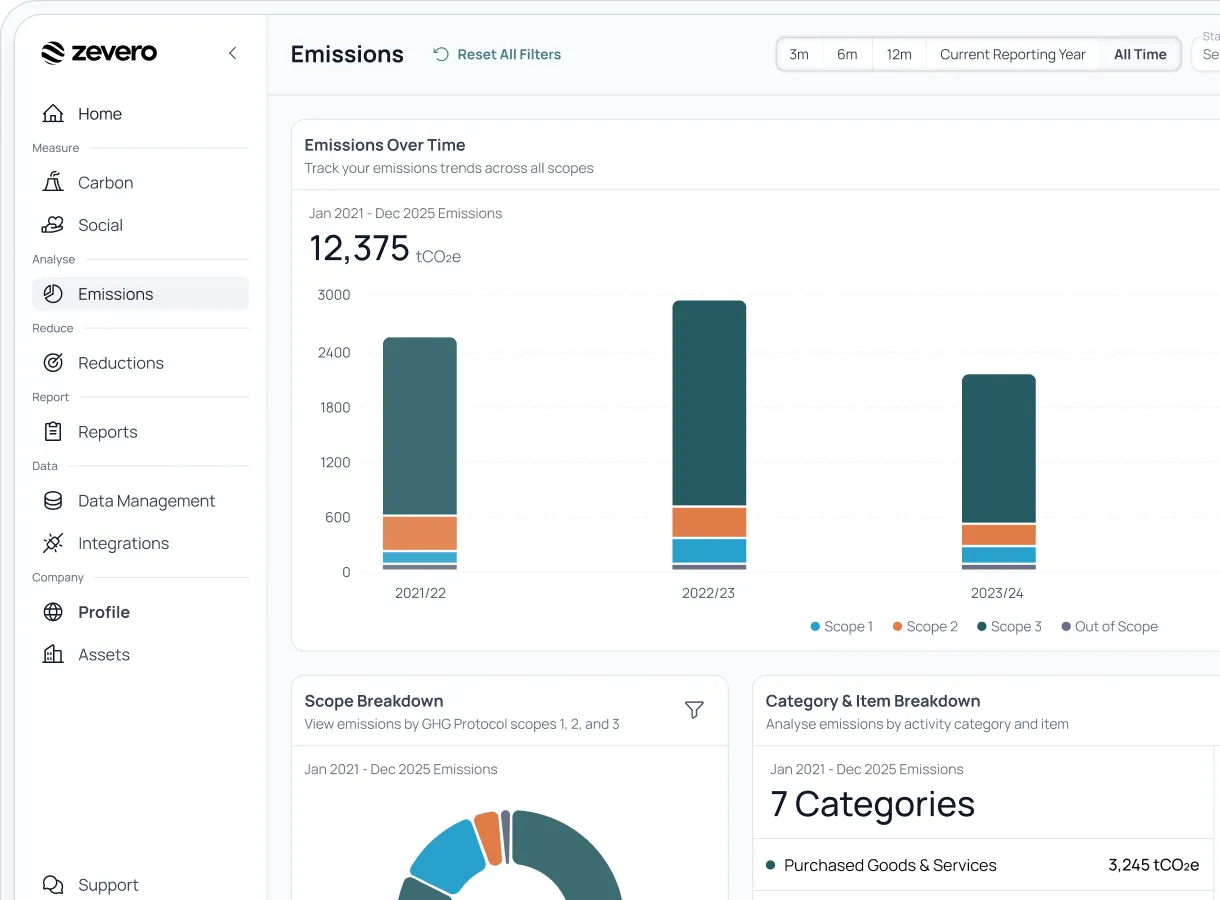
Mexico's dual framework marks a significant shift from voluntary best practice to mandatory disclosure with regulatory oversight, applying to both listed and private companies. For companies with operations or supply chain exposure in Mexico, the question is not whether to comply but how well prepared they will be when the first reporting cycle arrives. Zevero helps companies build the data infrastructure that NIS and CNBV Resolution compliance, and broader ISSB-aligned reporting, requires:
- Measure Scope 1, 2, and 3 emissions using methodology aligned with the GHG Protocol and IFRS S2, with audit-ready documentation built into every calculation
- Build a robust carbon data foundation covering Scope 1, 2, and 3 emissions, and support wider environmental disclosures through lifecycle assessment (LCA) data where required
- Build toward assurance readiness from the first reporting cycle using Zevero’s ESG Disclosure Reporting service, which produces audit-ready reports with full methodology documentation and data trails, making the 2027 limited assurance requirement a process step rather than a last-minute rebuild
Mexico's 2026 deadline is the starting line, not the finish line. The companies that treat it as a foundation for ongoing, auditable sustainability data will be better placed for every reporting obligation that follows. See how Zevero can help build that foundation.
FAQs
What language must reports be submitted in?
Do the NIS apply to Mexican subsidiaries of foreign parent companies?
How do the NIS and CNBV Resolution differ from CSRD?
Is Mexico's NIS framework likely to expand in scope in future?
What is the difference between limited and reasonable assurance?
Thanks for reading!
Mexico's Sustainability Reporting Standards: The CNBV Resolution and NIS Explained
Add us as a preferred source

Related posts

Read more

Blog
Dec 31, 2025
UAE Climate Law: What Businesses Need To Know
UAE Climate Law: What Businesses Need To Know
Read more
Blog
Apr 13, 2026
Philippines Sustainability Reporting: A Guide to PFRS S1 and S2
Philippines Sustainability Reporting: A Guide to PFRS S1 and S2

Read more
Blog
Oct 3, 2024
Preparing for SGX’s New Climate Reporting Mandates: What You Need to Know
Preparing for SGX’s New Climate Reporting Mandates: What You Need to Know
See how Zevero can streamline your carbon reporting
Grow your business and reduce your impact