Policy


Quick summary
- The UAE Climate Change Law applies to all entities generating GHG emissions in the UAE with no size or sector threshold.
- Scope 1 & 2 reporting is mandatory by 30 May 2026. Scope 3 reporting is anticipated to become mandatory from 2027.
- Voluntary ESG reporting does not satisfy the law. Compliance requires registration on the national MRV platform, a structured reduction plan, and maintaining records for up to five years.
- Non-compliance carries fines of up to AED 2,000,000, doubling to AED 4,000,000 for repeat violations within two years.
The UAE's Climate Law is now in force. Businesses operating in the UAE have until 30 May 2026 to comply with legally binding requirements to measure, report, and reduce their greenhouse gas emissions. For many organisations, this represents a meaningful shift: from voluntary climate commitments to enforceable regulatory obligation, with financial penalties for non-compliance.
In this post, we break down what the law requires, who it applies to, and what businesses need to do before the deadline.
What is the UAE Climate Law?
The law, formally titled Federal Decree Law No. 11 of 2024 on the Reduction of the Effects of Climate Change, was issued on 28 August 2024 and entered into force on 30 May 2025. The full compliance deadline for all entities is 30 May 2026. It supports the UAE’s Net Zero 2050 target and commitments under the Paris Agreement by aiming to reduce greenhouse gas emissions across the economy while strengthening climate adaptation and resilience. The law is overseen by the Ministry of Climate Change and Environment (MOCCAE), which sets reporting methodologies, sector-specific standards, and enforcement mechanisms.
Who does the law apply to?
The law applies to all public and private entities in the UAE (including free zones and state-owned enterprises) that generate greenhouse gas emissions. There is no minimum size or turnover threshold, and no sector exemptions. If your UAE operations produce GHG emissions, you are in scope.
What is required?
The law creates four categories of obligation for in-scope entities.
1. Measure and report emissions through the national MRV platform
Entities must measure and report GHG emissions regularly through MOCCAE's national Integrated Emissions Quantification Tool (IEQT), accessible at mrv.ae. Compliance involves registering on the platform, creating an administrator account, assigning roles for data provision and validation, and receiving approval from the relevant emirate-level focal point. The IEQT then guides emissions calculation and inventory preparation, with data submitted on an annual cycle.
Entities with operations in Abu Dhabi should also note that a parallel process may apply through the Environment Agency Abu Dhabi's Enhanced Transparency Framework MRV system, which links to the national platform.
2. Submit a reduction plan
Beyond measurement, entities must submit data on current and planned emissions reduction measures, including the expected results of those measures.
3. Actively contribute to emissions reduction
The law requires each entity to contribute to emissions reduction through at least one of the following: improving energy efficiency, using clean energy, enhancing and protecting natural carbon sinks, carbon capture use and storage (CCUS), using alternatives to saturated fluorocarbons, carbon offsetting, or implementing integrated waste management.
4. Retain supporting records
All records supporting emissions data must be retained for a minimum of five years and must be accessible to MOCCAE on request.
What about Scope 3?
While Scope 1 and 2 reporting is mandatory starting in 2026, Scope 3 reporting is anticipated to become mandatory from 2027, though this is not yet confirmed in law and should be treated as expected rather than certain. Organisations building compliance infrastructure now should consider whether their approach can extend to supply chain emissions data when that obligation arrives. Rebuilding a measurement and reporting process in 12 months is a significant cost that a platform-based approach can avoid.
Additional requirements for large emitters
A separate legal instrument, Cabinet Resolution 67/2024, sits alongside the UAE Climate Law and applies specifically to entities emitting 0.5 million metric tonnes or more of CO₂ equivalent per year (Scope 1 and 2 combined). These entities —defined as "Entities of Huge Carbon Emission" — are required to register with the National Carbon Credit Registry, prepare a GHG inventory aligned with ISO 14064, and obtain third-party verification from a MOCCAE-approved verifier.
The registration deadline for large emitters was 28 June 2025. Entities below the 0.5 MtCO₂e threshold may participate voluntarily.
Voluntary sustainability reports are not compliant
Notably, organisations that produce voluntary ESG reports, whether aligned to GRI, TCFD, CDP, or other frameworks, are not automatically compliant with UAE Climate Law. The regulation requires registration on the national MRV platform, structured submission of a formal reduction plan, and records maintained in a format accessible for regulatory review. These are specific, procedural obligations; a narrative-style disclosure will not be sufficient.
What are the penalties for non-compliance?
Administrative fines for non-compliance range from AED 50,000 to AED 2,000,000 for a first violation. For repeat offences within two years, penalties double, reaching up to AED 4,000,000. Additional administrative penalties are expected to be defined by future Cabinet resolution; these have not yet been published.
How Zevero supports businesses with the UAE Climate Law
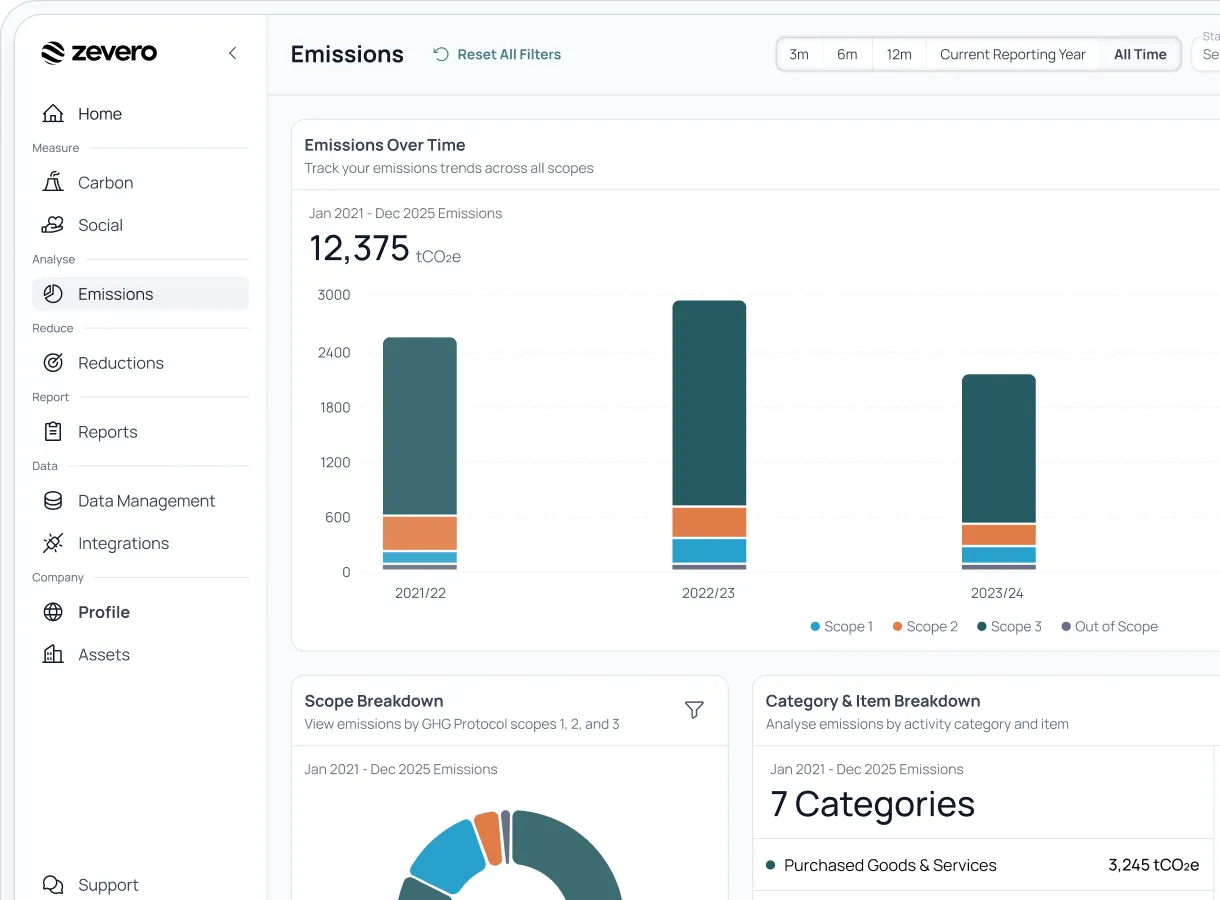
Zevero works with teams to bring carbon data into one place, helping them calculate and maintain a clear, auditable footprint across Scope 1, 2, and 3. Our in-house sustainability experts support methodology and reporting, making it easier to respond as regulatory guidance develops without needing to rebuild processes each time requirements change.
We work with teams that want to:
- Build a clear, repeatable approach to measuring carbon footprints
- Keep carbon data consistent and auditable over time
- Prepare for regulatory and disclosure requirements as they develop
- Improve confidence in the quality and traceability of carbon data
FAQs
Does the law apply if we're registered in a free zone but have limited physical operations there?
What methodology does MOCCAE require for calculating emissions?
Do we need third-party verification of our GHG inventory?
Our group already reports under CSRD or UK SRS. Does that satisfy the UAE requirement?

Related posts

Read more

Blog
Jun 3, 2025
SECR Reporting: A Guide for UK Businesses
SECR Reporting: A Guide for UK Businesses
.webp)
Read more
Blog
Oct 14, 2025
The UK Sustainability Reporting Standards (UK SRS) Explained
The UK Sustainability Reporting Standards (UK SRS) Explained

Read more
Blog
Oct 3, 2024
Preparing for SGX’s New Climate Reporting Mandates: What You Need to Know
Preparing for SGX’s New Climate Reporting Mandates: What You Need to Know
See how Zevero can streamline your carbon reporting
Grow your business and reduce your impact