Policy

The EU Carbon Border Adjustment Mechanism (CBAM) has moved from a reporting exercise to a financial obligation. From January 2026, every import of covered goods – steel, aluminium, cement, fertilisers, hydrogen, electricity – creates direct certificate cost exposure. The number of certificates you must surrender is determined by the embedded emissions of those goods. That number depends entirely on the quality of the data your suppliers provide.
For most importers, supplier data collection is the single biggest operational challenge standing between them and a compliant CBAM declaration. This guide covers what data you need, how to collect it, and what to do when suppliers don’t engage.
Why existing supplier sustainability data won’t work
ESG reports, supplier surveys, and life cycle assessments (LCAs) cannot be repurposed for CBAM. Generic sustainability data typically relies on industry averages and sector-level estimates. CBAM requires granular, installation-level emissions data calculated using the EU’s Monitoring and Reporting Regulation (MRR) methodology – tied to the specific facility where goods were produced. Environmental Product Declarations (EPDs) and LCAs, while useful for other sustainability reporting, do not meet this standard. Submitting them in place of MRR-aligned data will not satisfy CBAM requirements.
The default values permitted during the transitional period – October 2023 to December 2025 – are also no longer sufficient. From 2026, those values are not a standard fallback option. If you have been relying on them, that period is over.
What data you actually need from suppliers
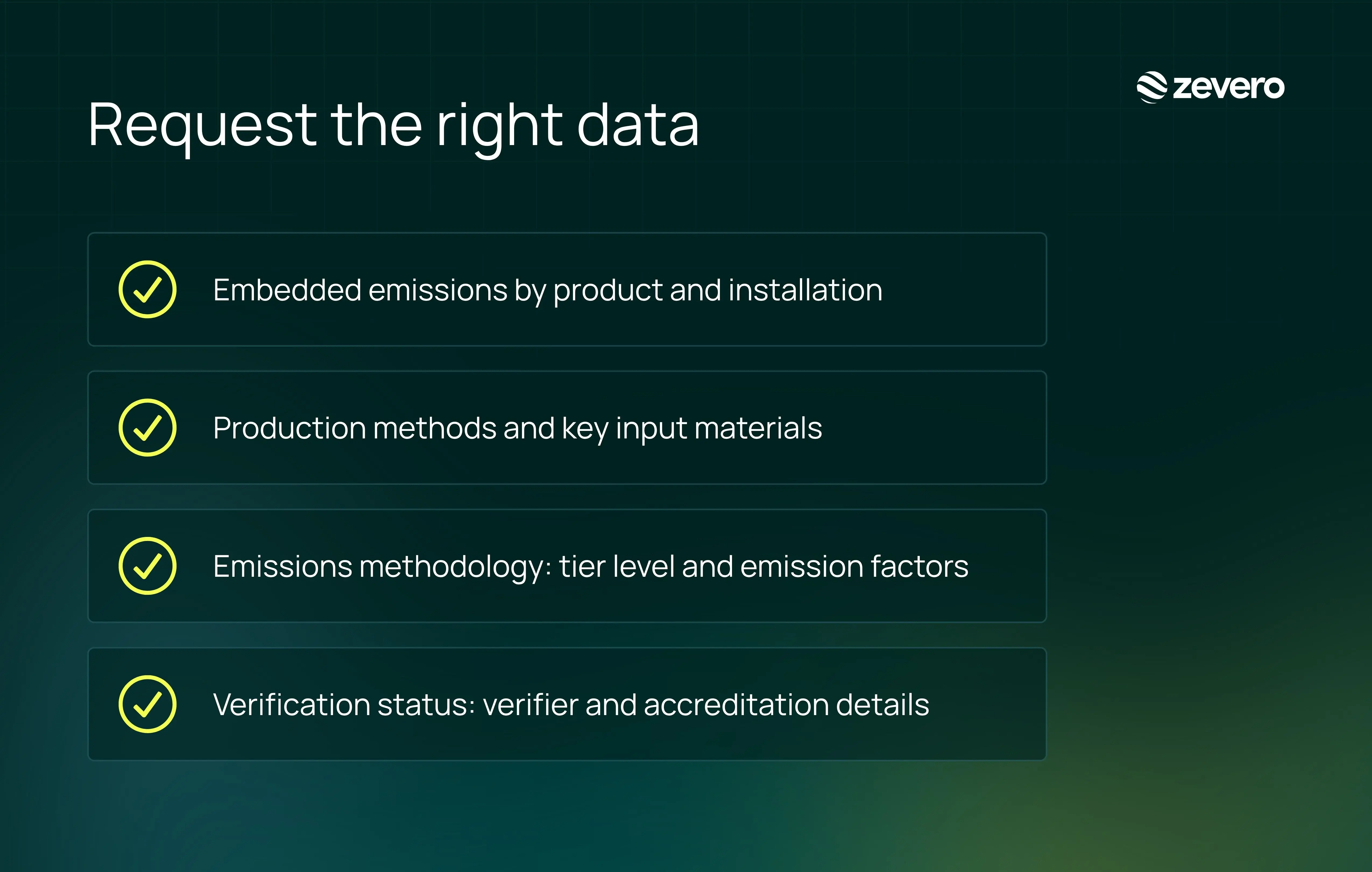
Collecting compliant CBAM data is not simply a matter of asking suppliers for their carbon footprint. The regulation specifics what must be measured, how it must be calculated and who must verify it. Most suppliers exporting to the European Union (EU) will not have produced data in this format before, which means your request needs to be precise enough to guide them through it. The minimum requirement covers four areas:
- Embedded emissions at installation and product level. Emissions must be tied to the specific production facility and product – not corporate averages. Data must be broken down into direct (Scope 1) and indirect (Scope 2) components, and structured in line with the EU's Annex IV communication template, which sets the formatting standard for supplier submissions.
- Production methods and input materials. Suppliers must provide production processes and routes, quantities and types of fuels, energy, and raw materials used, and system boundaries as defined in CBAM’s Annex II – for example, the specific kiln type for cement or the production route for steel.
- Calculation methodology. Importers need to know the tier level used (Tier 1 to 4 under MRR standards), the emission factors and activity data sources applied, and whether any approved default or fallback values were used. Until July 2024, fallback values could cover up to 100% of embedded emissions. That threshold dropped to 20% from July 2024, and from January 2026, fully verified MRR-aligned data is expected in full. Any reliance beyond permitted limits overstates emissions and increases your certificate liability directly.
- Third-party verification. As of 1 January 2026, verification by an accredited third party is mandatory. Collect verifier credentials, dates of verification and confirmation that the data has been uploaded to the CBAM registry by the supplier.
How to structure your outreach
Who to contact
Don't send requests to general sales or account contacts. They typically don't have access to installation-level emissions data. The right contacts are in sustainability or climate reporting, EHS, site operations or plant management, and occasionally quality assurance or technical product leads at the production facility itself. The key is reaching someone with sight of how the facility operates, not someone managing the commercial relationship.
What to send
Send a structured data request that includes a pre-formatted template aligned with the Annex IV format, a clear submission deadline, a named internal contact for questions, and explicit guidance on what happens if data is missing or late. Include a completed sample to reduce the likelihood of suppliers returning incorrectly formatted files. The less ambiguity in the request, the fewer follow-up cycles you will need.
How to track and escalate
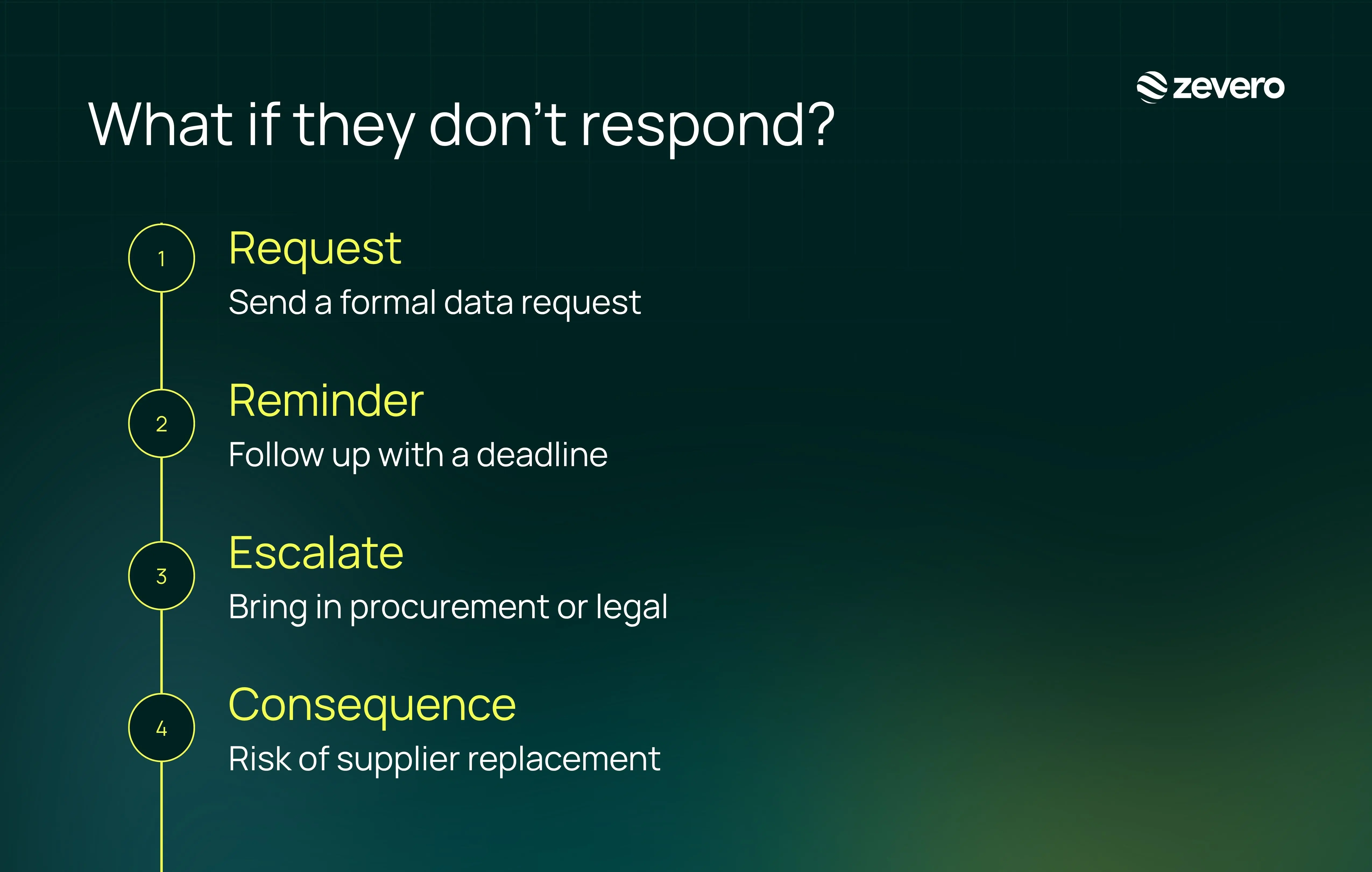
Maintain a central log of outreach status across all affected suppliers. Set a single reminder after the initial request, then escalate to procurement or legal if there is no response. Be explicit about consequences from the outset – vague requests produce vague responses.
For suppliers who remain unresponsive, here is a short escalation message:
Dear [Supplier],
This is a follow-up to the emissions data request we sent on [date]. As part of our EU CBAM compliance obligations, we must receive verified embedded emissions data for your product by [deadline]. If we do not receive a complete response, we will be unable to continue sourcing CBAM-regulated goods from your facility. Please contact [name] immediately if you need support or clarification.

The data quality problem and what it costs
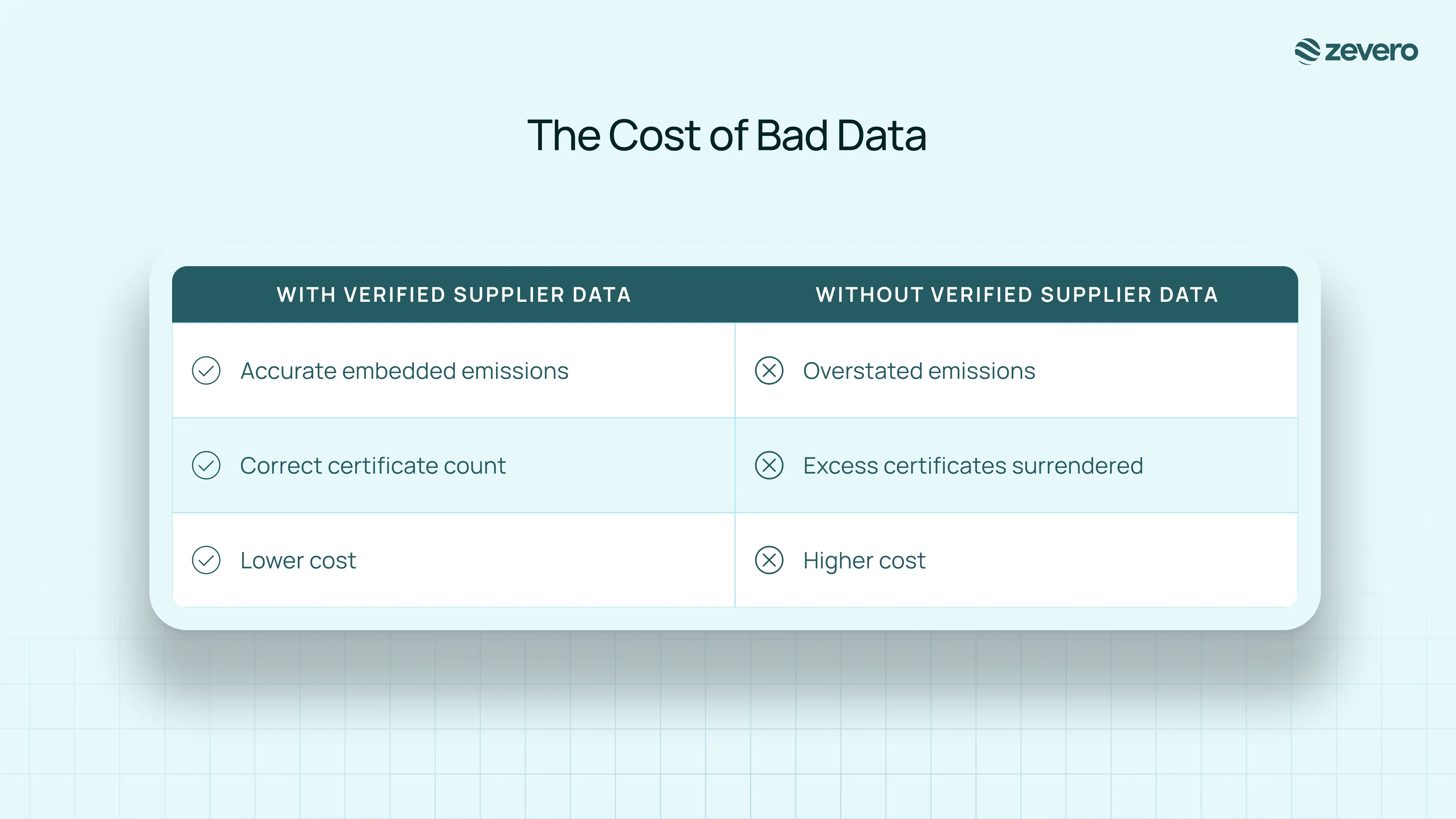
Poor supplier data does not just create a compliance risk, it creates a direct financial one. If installation-level data cannot be obtained, importers may be forced into conservative fallback approaches that overstate emissions, increasing the number of certificates that must be surrendered. The cost of building a robust supplier data collection process is almost always lower than the cost of overclaiming. CBAM certificate prices track EU ETS allowances, which ranged between €60 and €80 per tonne in early 2025. Every tonne of overstated emissions is an unnecessary certificate purchase. Across a large import programme, that gap compounds quickly. Getting the data right is not just a compliance task, it is a cost management decision.
When suppliers don't engage
Supplier non-engagement is common, particularly where the production facility operates in a jurisdiction with limited familiarity with EU carbon regulation. The response should be proportionate and sequenced. Start with support: many suppliers lack internal capacity to produce MRR-aligned data rather than willingness. Providing clear guidance, template files, or access to third-party technical assistance can move a non-compliant supplier into compliance faster than escalation alone.
Where capacity is not the issue, embed CBAM data obligations formally into supplier contracts. Set clear expectations on timelines, data quality, and verification. For suppliers who comply, preferred supplier status or commercial incentives reinforce the right behaviour. For installations that remain persistently non-compliant, switching suppliers is a legitimate and sometimes necessary outcome. This is not a theoretical risk management step, it is a practical response to a regulation that creates direct financial exposure for every non-compliant import.
Connect CBAM compliance to your broader climate programme
Supplier emissions data collected for CBAM has value beyond certificate management. The same installation-level data supports scope 3 measurement, decarbonisation target-setting, and procurement-based emissions reduction. Zevero helps companies manage CBAM supplier data as part of a connected sustainability programme:
- Comprehensive emissions tracking across direct operations and the entire value chain, so that embedded emissions can be calculated accurately at the product level, not just estimated at a company-wide level. This is critical when reporting carbon intensity for specific imported goods under CBAM.
- Transparent carbon accounting methodology aligned with recognised frameworks like the GHG Protocol, so businesses can demonstrate a clear, defensible approach to investors and auditors.
With the definitive phase now under way, businesses that build robust emissions data systems now will face significantly lower compliance risk and avoid unnecessary carbon costs compared to those scrambling to retrofit systems later.
Speak with our team to see how we help connect CBAM compliance to wider sustainability strategy.
What is the deadline for the first annual CBAM declaration?
What is the penalty for non-compliance?
Can I deduct carbon costs already paid in the country of origin?
How does CBAM interact with our existing Scope 3 reporting?

Related posts
Read more

Blog
Feb 5, 2026
CBAM Explained: The EU Carbon Border Adjustment Mechanism
CBAM Explained: The EU Carbon Border Adjustment Mechanism

Read more
Blog
Apr 28, 2025
The Key Role of Supplier Engagement in Scope 3 Reporting
The Key Role of Supplier Engagement in Scope 3 Reporting
See how Zevero can streamline your carbon reporting
Grow your business and reduce your impact