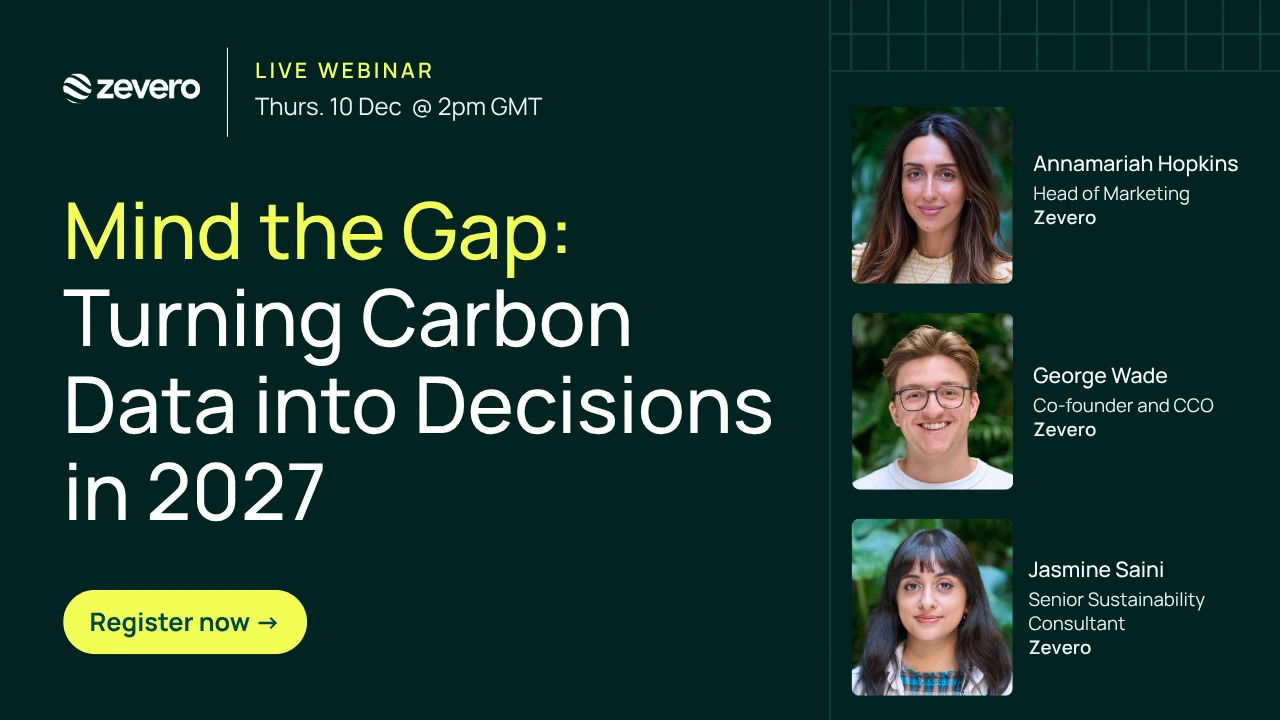
Mind the Gap: Turning Carbon Data into Decisions in 2027
97% of UK businesses say they measure emissions in some way, but less than one in five make that data a standard input to decisions. Unpack the 2026 UK Carbon Data Benchmark results and see the role of carbon data in organisations and how it's shaping deals.
Sign up to join the webinar
Thursday 10 December 2026, 2:00pm GMT · Live online
The large majority of UK businesses now collect carbon data in some format. Far fewer use it to make decisions, give it a clear owner, or can produce a credible figure while a deal is still live.
Customers, retailers, and lenders increasingly ask for emissions data before they commit. 2 in 5 commercial opportunities now require it. Yet only 19% of UK companies consistently consider it when making decisions, and 63% have lost or delayed a commercial opportunity in the last two years because their carbon data was incomplete or inaccessible.
Most carbon-related research only involves sustainability teams. This time, we went further.
The UK Carbon Data Benchmark 2026 surveyed decision-makers at companies with 100 or more employees, and four in five work outside sustainability. They're the finance, procurement, operations, and commercial leaders who now need carbon figures to win tenders, choose suppliers, and sign off on investment. They told us how their organisations use carbon data, how long it takes to access a credible number when it's needed, and what it has won or cost them.
Join experts from Zevero as we go over what the research found, and what it means for how you plan 2027.
What you'll learn
- Where you stand against 502 UK companies in how carbon data is used across the organisation, and what that means for winning tenders, contracts, and finance.
- Why carbon data stalls before it reaches a decision, what the delay is costing in lost and delayed opportunities, and how to shorten the time.
- How to tell if your data will hold up when it counts, before a customer, tender, or lender puts it to the test.
- The three practices that set the top performers apart, and how each links to winning business, securing finance, and bringing lower-carbon products to market.
- Where to focus time and budget in 2027 so your carbon data starts helping you win work and secure finance.
Can't join live? Register anyway and we'll send the recording and slides.
Who should attend
Sustainability leads, and the finance, procurement, operations and commercial colleagues who need carbon figures to win work, choose suppliers or sign off investment.
Meet the Speakers

Annamariah Hopkins - Head of Marketing, Zevero (Moderator)
Annamariah leads the global marketing strategy at Zevero and has helped build the company’s marketing function from the ground up. She brings more than four years’ experience in climate tech marketing, including a focus on supply chain sustainability during her roles at Sphera and SupplyShift. Annamariah spearheaded the UK Carbon Data Benchmark 2026, applying an academic research background that includes work published in peer-reviewed journals and featured in Cosmopolitan magazine.

George Wade - Co-founder & Chief Commercial Officer, Zevero
In his role at Zevero, George drives commercial growth by helping brands measure, reduce, and report their carbon emissions. He brings a deep passion for using data-driven solutions to fight climate change, drawing from his experience as a former carbon consultant in waste management. George also writes The Grumpy Optimist, a newsletter highlighting positive climate news.

Jasmine Saini - Senior Sustainability Consultant, Zevero
In her role at Zevero, Jasmine helps businesses build carbon data they can stand behind, from Scope 1, 2, and 3 footprints to the figures that go into tenders, supplier reviews, and investment cases. She brings five years of experience in carbon accounting, having started her career at Avieco and Accenture, helping large retail and consumer brands measure Scope 3 emissions.
Discover our resources
View all

Singapore Sustainability Grants: EDGE Grant and CCP-S Guide

Turning Carbon Data into Savings for Food and Beverage

How to Become a B Corp
