Education


Updated October 2026: PPN 06/21 has been replaced by PPN 006 for procurements under the Procurement Act 2023. PPN 006 applies to relevant procurements advertised on or after 24 February 2025; procurements started before that date still follow PPN 06/21. The government describes the update as a change of terminology, not of policy, so the Carbon Reduction Plan requirements below still apply.
The UK government has taken a bold step to embedding sustainability into public procurement processes. This blog explores what PPN 006 and its predecessor PPN 06/21 require, and how they affect businesses. From creating Carbon Reduction Plans (CRPs) to navigating reporting complexities, we’ll cover the essentials for compliance and sustainability success.
What are PPN 006 and PPN 06/21?
PPN 006, and before it PPN 06/21, is a Procurement Policy Note requiring suppliers bidding for major central government contracts, worth more than £5 million a year, to provide a Carbon Reduction Plan (CRP) as a condition of participation.
This policy's goal is to ensure that businesses seeking to work with the government have sustainability, specifically carbon reduction, embedded into the public procurement process. PPN 06/21 took effect in September 2021 and PPN 006 replaced it from 24 February 2025. Both support the UK’s goal of net zero emissions by 2050.
PPN 006 applies to central government departments, their executive agencies and non-departmental public bodies; other public bodies may choose to follow it, and the NHS sets its own Carbon Reduction Plan requirements. For example, a supplier bidding to provide goods or services such as office supplies, IT equipment, or food products for government facilities would be subject to this policy.
Because the CRP is a condition of participation, a bidder that cannot provide a compliant plan can be excluded from the procurement.
What are the key requirements of PPN 006?
- Scope:
- It is not sector-specific and applies to contracts for goods, services or works with an estimated value above £5 million a year, where a CRP is relevant and proportionate to the contract
- The threshold is the contract's estimated value, averaged over its life, so check the advertised value rather than the size of your own part of the work.
- Some government entities e.g. the NHS require a CRP regardless of the contract size.
- Develop a carbon reduction plan (CRP): Suppliers must provide a CRP that meets specific criteria which we will cover in the next section
- Alignment with net zero: The CRP must reflect the supplier’s commitment to achieving net zero emissions by 2050.
- Compliance with GHG Protocol: Reporting must include Scope 1, Scope 2, and some Scope 3 emissions.
- Annual reporting: The CRP must be updated annually to show progress.
Why does PPN 006 matter?
It ensures that sustainability is embedded in public procurement decisions and aims to:
- Promote transparency in carbon reporting
- Reduce the environmental impact of government projects
- Encourage suppliers to adopt greener practices
- Align with the national climate goals
What is a Carbon Reduction Plan (CRP)?
This is the key requirement of PPN 006. It outlines the supplier’s strategy for measuring and reducing emissions and alignment with government expectations. Here are the key elements of a CRP:
- Baseline emissions data: Suppliers must provide emissions data from a defined baseline year.
- Current emissions: A breakdown of Scope 1, Scope 2 and relevant Scope 3 emissions, which we will cover in more detail in the next section.
- Reduction targets: Clearly stated goals for reducing carbon emissions in line with net zero targets.
- Carbon reduction projects: Details of actions the supplier will take to achieve reductions, such as energy efficiency upgrades or sustainable supply chain practices.
- Declaration and sign-off: This plan will need to be signed off by a board of directors or equivalent management body.
Once this plan is created, it must be published and clearly signposted on the supplier's UK website, and updated at least once a year.
The current Carbon Reduction Plan template, technical standard and FAQs are on the PPN 006 page on GOV.UK.
Requirements for emission reporting:
The following is required when assembling the emissions information for the report:
- Scope 1: Direct emissions from sources owned or controlled by the organisation, such as fuel use in company vehicles or on-site heating systems
- Scope 2: Indirect emissions from purchased energy.
- Scope 3: 15 categories have been defined by the GHG Protocol and the following 5 are required to be defined in a CRP:
- Upstream transportation and distribution: Emissions from the transportation of materials to your business e.g. the delivery of raw materials from a supplier
- Waste generated in operations: Emissions from waste processing or landfill use e.g. food waste disposal
- Business travel: Emissions from employees travelling for work with vehicles not owned by the company e.g. flights or rental cars
- Employee commuting: Emissions from staff travelling to and from work whether by vehicle, cycling or public transport
- Downstream transportation and distribution: Emissions from transporting the final product to the end consumer.
The emissions data should be calculated using a recognised framework like the GHG Protocol and the data should be converted into carbon dioxide equivalents (CO2e) as per the requirements here.
How can Zevero support you with PPN 006?
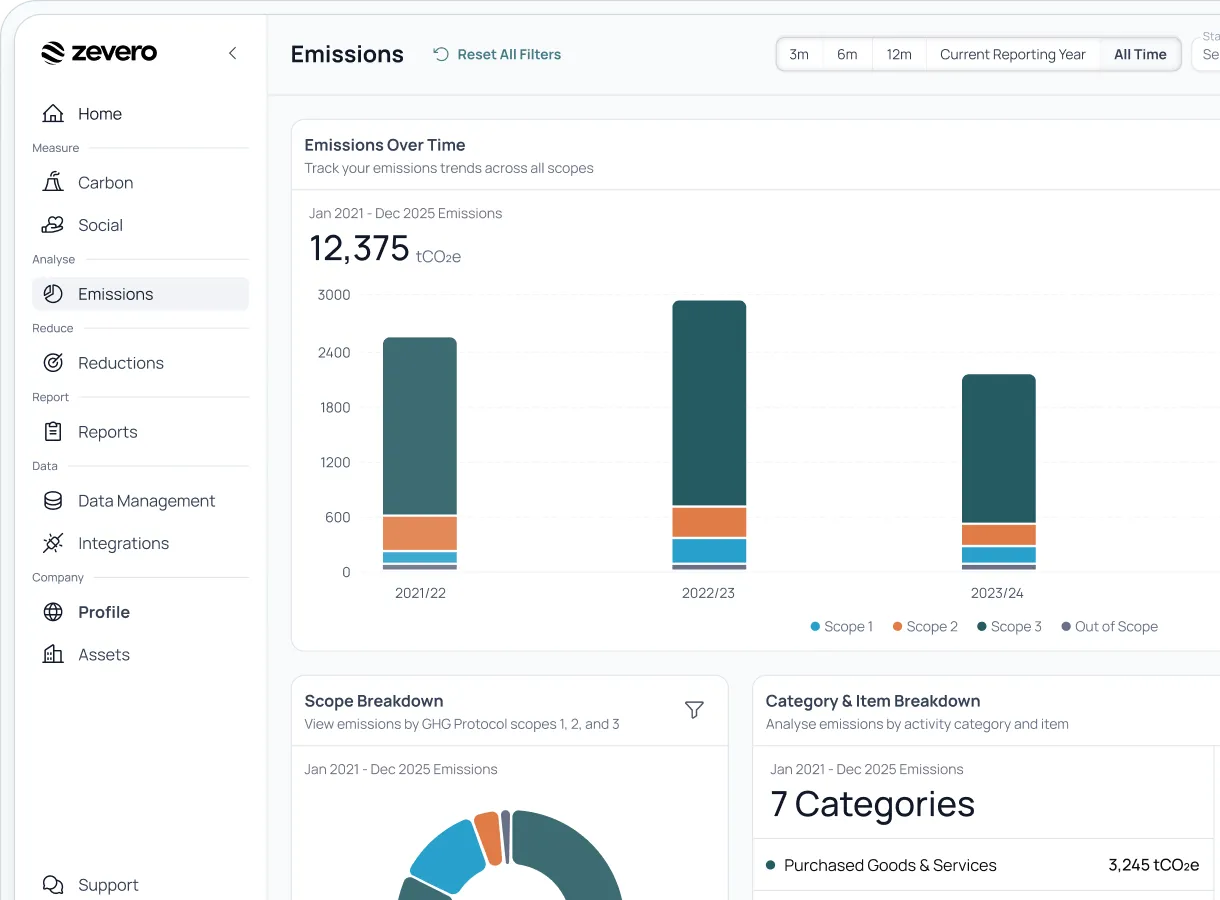
Zevero’s carbon management platform simplifies the complexities of PPN 006 compliance.
Here’s how we can support you:
1. Comprehensive emissions tracking
Track Scope 1, 2 and 3 emissions in real-time through automated data collection. Zevero’s emission engine uses AI-driven technology to ensure granular and accurate emissions reporting.
2. Advisory support
Receive guidance from Zevero’s team of sustainability experts on setting realistic carbon reduction targets, identifying quick wins and long-term strategies or decarbonisation.
3. Support with reporting
Zevero can provide the emissions data that can be translated into actionable insights and can support the creation of your carbon reduction plan. Want a real-world example of how we’ve supported our customers, then check out VITHIT’s CRP here which we supported in producing.
Conclusion
PPN 006, like PPN 06/21 before it, represents a huge shift in how sustainability influences public procurement. For suppliers, it’s not just a compliance exercise but an opportunity to reach net zero. By aligning with the policy’s requirements and leveraging tools like Zevero’s platform, you can position your business as a trusted, forward-thinking supplier for government contracts.
If you’d like to learn more about how we can support your decarbonisation journey, then get in touch with our team.
Carbon data is costing UK businesses deals. See who’s missing out and why.
Thanks for reading!
PPN 006 and PPN 06/21: Carbon Reduction Plans for UK Public Contracts
Add us as a preferred source

See how Zevero can streamline your carbon reporting
Grow your business and reduce your impact