Industry News

Quick summary
- ISO/DIS 14060 is the first ISO standard to formally define organisational net zero, distinct from carbon neutrality through offsetting.
- It is currently in public consultation until 10 August 2026, with final publication expected in late 2026 or early 2027.
- The draft standard prohibits using carbon credits to claim progress toward emission reduction targets, requires front-loaded reductions through a cumulative GHG budget, and mandates publicly available transition plans integrated into business strategy.
Published on 17 June 2026 as a draft standard, ISO/DIS 14060: Net-Zero Aligned Organizations arrived one week after the SBTi released Version 2.0 of its Corporate Net Zero Standard. Together, they reflect a maturing of the net zero landscape: the standard-setting community has reached a point of convergence on what credible organisational net zero requires, and that consensus is now being codified.
Until now, there has been no single authoritative standard defining what net zero means for an organisation. Commitments have been made against a range of frameworks, with varying levels of rigour, and the line between net zero and carbon neutrality has often been blurred. ISO 14060 changes that. It establishes a clear, consistent definition of organisational net zero, draws a formal distinction from carbon neutrality through offsetting, and sets out a structured framework for how organisations can credibly claim and maintain net zero alignment.
What "organisational net zero" means under ISO 14060
ISO/DIS 14060 defines organisational net zero as the condition in which all greenhouse gas (GHG) emissions within the organisation's inventory have been reduced to residual emissions, and those residual emissions are counterbalanced by carbon dioxide removals. Residual emissions are defined as those that remain at the net zero target date after all technically and economically feasible reduction measures have been implemented. Designating emissions as residual because they are difficult or costly to address is not sufficient. The standard requires a documented, publicly available feasibility analysis to justify any residual emissions that exceed the level indicated by the organisation's sectoral net zero pathway.
Only durable carbon dioxide removals can counterbalance residual emissions at net zero. These must meet six quality criteria: durable (minimum 100 years of storage), additional, independently quantified, free from carbon leakage, not double-counted, and credibly accounted for. Reduction or avoidance credits do not meet this definition and cannot be used for counterbalancing.
The four-stage claims framework
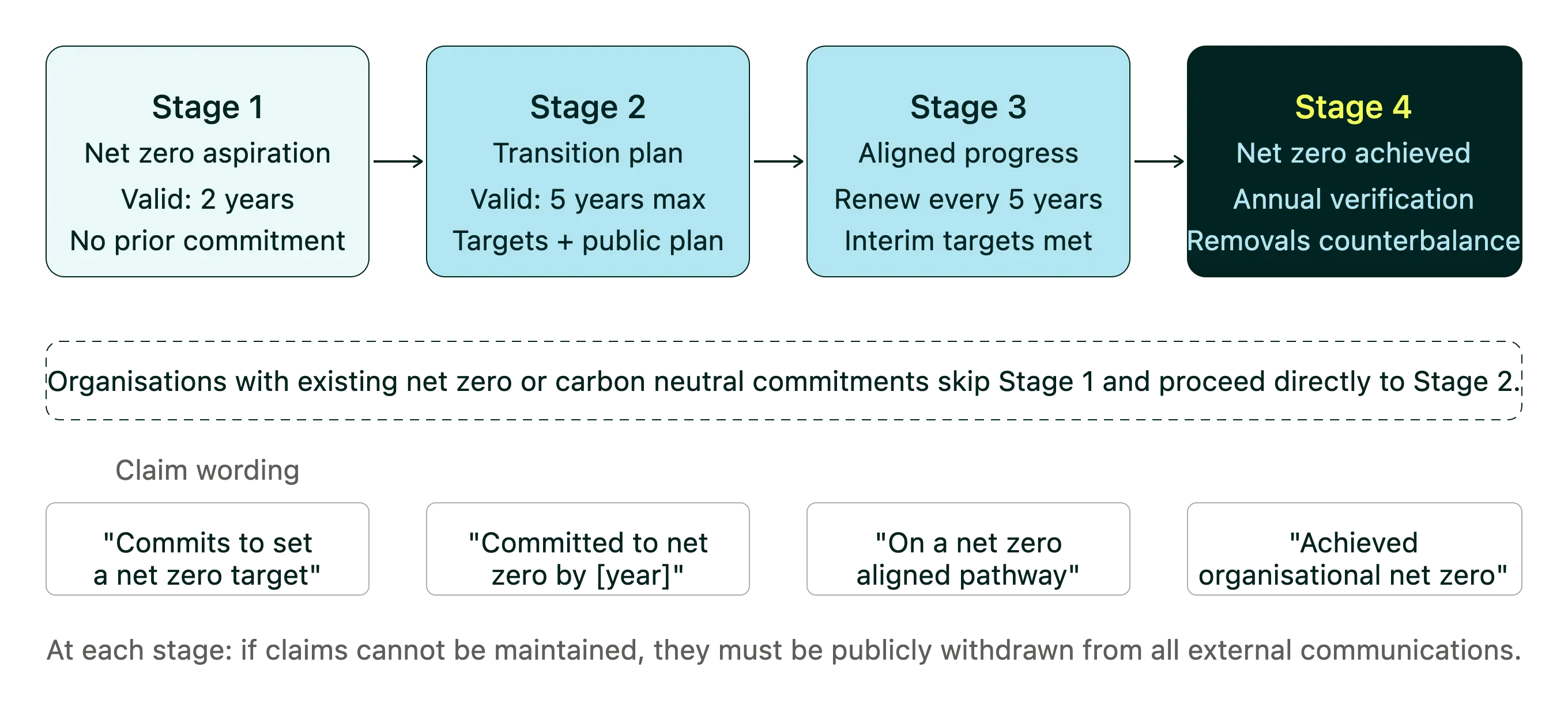
Rather than a single net zero declaration, ISO/DIS 14060 establishes four progressive stages. Each stage has defined requirements, timelines, and prescribed language for external communications.
Stage 1: Net zero aspiration
Available only to organisations with no prior net zero or carbon neutral commitment. The organisation commits to developing a target and a transition plan. The claim is valid for two years, with a one-year extension if documented progress has been made. If a GHG inventory, interim targets, and transition plan are not published within that window, the claim must be withdrawn from all external communications.
Stage 2: Net zero aligned transition plan
The organisation has set science-based targets, developed a transition plan, and commits to its implementation. Valid for a maximum of five years. If performance deviates significantly from the stated pathway and this is not disclosed publicly within 30 months, the claim must be withdrawn.
Stage 3: Net zero aligned progress
The organisation is meeting its interim targets and making demonstrable progress on its pathway. The claim is renewable every five years and is subject to the standard's remedial action provisions if targets are missed.
Stage 4: Net zero achievement
Organisational net zero has been reached. It is maintained through annual counterbalancing of residual emissions with durable carbon dioxide removals, supported by annual public reporting.
The language associated with each stage is set by the standard. "On a net zero aligned pathway" is the minimum required wording at Stage 3. An organisation cannot describe itself as "net zero" without meeting Stage 4 requirements.
The role of carbon credits
A significant number of existing corporate net zero strategies rely on purchasing carbon credits to demonstrate progress against emission reduction targets. Under ISO/DIS 14060, this approach is not compliant. Carbon credits cannot be used to claim progress toward interim or net zero GHG emission reduction targets. The permitted uses are more limited: contributing to global net zero through beyond-value-chain action, supporting remedial measures after a missed interim target, addressing historical emissions as a high-ambition activity, and (exclusively at net zero) using high-quality removal credits to counterbalance genuinely residual emissions.
Companies whose net zero plans are built around purchasing reduction or avoidance credits will need to reassess their strategy. The standard requires real reductions in place of credit use, and the restructuring this implies is substantive. The implications extend beyond individual companies to the voluntary carbon market: a significant proportion of existing corporate net zero commitments are credit-dependent, and this standard renders that model invalid for claims of net zero progress.
Target-setting and the GHG budget concept
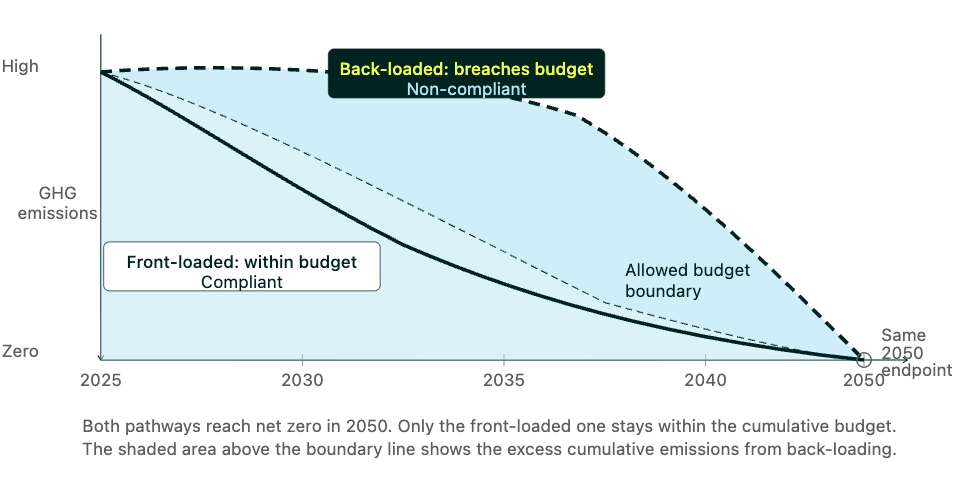
ISO/DIS 14060 requires science-aligned GHG emission reduction targets for all three scopes, set against a peer-reviewed net zero pathway consistent with limiting warming to 1.5°C. Eligible pathways must meet a defined set of criteria, including independence of development, peer review, and publicly available methodology. Central to the target-setting framework is the concept of an organisational GHG budget: the maximum cumulative emissions the organisation is permitted to produce between its base year and its net zero target year.
The practical consequence is that strategies which delay action and rely on steep reductions later in the transition period will exceed the cumulative budget, even if the 2050 target is nominally met. The standard requires early, front-loaded reductions. This is not a recommendation; it is built into the compliance structure.
The first interim target must be set within five years of the year targets are established. Subsequent interim targets must be no more than ten years apart. Separate targets are required for each scope.
Scope 3
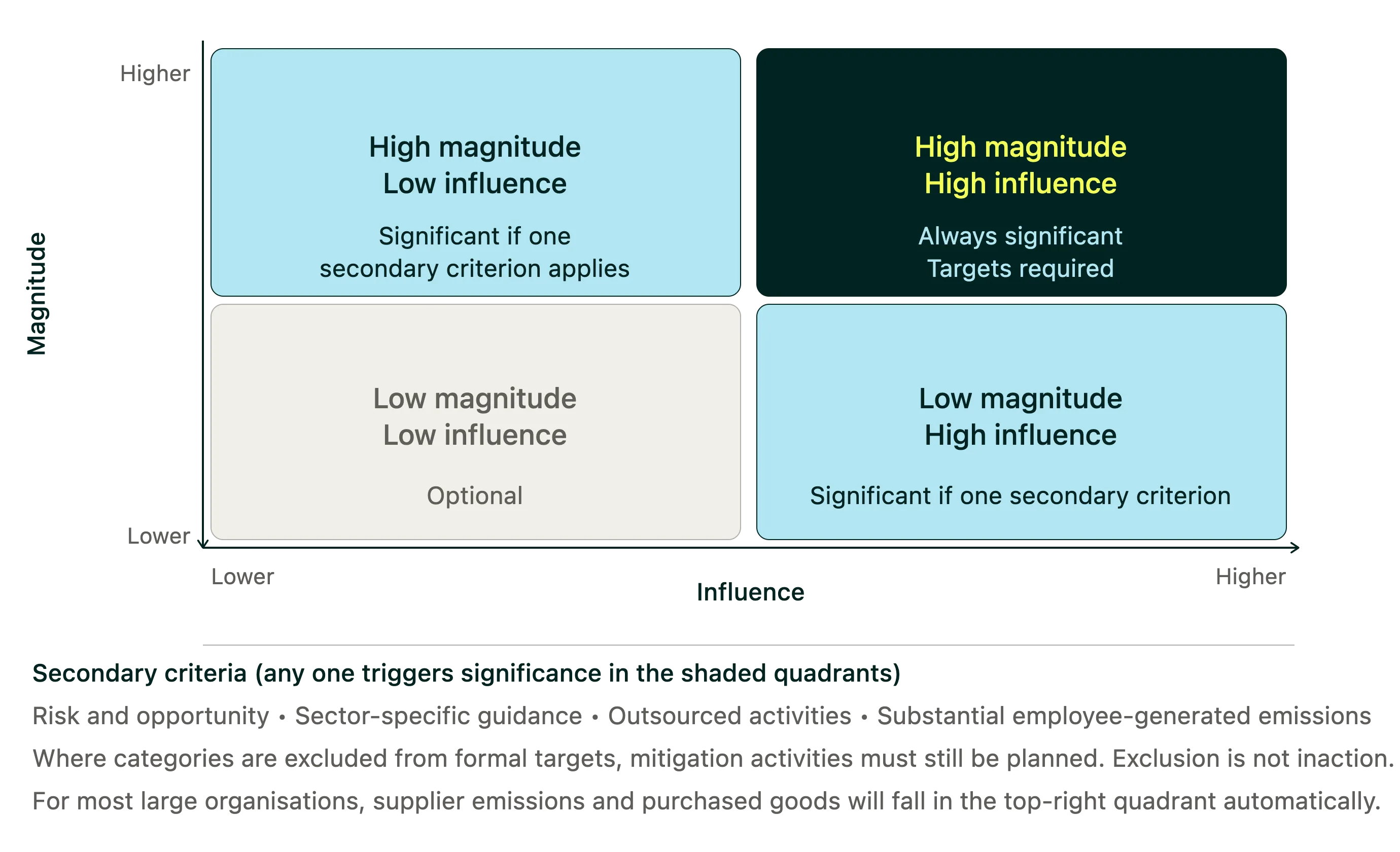
For most large organisations, Scope 3 has been the category with the most latitude. ISO/DIS 14060 introduces a structured significance test based on two primary criteria: the magnitude of the emissions and the organisation's ability to influence them. Where both are high, targets are required. Most large companies will find that supplier emissions and purchased goods and services meet this threshold.
The draft standard does not make every Scope 3 category mandatory, but it requires public disclosure of any categories excluded from target-setting, and organisations must still set mitigation activities to address excluded categories. Exclusion from formal targets does not mean no action is required. This aligns with the direction being taken in the proposed GHG Protocol Scope 3 revisions, which are also moving toward stricter coverage thresholds.
Equity and differentiated net zero timelines
One element of the standard that tends to be overlooked in early coverage is how it handles organisations operating across different geographies. Not all countries have the same net zero target year, and the standard reflects that. Net zero years are differentiated by country income level using World Bank income classifications: 2050 for high-income countries, 2060 for upper-middle-income, and 2070 for lower-middle and low-income countries. For multinationals, the target year is calculated as a weighted average based on where their emissions occur. This means a company with substantial operations in emerging markets may legitimately have a science-aligned net zero target beyond 2050.
This reflects the Paris Agreement's principle that historical responsibility and economic capacity should shape the pace of transition. The standard requires organisations to disclose whether and how these equity considerations are reflected in their chosen pathway.
Transition plans
A publicly available transition plan is required from Stage 2 onwards. The standard specifies that the plan must be integrated into the organisation's core business planning and financial processes. It cannot function as a standalone sustainability document.
Required content includes:
- Net zero target and interim milestones
- Anticipated residual emissions
- Timelines for specific mitigation actions
- Governance and resource allocation
- Plans for engaging the value chain on Scope 3
- Roadmap for building carbon dioxide removal capacity
Plans must be updated at least every five years, and any deviations from previously published commitments must be explained publicly.
On removals specifically: organisations must begin building their carbon dioxide removal capacity no later than five years after setting targets, not at their net zero target year. The rationale is practical; sufficient removal capacity cannot be assembled in a short window, and the standard reflects this by requiring early investment and staged milestones.
Data quality
ISO/DIS 14060 treats data quality improvement as a compliance obligation rather than a best practice aspiration. Organisations are required to implement and document processes for continually improving the quality and completeness of their GHG quantification, with evidence of those processes available. Critically, incomplete data cannot be used to justify delays in taking action. Organisations are expected to act on estimates while working to improve them. Spend-based methods for Scope 3 are acknowledged as a common starting point but are noted as the least accurate approach for tracking actual reductions. The direction of travel is toward primary activity data and supplier-specific emission factors, consistent with the methodology underpinning the GHG Protocol Corporate Standard.
This creates a direct commercial imperative for carbon data infrastructure. Organisations that cannot measure their emissions with sufficient rigour, and demonstrate improvement over time, lose the right to make claims under this standard. For most large organisations, that means treating carbon data systems as a compliance investment rather than a reporting overhead.
When interim targets are missed
Missing an interim target does not automatically end a claim. The standard provides a structured remedial framework with outcomes that depend on the scope and scale of the miss.
For Scope 2 or Scope 3 misses of up to 25%: the organisation may enter an adjustment period of up to three years, retaining its Stage 3 claim provided it publicly discloses the adjustment period, specifies which scopes are affected, and reports the deviation percentage, with annual progress updates throughout.
For Scope 2 or Scope 3 misses exceeding 25%: the Stage 3 claim is lost and the organisation enters a remedial period of up to three years. A binding remedial plan must be published within twelve months, with implementation subject to annual verification.
Organisations are limited to a maximum of two non-consecutive adjustment or remedial periods across their entire net zero journey. Missing a third consecutive interim target requires permanent withdrawal of the claim until the organisation returns to its pathway.
Implications for organisations
Organisations with existing net zero commitments should first assess whether their current commitments are backed by a transition plan that meets the standard's requirements: integrated into business planning, addressing residual emissions, and with documented removal milestones. If that plan does not exist, Stage 2 is not available.
Organisations with credit-dependent strategies will need to consider whether their existing approach can be adapted. If reduction or avoidance credits are being used to claim progress toward targets, those claims are not compliant under this standard. Replacing credits with genuine reductions, building a removals portfolio, and in some cases revisiting timelines are likely to be required.
Organisations with back-loaded transition plans should model their cumulative GHG budget now. If the plan places the majority of emission reductions in the 2040s, the budget may already be in overshoot before any action is taken. Understanding where the gap is earlier allows for a more manageable adjustment.
Organisations with material Scope 3 gaps should apply the significance test to identify which categories require formal targets, and begin a programme to improve data quality. The standard expects documented improvement over time.
Looking ahead
ISO/DIS 14060 is still a draft, and the final text may shift before publication, but the direction it sets is clear and consistent with where the broader regulatory and standard-setting landscape has been heading for some time. Greenwashing scrutiny is intensifying, supply chain disclosure requirements are expanding, and the gap between a credible net zero strategy and a stated commitment is becoming harder to obscure. For organisations that have already invested in robust carbon data, science-based targets, and transition plans integrated into their business strategy, this standard largely validates the work they have done. For those that have not, the window for getting ahead of it is narrowing.
The practical starting point for most organisations is understanding where their current position sits relative to the standard's requirements: which claims they can credibly make, where their data infrastructure needs to improve, and what their transition plan still needs to address. That work is worth doing now, before the standard is ratified.
If you would like to understand how your organisation's current net zero approach measures up against ISO 14060, get in touch with the Zevero team. We work with organisations across their full emissions footprint: from initial measurement through to target-setting, transition planning, and the data infrastructure that underpins all of it.
FAQs
How does ISO 14060 differ from ISO 14068?
Can an organisation with an existing net zero commitment use Stage 1?
Can carbon credits be used to achieve net zero under ISO14060?
What happens if an interim target is missed?
Is ISO 14060 finalised?
Thanks for reading!
ISO 14060: What the First ISO Net Zero Standard Means for Your Business
Add us as a preferred source

Related posts

Read more

Blog
Jul 31, 2025
ISO 14064 vs ISO 14067: The Standards Behind Organisational and Product Carbon Reporting
ISO 14064 vs ISO 14067: The Standards Behind Organisational and Product Carbon Reporting

Read more
Blog
Jan 24, 2025
Carbon Neutral vs Net Zero: What’s the Difference?
Carbon Neutral vs Net Zero: What’s the Difference?
See how Zevero can streamline your carbon reporting
Grow your business and reduce your impact