Education

Quick summary
- IROs are the foundation of CSRD reporting. Without a robust identification process, a company cannot determine what to report on or which ESRS topics are material to its business.
- Impacts, risks, and opportunities are three distinct concepts. Impacts are effects the company has on the world. Risks and opportunities are effects sustainability factors have on the company. Both must cover the full value chain, not just a company's own operations.
- IRO-1 covers the process, IRO-2 covers the outcome. IRO-1 documents how you identified and assessed your IROs, including methodology and thresholds. IRO-2 publishes the list of material topics linked to relevant ESRS standards and must explain why topics assessed as not material were excluded. Both are mandatory under ESRS 2 and subject to assurance.
The Corporate Sustainability Reporting Directive (CSRD) sets out disclosure requirements across a broad range of sustainability topics through the European Sustainability Reporting Standards (ESRS). Which of those topics a company must report on is determined by a double materiality assessment, and the inputs that drive it are impacts, risks, and opportunities, collectively known as IROs. Understanding what IROs are, how they are identified, and how they connect to disclosure requirements is the starting point for any serious CSRD reporting process.
What are IROs?
IRO stands for impacts, risks, and opportunities. IROs play a crucial role in determining what is material for a company's sustainability report. By identifying where the business has an impact, where sustainability issues pose risks, and where opportunities exist, companies can prioritise what needs to be disclosed under the European Sustainability Reporting Standards (ESRS). Under CSRD, impacts, risks, and opportunities are three distinct concepts that together determine which sustainability topics are material to your business and therefore which ESRS disclosure requirements apply.
Impacts
A company’s impact refers to the positive or negative effects that it exerts on people and the environment through its business activities, products, or services. These effects can be immediate or long-term, and direct or indirect. A manufacturer's greenhouse gas emissions are an impact. So is the effect of a company's sourcing practices on the communities around its suppliers. Impacts can be actual, meaning they are already occurring, or potential, meaning they could occur in the future. CSRD requires companies to assess and disclose both.
Risks
A risk is any sustainability issue that could affect a company's financial performance. Examples include the risk of regulatory fines if emissions targets are missed, the risk of supply chain disruption from climate-related extreme weather, or the risk of reputational damage from poor labour practices in a supplier's operations.
Opportunities
An opportunity is the positive financial counterpart to risk: a sustainability factor that could improve the company's financial position rather than threaten it. Examples of opportunities would be energy efficiency investments that reduce operating costs, access to green financing at preferential rates, and growing customer demand for lower-carbon products.
Across the full value chain
A point that is frequently underestimated: IROs do not apply only to a company's own operations. The CSRD requires organisations to consider the whole supply chain. IROs need to be classified as to whether they occur in upstream activities, own activities, or downstream activities. A company's most significant impacts may sit deep in its supply chain rather than on its own factory floor.
The process of systematically identifying and evaluating all of these impacts, risks, and opportunities across the value chain is known as the IRO assessment. It determines which sustainability topics are material to the business and, in turn, which ESRS disclosure requirements apply.
Why IROs sit at the heart of CSRD
Which topical ESRS standards your company reports against is determined by the IRO assessment. Topics assessed as not material do not require full disclosure, though ESRS 2 General Disclosures are mandatory for all in-scope companies regardless of materiality outcome, and companies must briefly explain why topics were assessed as not material.
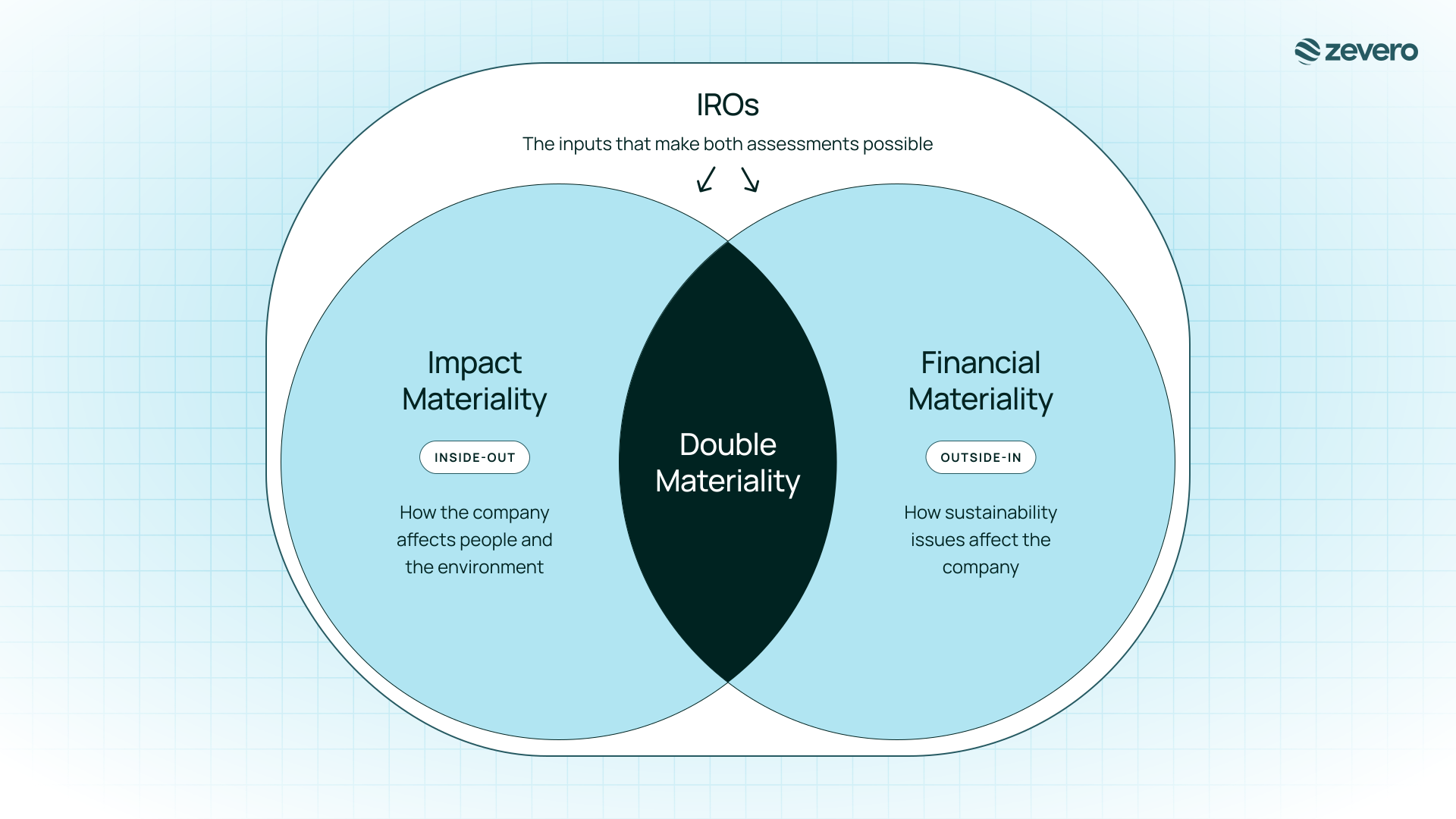
Double materiality has two lenses, and IROs feed both.
- Impact materiality asks: how does the company affect people and the environment? This is sometimes called the inside-out perspective, meaning the company looking outward at its own effects.
- Financial materiality asks: how do sustainability issues affect the company's financial position? This is the outside-in perspective, meaning external sustainability factors looking inward at the business.
IROs connect these two perspectives, acting as the foundation of materiality assessments. Because material sustainability topics are identified through the assessment of impacts, risks, and opportunities, IROs play a critical role in determining which ESRS disclosure requirements apply and how those disclosures are structured.
This is why IROs are not a compliance checkbox to be completed once and filed away. They are the analytical foundation on which the entire CSRD reporting structure rests. The IRO identification process is where the quality of a CSRD report is determined, before a single data point is collected.
How companies can identify their IROs
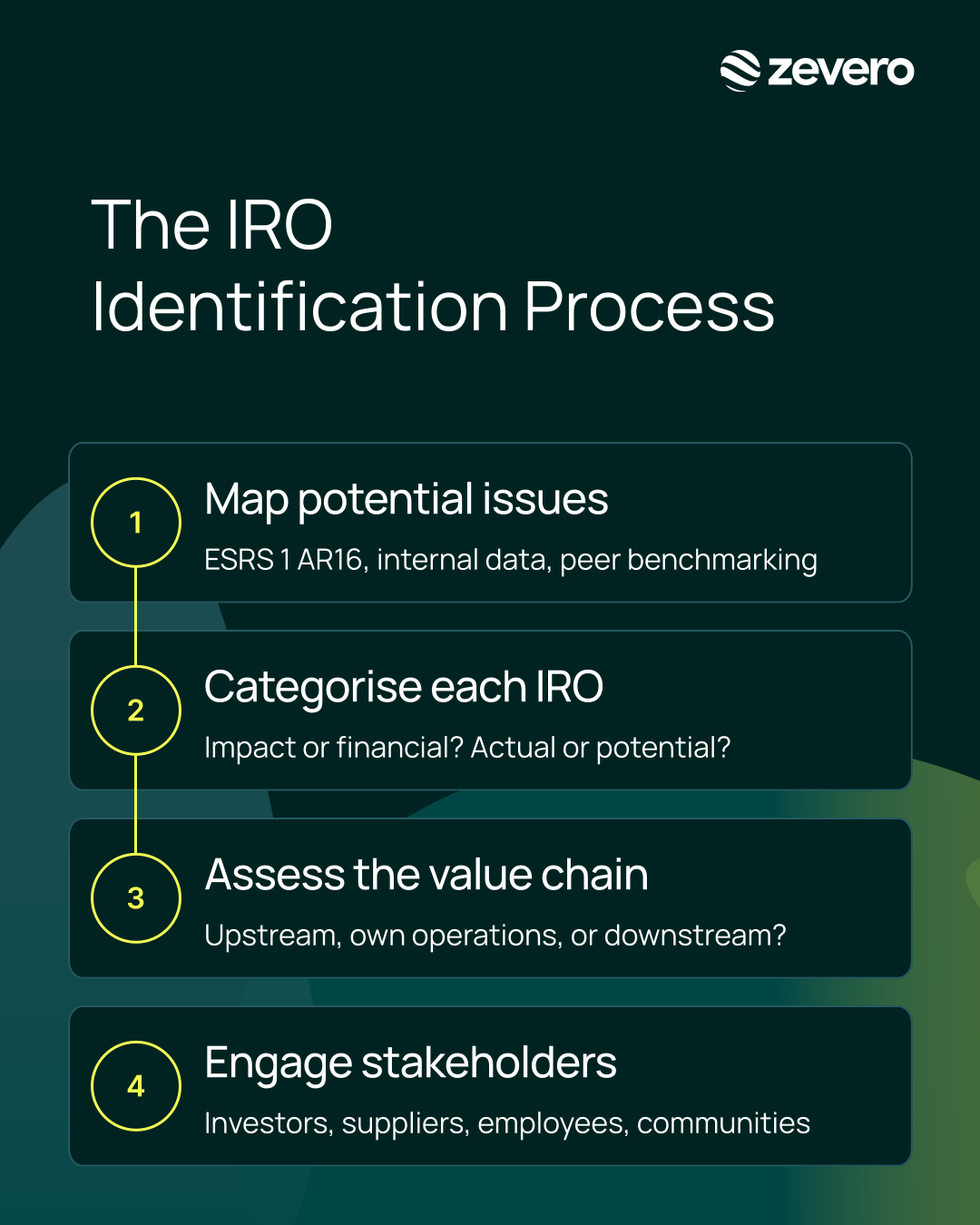
The IRO identification process starts broad and narrows over time. There is no single prescribed method under ESRS, but the process generally follows a recognisable pattern. Companies should begin by mapping out all potential sustainability issues that could be relevant to their operations. This can be done by reviewing EFRAG's pre-defined list of over 100 sustainability matters across environmental, social, and governance topics, which can be found in ESRS 1 AR16.Companies do not need to identify an IRO for every item on the list, but it serves as a structured starting point for ensuring nothing significant is overlooked.
At the beginning of the process, the corporate context should be analysed. This includes a review of business activities, business relationships, upstream and downstream value chains, and affected stakeholders, in order to identify the relevant sustainability aspects.
Once potential IROs are mapped, companies categorise them: is this an impact, a risk, or an opportunity? For impacts, is it actual — already occurring — or potential? Where in the value chain does it occur? What time horizon is relevant: short, medium, or long term?
Stakeholder engagement, while not explicitly mandated under ESRS, is strongly recommended. Input from investors, suppliers, employees, and affected communities helps validate the list of potential IROs and ensures that the assessment reflects perspectives beyond the company's own internal view.
How materiality is determined
Identifying a list of potential IROs is the starting point. The next step is assessing which of them are significant enough to be considered material, and therefore trigger disclosure requirements. The criteria differ depending on the type of IRO:
- For impacts, materiality is assessed on the basis of severity, which has three dimensions: scale (how serious the harm or benefit is), scope (how many people or how much of the environment is affected), and reversibility (whether the harm can be undone or is permanent). For potential impacts, the likelihood that the impact will occur is also factored in.
- For risks and opportunities, the assessment focuses on financial significance: how likely is the risk or opportunity to materialise, and how large could its effect on the company's financial position be?
ESRS does not prescribe a fixed scoring method; companies set their own thresholds. This flexibility is intentional. For example, a materiality threshold appropriate for a large industrial manufacturer is unlikely to be appropriate for a professional services firm. ESRS leaves companies to calibrate their own approach based on their sector, size, and business model. However, the choices companies make about their scoring methodology are subject to disclosure under IRO-1 and to third-party assurance as CSRD matures.
The two CSRD disclosure requirements: IRO-1 and IRO-2
Once the double materiality assessment is complete, CSRD requires companies to disclose both the process that was used and the outcomes it produced. This is captured in two specific disclosure requirements under ESRS 2:
IRO-1 requires companies to describe the process they used to identify and assess material IROs. This means explaining how potential IROs were mapped, how the value chain was considered, what scoring methodology was applied, and how thresholds were set. The process disclosure is as important as the outcome: assurance providers will scrutinise it alongside the results.
IRO-2 requires companies to publish the list of material sustainability topics that resulted from the assessment, linked to the relevant ESRS disclosure requirements. It is also important to be able to justify why certain topics have not been considered as material by the organisation. In the case of ESRS E1 dedicated to climate change, if the subject is not considered material, a detailed explanation must be provided by the organisation, together with an analysis of the conditions that could change this decision.
Together, IRO-1 and IRO-2 create a transparent, auditable record of how the company decided what to report on. They are not technical appendices. They are central to the credibility of the entire sustainability report.
Getting your IROs right
Identifying and assessing IROs is not a one-time exercise. It is the foundation of a credible sustainability strategy, not just a reporting hurdle. The companies that treat it as a genuine analytical process, rather than a compliance box to tick, build a sustainability strategy that is grounded in evidence rather than assumption.
That clarity has value beyond the sustainability report. It informs procurement decisions, capital allocation, risk management, and stakeholder engagement in ways that a compliance-only approach does not.
Zevero helps companies build the data foundation that CSRD reporting depends on — from Scope 3 emissions measurement and to ESG reporting across frameworks. If you are working through your CSRD preparation, speak to the Zevero team.
FAQs
Do IROs need to cover the supply chain?
What is a reasonable materiality threshold for IROs?
How long does an IRO assessment take?
Does the IRO assessment need to be repeated every year?
Thanks for reading!
What are IROs? Understanding Impacts, Risks & Opportunities Under CSRD
Add us as a preferred source

Related posts

Read more

Blog
Feb 12, 2025
What is CSRD? How the Corporate Sustainability Reporting Directive Impacts Businesses Worldwide
What is CSRD? How the Corporate Sustainability Reporting Directive Impacts Businesses Worldwide
Read more
Blog
Jan 26, 2026
How Materiality Assessments Shape Credible Climate Strategy
How Materiality Assessments Shape Credible Climate Strategy

Read more
Blog
Feb 26, 2025
The EU Omnibus Proposal: What It Means for Your Sustainability Reporting
The EU Omnibus Proposal: What It Means for Your Sustainability Reporting
See how Zevero can streamline your carbon reporting
Grow your business and reduce your impact