Education

Quick summary
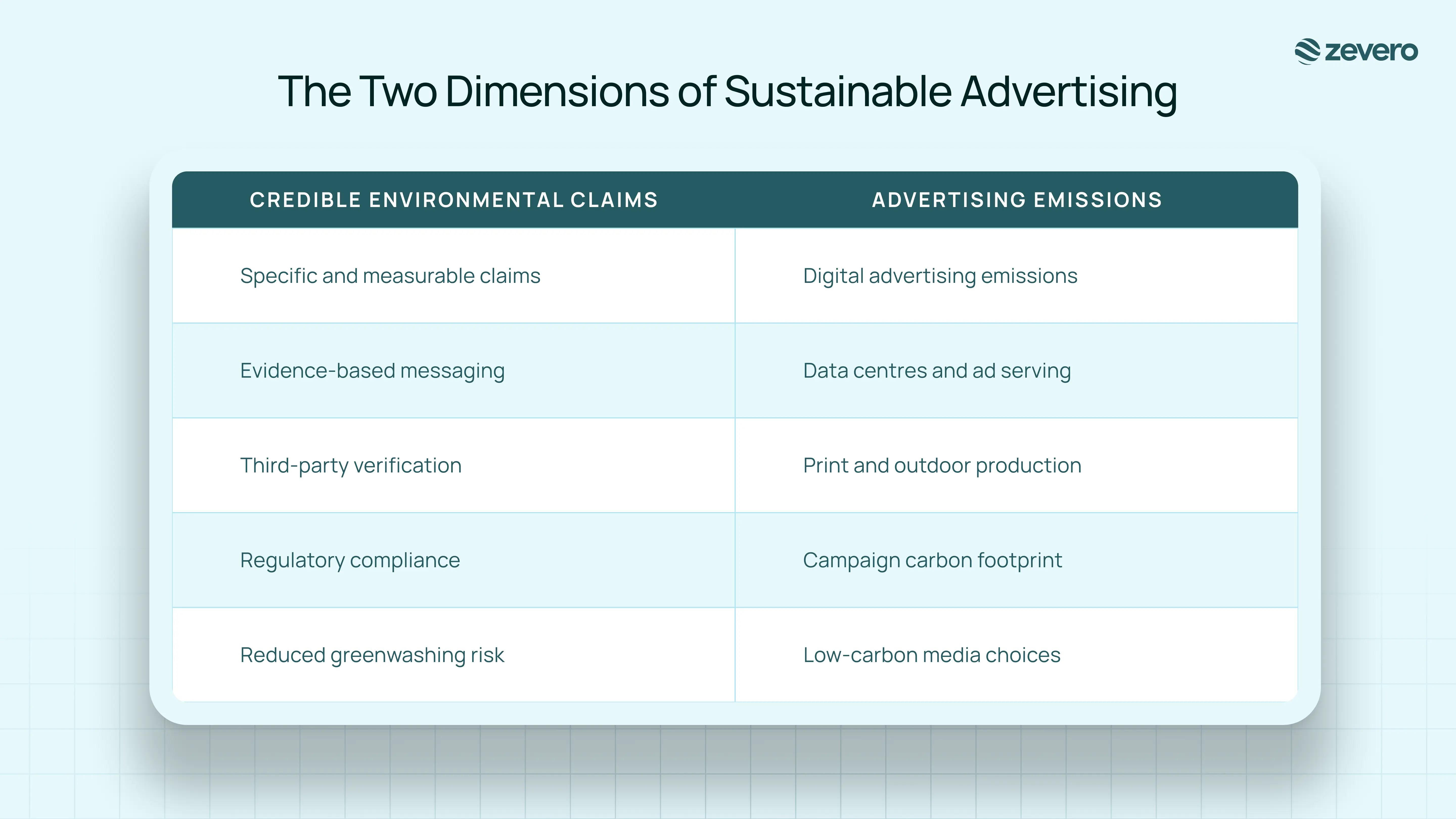
- Sustainable advertising has two dimensions: making credible, substantiated environmental claims, and reducing the carbon footprint of advertising activity itself.
- Measurement sits at the foundation of both the credibility of environmental claims and the reduction of campaign emissions. Companies that measure their emissions are better positioned to communicate their performance, and better protected when claims are scrutinised.
- Enforcement of green claims is tightening across major markets. Unsubstantiated claims carry growing legal and reputational risk.
Businesses are under growing pressure to communicate their sustainability credentials. Customers expect it, investors look for it, and competitors are doing it. But the gap between what companies say and what they can actually prove creates reputational and legal risk. A green claim that cannot be substantiated is no longer just a marketing misstep. It is an enforcement risk.
This blog covers both dimensions of sustainable advertising: the credibility of claims and the environmental impact of advertising itself. Both require companies to measure their impact and communicate it clearly.
What is sustainable advertising?
Sustainable advertising has two components. The first is making honest, substantiated environmental claims that accurately reflect a company's sustainability performance. The second is reducing the emissions generated by advertising activity itself, from digital ad delivery to physical production.
It is worth distinguishing sustainable advertising from sustainable marketing.
- Sustainable marketing is the broader strategic concept of embedding sustainability into product design, pricing, positioning, and the wider marketing function.
- Sustainable advertising is narrower and more specific, focused on the claims made in advertising and the footprint of advertising operations.
Making credible green claims
Greenwashing in advertising usually takes one of a few recognisable forms: vague terms such as "eco-friendly" or "green" with no defined meaning, unsubstantiated carbon neutral claims, or selective disclosure that highlights one positive attribute while overlooking a more significant environmental impact.
The regulatory landscape has tightened considerably, and enforcement is increasing across major markets:
- United Kingdom: The Competition and Markets Authority (CMA) Green Claims Code sets out the standard for environmental claims, and the Digital Markets, Competition and Consumers Act 2024 (DMCCA), in force from April 2025, gives the CMA stronger enforcement powers. The Advertising Standards Authority (ASA) operates a parallel regime through the CAP and BCAP advertising codes, updated in 2024 with specific environmental claims provisions.
- European Union: The Empowering Consumers for the Green Transition Directive (ECGT Directive, Directive 2024/825), adopted in February 2024, explicitly outlaws generic environmental claims and requires third-party verification for all sustainability labels. It comes into full enforcement on 27 September 2026.
- United States: The Federal Trade Commission (FTC) Green Guides set out the standard for environmental marketing claims. Last updated in 2012, they have been under review, and enforcement targets unsubstantiated renewable energy and carbon offset claims.
- Canada: Canada’s Bill C-59 Competition Act amendments, in force from June 2024, require environmental claims about products and businesses to be substantiated using internationally recognised methodology.
What credible claims look like in practice is consistent across all these regimes. Claims should be specific rather than vague, measurable rather than subjective, supported by evidence, independently verified where possible, and time-bound when they relate to future commitments. A claim such as "we have reduced operational emissions by 30% against a 2019 baseline, verified by an independent assessor" stands up to scrutiny. A claim such as "we are a green company" does not.
The regulatory environment is moving toward tighter enforcement. Companies that lag on substantiation are taking on growing legal and reputational exposure.
The carbon footprint of advertising itself
The second dimension of sustainable advertising rarely appears in sustainability strategies, procurement reviews, or emissions inventories. But advertising has a real carbon footprint, and for companies running large-scale campaigns across digital and physical channels, it is one worth measuring.
Digital advertising is not carbon-free simply because it is not physical. Data centres, programmatic advertising systems, and high-bandwidth video formats all consume energy. The complexity of the digital advertising supply chain, with its layers of intermediaries and data transfer, has a meaningful carbon cost that most companies never measure.
Print and outdoor advertising carries the more visible footprint of materials, production, and distribution, along with the energy used to power illuminated and digital billboard formats.
This dimension receives far less attention, which makes it an area where sustainability managers can add genuine value by asking better questions of their marketing teams. “What is the emissions footprint of our largest campaigns?” “Are we using low-carbon ad platforms?” “Can we reduce reliance on the most energy-intensive formats without losing effectiveness?” These questions are rarely asked, yet they are often the first step toward reducing a footprint that has never been measured.
What good looks like in practice
Effective sustainable advertising comes down to a set of practices that both stand up to scrutiny and reduce environmental impact:
- Be specific and measurable in claims. Replace vague language with concrete figures, baselines, and timeframes.
- Get third-party verification. Independent verification significantly strengthens any claim and is increasingly expected by regulators.
- Understand the regulation for your market. The rules differ across the UK, EU, and US, and companies advertising across borders should apply the strictest standard relevant to each market.
- Audit the emissions footprint of campaigns. Measure the carbon cost of advertising activity the same way other business emissions are measured.
- Work with low-carbon platforms and formats. Choose ad platforms and formats that minimise energy use where this can be done without sacrificing effectiveness.
Brands doing this well
A useful illustration of credible environmental advertising is Patagonia's "Don't Buy This Jacket" campaign, run as a full-page advertisement in The New York Times on Black Friday in 2011. The ad featured one of the company's best-selling fleece jackets under the headline urging customers not to buy it, and detailed the environmental cost of producing a single garment, including the water used and the carbon emitted. The campaign worked because it was honest, specific, grounded in real data, and consistent with Patagonia's wider business practices. It did not claim the product was harmless. It quantified the environmental impact and encouraged more considered consumption.
Interface demonstrates the importance of linking communications to robust measurement. The flooring manufacturer has spent decades reporting on its environmental performance and publishing detailed product-level environmental data. Its sustainability communications focus on documented progress, verified metrics, and long-term targets rather than vague environmental claims. This approach reduces the gap between what the company says and what it can prove.
The principle these examples illustrate is consistent. Credible sustainable advertising is specific, substantiated, and aligned with business performance. Brands that face criticism are often those whose claims move ahead of the evidence. Those that build trust communicate within the limits of what they can measure, verify, and demonstrate.
Credible advertising starts with credible data
Both dimensions of sustainable advertising, the credibility of claims and the footprint of campaigns, come back to the same foundation: measurement. A company cannot substantiate a claim it has not measured, and it cannot reduce a footprint it has not quantified.
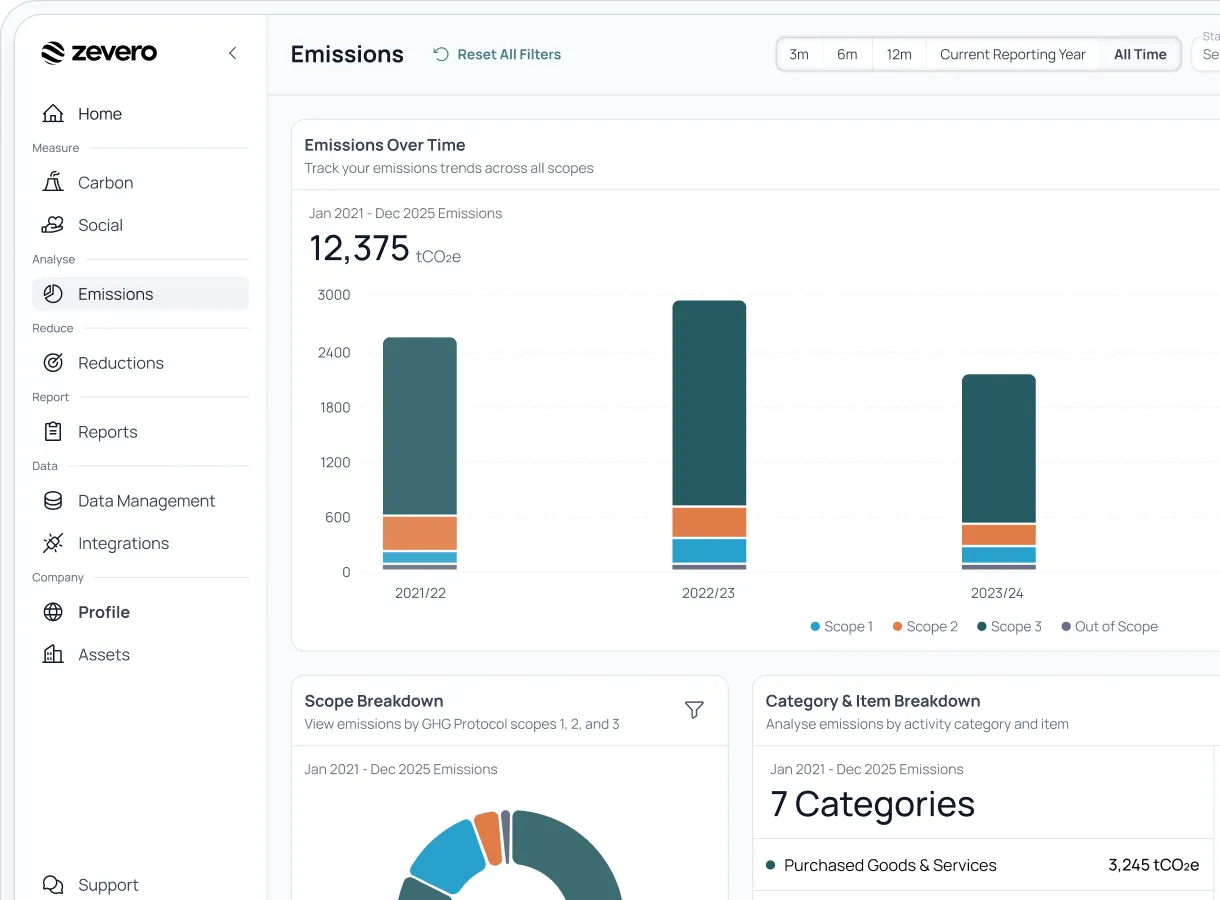
Companies that can measure and substantiate their environmental performance are better positioned to communicate it and better prepared when their claims face scrutiny. The Zevero platform enables businesses to measure emissions with granularity and GHG Protocol-aligned methodology, so you have traceable data that credible environmental claims require.
FAQs
Is "carbon neutral" still a safe claim to make in advertising?
Who is legally responsible for a misleading green claim: the brand or the advertising agency?
How can a company measure the carbon footprint of its digital advertising?
Does sustainable advertising apply to B2B companies, or only consumer brands?
What is the difference between the Green Claims Code and the Green Claims Directive?

Related posts
.webp)
Read more

Blog
Aug 4, 2025
The Rise of Greenhushing: Why Quiet Sustainability Isn’t the Answer
The Rise of Greenhushing: Why Quiet Sustainability Isn’t the Answer

Read more
Blog
Apr 26, 2024
How Can We Make Our Office More Sustainable
How Can We Make Our Office More Sustainable
.jpg)
Read more
Blog
Feb 27, 2025
How to Create a Sustainability Report That Drives Real Impact
How to Create a Sustainability Report That Drives Real Impact
See how Zevero can streamline your carbon reporting
Grow your business and reduce your impact