Policy


Quick summary
- The EU Green Deal is the EU's legally binding roadmap to climate neutrality by 2050, with an interim target of at least 55% emissions reduction by 2030 under the European Climate Law.
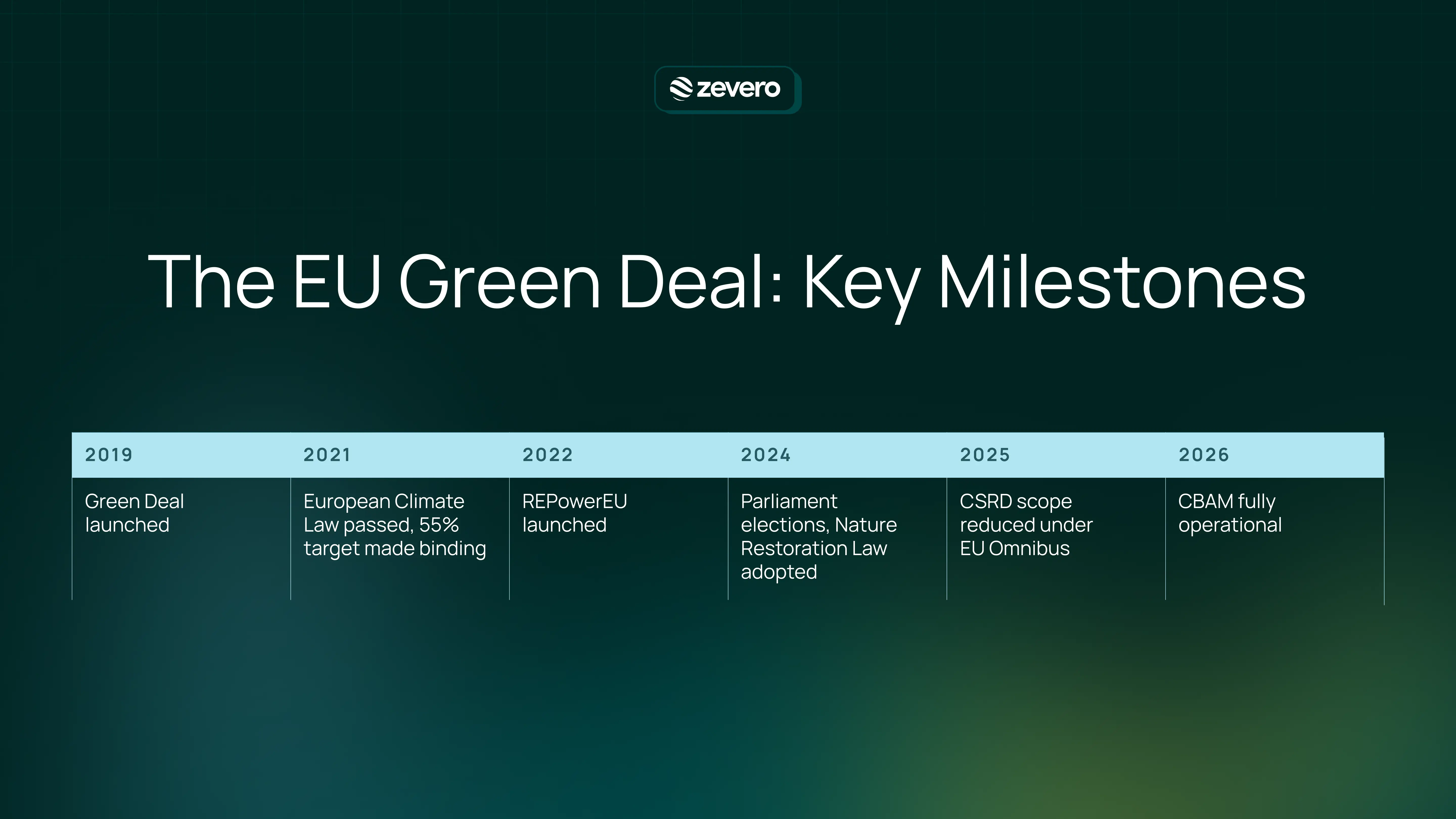
- Despite political headwinds and some implementation delays, the headline targets have not changed, but the regulatory landscape is still evolving, with recent scope reductions to CSRD and adjustments to several other directives.
- Businesses trading with or operating in the EU face growing obligations across emissions reporting (CSRD), supply chain due diligence (CSDDD), and carbon border costs (CBAM) with exposure extending to non-EU companies.
The European Union Green Deal is the most ambitious economic transformation plan a major economy has launched in a generation. Touching nearly every sector of the economy, it sets out coordinated ambitions for how energy is produced, how buildings are heated, how food is grown, how goods are manufactured, and how companies report on their environmental impact.
Since its launch in December 2019, the EU Green Deal has faced significant headwinds. The COVID-19 pandemic disrupted its implementation timeline. Russia's invasion of Ukraine forced a reassessment of energy security priorities. Political shifts following the 2024 European Parliament elections have led to adjustments in certain areas. But the EU's climate targets remain unchanged. This guide explains what the Green Deal is, what it covers, how it is being financed, and what businesses operating in or with ties to the EU need to understand about its direction of travel.
What is the EU Green Deal?
The EU Green Deal is the European Union’s overarching strategy for becoming climate neutral by 2050. It is not a single flaw. It is a framework: a coordinated package of policies, legislative initiatives, and investment instruments designed to transform the EU’s economy across multiple sectors simultaneously.
The Green Deal was approved in 2020, with the European Parliament voting to support the plan in January 2020 and the European Climate Law subsequently preserving the 2050 neutrality goal in legislation. The Climate Law also set a binding intermediate target: a reduction in greenhouse gas emissions of at least 55% by 2030, compared to 1990 levels. The Fit for 55 package is the EU's suite of legislative measures designed to deliver that 2030 target, covering everything from emissions trading to energy efficiency standards.
The underlying logic of the Green Deal extends beyond emissions reduction. It frames decarbonisation as an economic opportunity: decoupling growth from resource consumption, driving innovation in clean technology, and ensuring that regions and communities most exposed to the costs of transition are supported. The Green Deal invests in innovation, clean technology, and green infrastructure while ensuring a just transition for the communities most affected. The EU committed to mobilising over €1 trillion over the decade to fund this transition, drawing on a combination of EU funds, national budgets, and private capital.
What does the EU Green Deal cover?
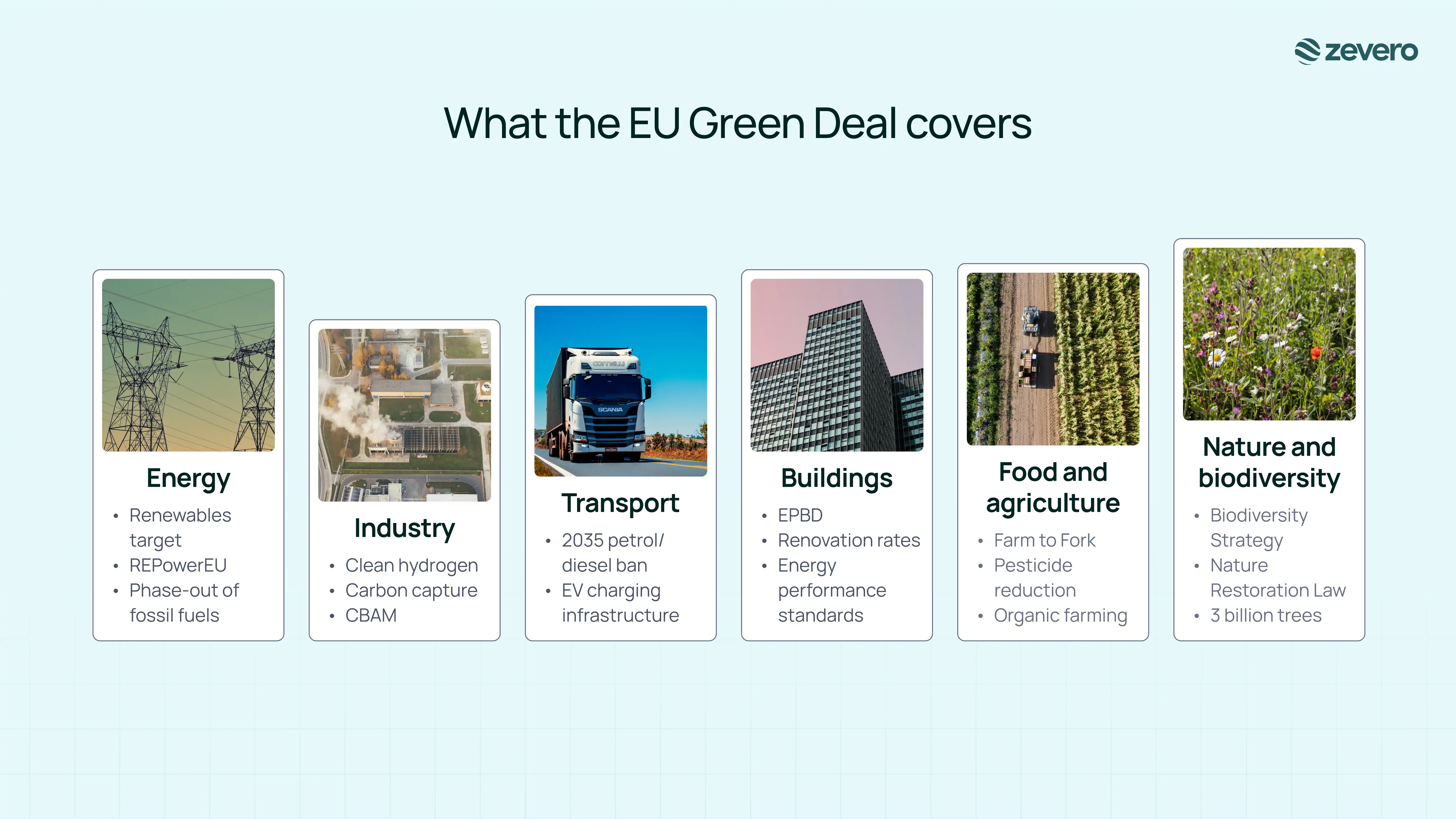
The Green Deal is explicitly cross-sectoral. Rather than targeting a single industry or policy area, it sets out coordinated ambitions across energy, industry, transport, buildings, food, and nature. The intent is to ensure that progress in one area is not undermined by inaction in another.
Energy
Decarbonising the energy system is central to the Green Deal. The EU has set a target to reach a 42.5% share of renewables in its energy mix by 2030. The REPowerEU plan, accelerated following Russia's invasion of Ukraine, directed 40% of its funds towards delivering affordable, secure, and sustainable energy, while helping to reduce fossil fuel dependency and diversify supply. Energy security and decarbonisation are now explicitly linked in EU policy, and the permitting of renewable energy infrastructure has been substantially accelerated as a result.
Industry
Decarbonising heavy industry is one of the Green Deal's most technically complex challenges. Sectors such as steel, cement, and chemicals account for a significant share of EU emissions and are difficult to abate without fundamental changes to production processes. The Green Deal has pushed investment into clean hydrogen, carbon capture, and low-carbon industrial technologies to address this.
The Carbon Border Adjustment Mechanism (CBAM) is the EU's mechanism for applying a carbon price to certain goods imported into the EU, including steel, cement, aluminium, fertilisers, electricity, and hydrogen. Its purpose is to prevent carbon leakage, which occurs when production relocates outside the EU to avoid carbon pricing rather than actually reducing emissions. CBAM is set to be fully operational by 2026.
Transport
The Green Deal includes a target to end the sale of new petrol and diesel cars in the EU by 2035. Beyond road transport, it also addresses aviation and shipping, both of which are among the harder sectors to decarbonise. Clean energy infrastructure for transport has been accelerated, with electric vehicle charging stations now required every 60 kilometres across the EU's major road network.
Buildings
Buildings account for approximately 40% of EU energy consumption, making them a critical target for the Green Deal. The Energy Performance of Buildings Directive (EPBD) is the primary mechanism here, requiring member states to accelerate renovation rates and raise minimum energy performance standards across residential and commercial property.
Food and agriculture
The Farm to Fork strategy is the Green Deal's framework for making EU food systems more sustainable. Its targets include reducing pesticide use, cutting fertiliser losses, expanding organic farming, and reducing food waste across the supply chain.
Agriculture has proved to be one of the more contested areas of the Green Deal politically. Large-scale farmer protests across several EU member states in early 2024 challenged aspects of the strategy, leading the Commission to soften some of its proposals. The debate reflects genuine tensions between sustainability ambition and the economic pressures facing farming communities.
Nature and biodiversity
The EU Biodiversity Strategy sets out targets to restore degraded ecosystems, expand the share of land and sea under legal protection, and plant 3 billion trees by 2030. The Nature Restoration Law, adopted in 2024 after significant political debate, created binding targets for ecosystem restoration across member states for the first time.
How is the Green Deal being financed?
The Sustainable Europe Investment Plan is the EU's framework for directing capital toward the transition. It draws on EU structural funds, the InvestEU programme, and national co-financing to mobilise both public and private investment. The Just Transition Mechanism is a specific instrument within this framework, designed to support regions and sectors most exposed to the costs of moving away from fossil fuels. As part of that broader commitment, the Just Transition Fund has allocated nearly €20 billion specifically to diversify local economies and reskill workers in regions most exposed to the transition away from fossil fuels.
On the private capital side, the EU Taxonomy for sustainable finance provides a classification system defining which economic activities qualify as environmentally sustainable. It functions as a reference point for investors, lenders, and companies disclosing how their revenues or investments align with EU sustainability criteria.
Challenges and political headwinds
The Green Deal's ambitions have met real-world resistance, and acknowledging that is important for understanding where it currently stands. The pandemic and the energy crisis following Russia's invasion of Ukraine created pressure to prioritise short-term energy security, at times in tension with longer-term decarbonisation timelines. Both disruptions ultimately reinforced the case for accelerating clean energy investment: the REPowerEU plan was designed to expand renewable energy capacity precisely because of the energy security crisis, not despite it.
The 2024 European Parliament elections produced gains for centre-right and Eurosceptic parties, shifting the political balance on certain environmental files. This resulted in some rollbacks, particularly on the Nature Restoration Law and elements of the Farm to Fork strategy. The Corporate Sustainability Reporting Directive (CSRD) has also been subject to scope adjustments under the EU Omnibus package, reducing the number of companies in scope for the first phase of implementation.
A 2025 assessment by the EU's Joint Research Centre found that progress has been mixed: greenhouse gas emissions have been consistently decreasing, with substantial reductions in energy and industry, but some areas, particularly biodiversity and ecosystem restoration, are not on track. The study also noted that 28% of Green Deal targets currently lack sufficient data to measure progress. The headline targets remain: at least 55% emissions reduction by 2030, and climate neutrality by 2050. What has shifted is the pace and political appetite for some of the more contested elements.
What does the EU Green Deal mean for businesses?
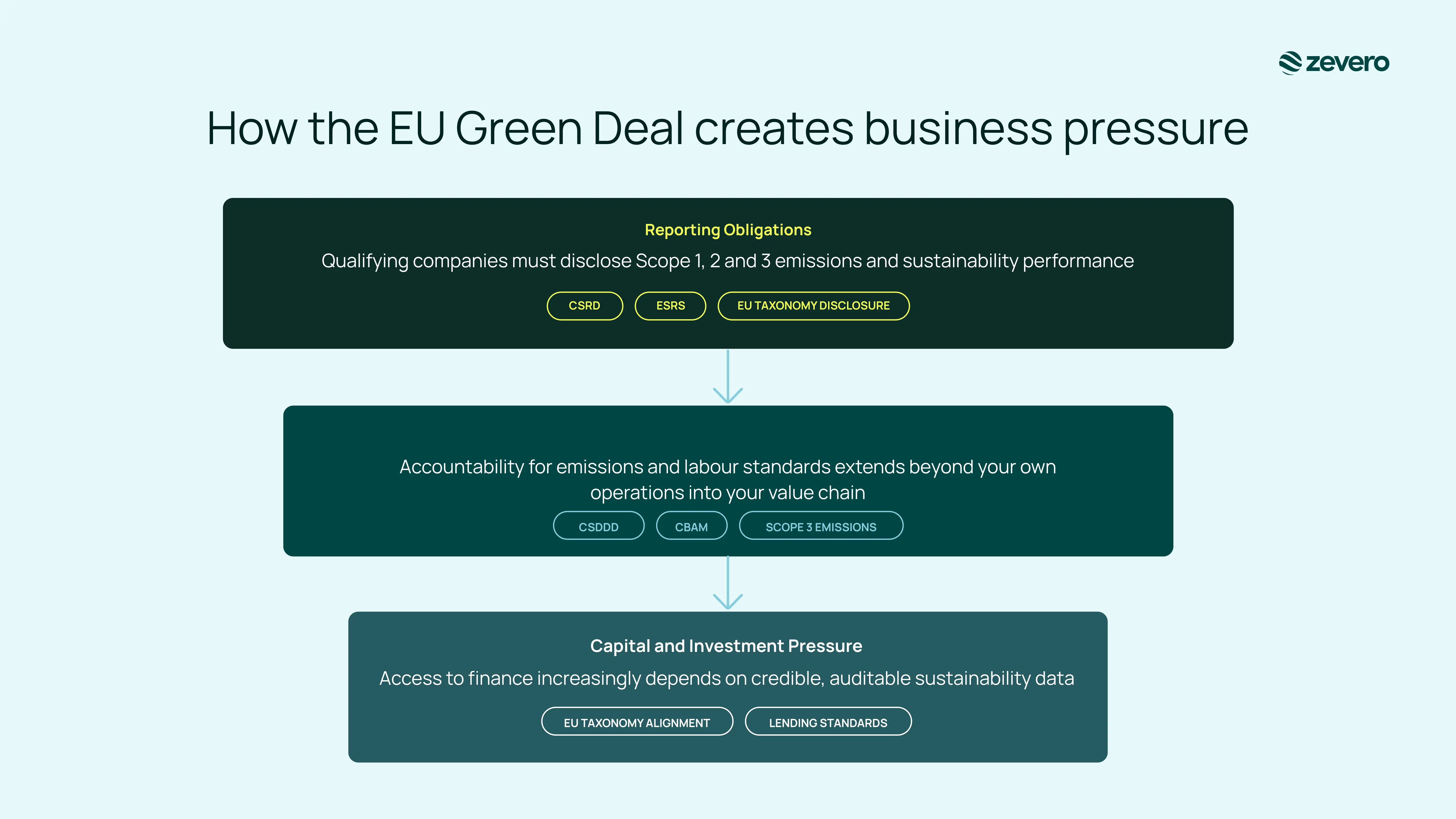
The Green Deal is reshaping the regulatory, financial, and competitive environment for businesses operating in or with ties to the EU. Its effects vary by sector and company size, but any business operating in or trading with the EU will feel it. The most direct exposure comes through reporting requirements. The CSRD requires qualifying companies to disclose detailed information on their environmental, social, and governance performance under the European Sustainability Reporting Standards (ESRS). For companies in scope, this means disclosing Scope 1, 2, and 3 greenhouse gas (GHG) emissions, alongside data on energy use, biodiversity impacts, and supply chain practices.
Supply chain exposure is a second pressure point. Requirements flowing from the Corporate Sustainability Due Diligence Directive (CSDDD) and CBAM are pushing accountability for emissions and labour standards further up the value chain. Companies that cannot demonstrate the provenance and carbon intensity of their inputs face growing risk, from regulators and from customers alike.
Capital allocation is a third pressure point. As EU Taxonomy alignment becomes a more standard component of investment and lending criteria, companies with credible, auditable sustainability data are better positioned to access finance on favourable terms.
The companies building robust carbon accounting infrastructure now are not just preparing for compliance. They are building the capability to respond clearly to investors, customers, and regulators as this landscape continues to evolve.
Navigating the EU Green Deal starts with your data
The EU Green Deal represents a fundamental shift in how the EU's economy is expected to operate over the coming decades. It will continue to evolve: targets will be stress-tested, timelines will shift, and the political context will change. But the direction is clear. Regulatory pressure on emissions, supply chain accountability, and sustainability disclosure will increase, not ease.
The companies best placed to navigate this are those that have built the data infrastructure to respond quickly. Zevero helps businesses do exactly that:
- Measure Scope 1, 2, and 3 emissions accurately and consistently, giving you the verified data CSRD and investor queries demand.
- Track supply chain carbon exposure so CBAM and CSDDD obligations do not catch you off guard.
- Align with the EU Taxonomy by mapping your activities against sustainability criteria with auditable, structured data.
- Move from annual reporting to continuous monitoring, so your carbon data is always current and decision-ready.
The earlier you build it, the better placed you are. Find out how Zevero can help you get ahead of the Green Deal.
FAQs
What is the difference between the EU Green Deal and Fit for 55?
Does the Green Deal apply to companies outside the EU?
How does the EU Green Deal relate to the CSRD?
What is the EU Taxonomy?
Has the EU Green Deal been weakened by recent political changes?

Related posts
Read more

Blog
Feb 5, 2026
CBAM Explained: The EU Carbon Border Adjustment Mechanism
CBAM Explained: The EU Carbon Border Adjustment Mechanism

Read more
Blog
Feb 12, 2025
What is CSRD? How the Corporate Sustainability Reporting Directive Impacts Businesses Worldwide
What is CSRD? How the Corporate Sustainability Reporting Directive Impacts Businesses Worldwide
Read more
Blog
Jul 22, 2026
CSDDD: What Can Businesses Do to Stay Ahead of the Curve?
CSDDD: What Can Businesses Do to Stay Ahead of the Curve?
See how Zevero can streamline your carbon reporting
Grow your business and reduce your impact