Policy


Quick summary
- The ban on destroying unsold goods applies to large companies from July 2026. Building product-level data capability before delegated acts activate for your category is considerably easier than retrofitting it under compliance pressure.
- The ESPR applies to all products placed on the EU market, regardless of where they are made. Non-EU manufacturers and exporters selling into the EU are in scope.
- The Digital Product Passport is the ESPR's central compliance mechanism, requiring product-level sustainability data to be structured, accessible, and maintained for the product's lifetime plus ten years. Requirements vary by product group and are confirmed through individual delegated acts.
- The ESPR shifts supply chain emissions data from a reporting input to a product compliance requirement, moving from company-level to product-level granularity.
Most of the EU's sustainability regulation has focused on how companies report their environmental impact. The Ecodesign for Sustainable Products Regulation (ESPR) takes a different approach: it sets sustainability requirements for physical products themselves, covering how they are designed, what information must travel with them, and what companies can and cannot do with unsold stock.
The ESPR entered into force on 18 July 2024. Its scope is broad and its reach extends to companies headquartered outside the EU. All products in the relevant categories that enter the EU market, regardless of their country of manufacture, must comply. For companies that manufacture, import, or sell physical products into the EU, this regulation is worth understanding now, not when the delegated acts for your product category are finalised.
What is the ESPR?
The ESPR is the EU's framework for making physical products more durable, repairable, recyclable, and resource-efficient across their whole lifecycle. Unlike its predecessor, the 2009 Ecodesign Directive, which mainly targeted energy efficiency in products like fridges and washing machines, the ESPR expands the scope to almost all product categories, placing a strong emphasis on product circularity.
Delegated acts are legally binding rules adopted by the European Commission to fill in the technical detail of a framework regulation, in this case setting the specific sustainability requirements for each product group. The ESPR works through this system: rather than applying a single set of rules to all products at once, it sets requirements for specific product groups over time. In April 2025, the Commission adopted the first ESPR and Energy Labelling Working Plan, covering five years with a review in 2028. A transition regime lasting until 2030 has been in place since the ESPR's entry into force in July 2024, enabling the previous Directive to continue to operate in the interim.
What does the ESPR require?
The ESPR introduces three categories of requirements that companies selling into the EU need to understand.
Performance and information requirements
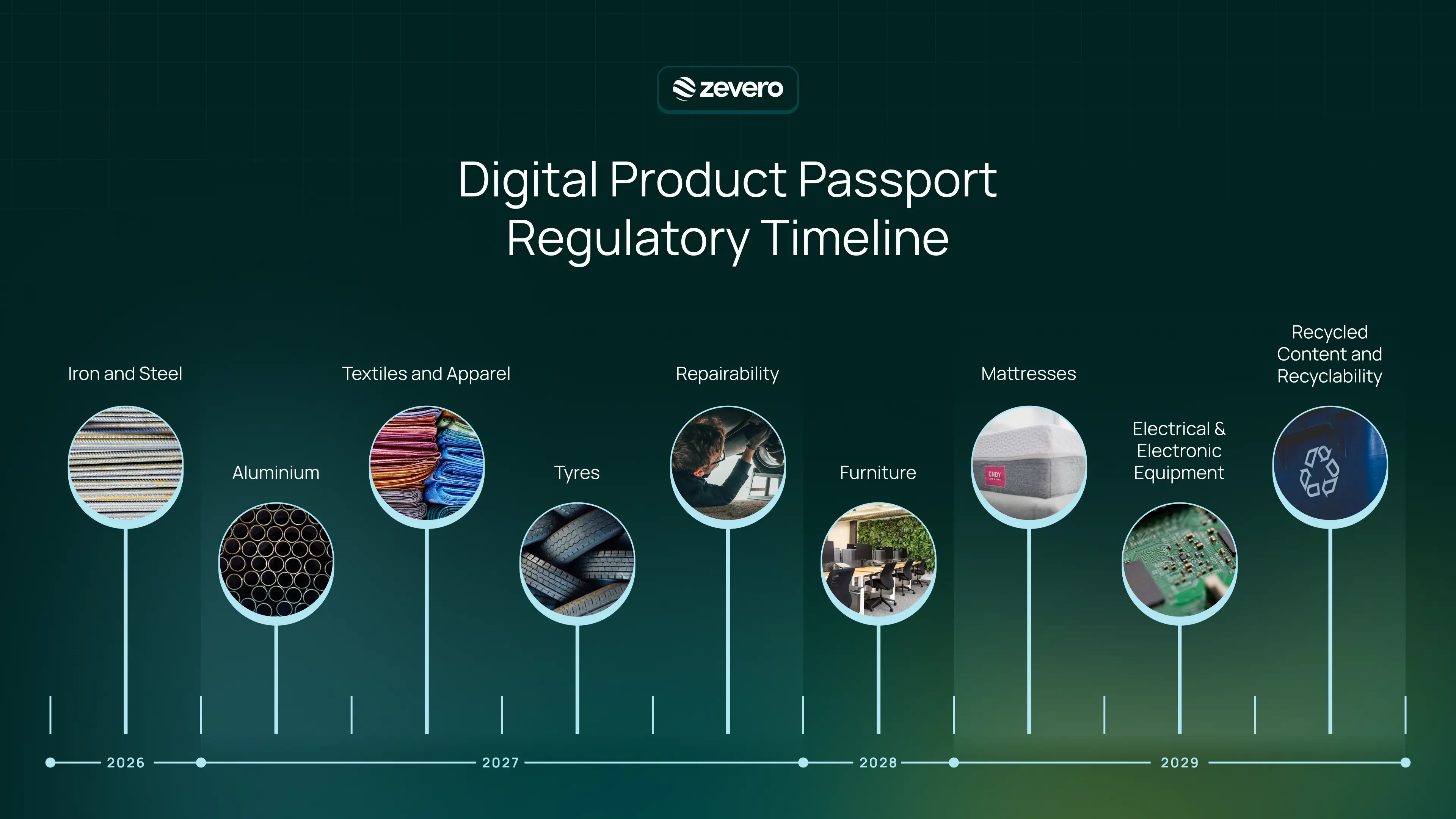
The ESPR empowers the European Commission to set product-specific rules on durability, repairability, recyclability, energy efficiency, and environmental impact. Eleven product groups have been prioritised in the first working plan: iron and steel, aluminium, textiles, furniture, tyres, detergents, paints, lubricants, chemicals, energy-related products, and information and communication technology. Detailed rules for each group will follow in individual delegated acts.
From 2026, ESPR begins with iron and steel, focusing on emissions, energy efficiency, and resilience. In 2027, aluminium, textiles, and tyres join, with measures for secondary materials, longer product lifespans, and improved recyclability.
The ban on destroying unsold goods
One of the boldest measures introduced by the ESPR is its ban on the destruction of unsold consumer goods. This directly targets a well-documented practice in fashion, electronics, and retail where unsold inventory is destroyed to avoid storage or discounting costs. The prohibition will enter into force on 19 July 2026 for major enterprises and on 19 July 2030 for medium-sized enterprises.
The Digital Product Passport (DPP)
The Digital Product Passport (DPP) is the ESPR's mechanism for making product sustainability data accessible and verifiable. The DPP is a digital data container designed to enhance transparency, traceability, and circularity by providing standardised, product-specific sustainability and lifecycle data.
The DPP will be attached to each product in the form of an NFC chip, QR code, or RFID tag, and linked to a cloud-hosted passport. It is not a marketing tool. It is a structured, regulated record that must be complete, accurate, and continuously updated. The DPP must be maintained for at least the typical lifetime of the product plus an additional ten years. The data captured will vary by product group but is expected to include material composition, substances of concern, environmental performance indicators, carbon footprint, repairability scores, and end-of-life information. By July 2026, the European Commission will deploy a central DPP registry to support enforcement and transparency.
Who does the ESPR apply to?
The ESPR applies to manufacturers and importers placing products on the EU market. It is not limited to EU-based companies. The obligation to implement the DPP lies with the economic operator who places the product on the market or puts it into service, regardless of where the product is manufactured. This means a company headquartered in the US, UK, or Asia that exports products into EU member states is in scope if those products fall within a covered category.
Where a manufacturer is not established in the EU, the obligation falls on a designated EU-based representative or importer acting on their behalf. Obligations do not all apply at once: requirements roll out by product group through delegated acts, and the timeline for each group differs. Companies should monitor which delegated acts apply to their specific product categories as the working plan progresses through 2026 to 2030.
What does the ESPR mean for supply chain data?
The ESPR introduces a data burden that goes well beyond traditional sustainability reporting. Producing a compliant DPP requires product-level data: material composition, lifecycle environmental performance, supplier inputs, and carbon footprint, gathered and maintained at the individual product level, not at the company level. This is where Scope 3 emissions data becomes operationally relevant in a new way. For most companies, Scope 3 Category 1 (purchased goods and services) is already one of the hardest categories to measure accurately. The ESPR effectively makes supply chain emissions data a product compliance input, not just a reporting figure.
Companies already working towards The Corporate Sustainability Reporting Directive (CSRD) compliance will find some overlap in the data they need, but the ESPR goes further: where CSRD asks how much carbon a company emits in total, the ESPR asks how much carbon is embedded in each individual product. Building that capability now, while delegated acts are still being finalised, is considerably easier than retrofitting it under compliance pressure. Getting ready for DPPs requires aligning sustainability, procurement, and data teams to produce structured, verifiable product-level sustainability data that regulators and supply chain partners can access and check.
How Zevero can help
The ESPR is a long-term structural shift in how the EU governs physical products. The companies best placed to navigate it are those building product-level data infrastructure now, before delegated acts lock in the specific requirements for their categories.
Zevero helps businesses build that foundation:
- Calculate product-level carbon footprints across your portfolio, so the emissions data a Digital Product Passport requires is already structured, traceable, and audit-ready
- Map your supply chain emissions at Category 1 level, giving you the granular purchased goods and services data that DPP compliance will demand from your suppliers
The earlier you build that capability, the better placed you are when delegated acts confirm the requirements for your product categories. Get in touch with the Zevero team to find out how we can help.
FAQs
Are there any exemptions for SMEs?
Does the ESPR apply to products already on the market?
Who is responsible for the DPP if a product changes hands through a supply chain?
How does the ESPR interact with the EU Battery Regulation?
Thanks for reading!
ESPR: The EU's New Rules for Sustainable Products, Explained
Add us as a preferred source

Related posts
.jpg)
Read more

Blog
Oct 28, 2025
The Digital Product Passport: A New Era of Transparency in the EU
The Digital Product Passport: A New Era of Transparency in the EU

Read more
Blog
Oct 20, 2025
Get to Know the EU Construction Products Regulation
Get to Know the EU Construction Products Regulation

Read more
Blog
Aug 11, 2025
Green Claims Code in the UK: What businesses need to know
Green Claims Code in the UK: What businesses need to know
See how Zevero can streamline your carbon reporting
Grow your business and reduce your impact