Policy

%20(1).webp)
Quick summary
- CSDS 1 and CSDS 2 are currently voluntary in Canada. The CSA paused its mandatory rulemaking in April 2025, citing US regulatory uncertainty. A mandatory rule remains possible but the timeline is unconfirmed.
- FRFIs are the exception. OSFI Guideline B-15 requires federally regulated financial institutions to report under a CSDS-aligned framework, with Scope 3 phased in to fiscal year-end 2028.
- Voluntary does not mean low priority. Investor expectations, existing securities law obligations, and mandatory requirements in other jurisdictions all create pressure to act now regardless of the CSA pause.
In December 2024, the Canadian Sustainability Standards Board (CSSB) finalised the Canadian Sustainability Disclosure Standards (CSDS), Canada's first nationally developed sustainability reporting standards, built on the ISSB global baseline. They are currently voluntary, and the path to mandatory adoption remains uncertain.
In April 2025, the Canadian Securities Administrators (CSA) paused its mandatory climate disclosure rulemaking, citing US regulatory uncertainty and broader geopolitical developments. But voluntary status does not eliminate the pressure to disclose. Existing Canadian securities law already requires disclosure of material climate risks, investors are requesting CSDS-aligned data, and companies with EU, Mexican, or Australian operations may already face mandatory requirements elsewhere that CSDS preparation supports.
What are CSDS 1 and CSDS 2?
On December 18, 2024, the CSSB finalised CSDS 1 and CSDS 2 along with the Criteria for Modification Framework, which outlines how the CSSB decides to make changes to IFRS Sustainability Disclosure Standards to reflect Canadian priorities.
CSDS 1 covers general requirements for sustainability-related financial disclosures. It mirrors IFRS S1 in structure, requiring entities to disclose information on sustainability-related risks and opportunities across four pillars: governance, strategy, risk management, and metrics and targets.
CSDS 2 covers climate-related disclosures. It mirrors IFRS S2 and requires disclosure of climate-related risks and opportunities, both physical and transition risks, scenario analysis, Scope 1, 2, and 3 GHG emissions, and climate-related targets and transition plans.
Both standards are effective for annual reporting periods beginning on or after 1 January 2025, on a voluntary basis. They require the same disclosures as IFRS S1 and S2, with one difference: Canada has built in additional time to phase in Scope 3 reporting and quantitative scenario analysis.
How CSDS relates to ISSB
Canada's decision to build CSDS on the ISSB global baseline rather than creating a standalone domestic framework has practical implications for companies operating beyond Canadian borders. Here is why that alignment matters:
- Cross-border efficiency. A CSDS-aligned report satisfies investor and regulatory expectations in multiple jurisdictions simultaneously, without building separate processes for each.
- Existing mandatory exposure. Companies with operations in the EU, California, or Mexico may already be subject to mandatory sustainability reporting requirements elsewhere. CSDS preparation directly supports those obligations from the same data foundation.
- Global comparability. Canadian companies building against CSDS are building against the same baseline that governs mandatory reporting in Australia, Singapore, Japan, and the UK. Companies that invest in CSDS preparation are not doing Canada-specific work, they are building against a global standard.
Where things stand on mandatory reporting
The current regulatory picture has three distinct tracks, each applying to a different population of companies. Understanding which track applies to a given entity is the most important first step in assessing CSDS exposure.
The CSA pause
For most Canadian public companies, a mandatory CSDS rule is not on the immediate horizon. The CSA has signalled it will revisit the project in future years but has given no timeline for doing so. In the meantime, the underlying disclosure obligation has not gone away. Canadian securities law already requires companies to disclose material climate-related risks in the same way they would disclose any other material information, and the CSA pause does not change that.
OSFI Guideline B-15
Federally regulated financial institutions (FRFIs) such as banks and insurance companies are not covered by the CSA pause. OSFI's Guideline B-15 requires FRFIs to make CSDS-aligned climate disclosures regardless of what the CSA decides. The largest banks and insurance groups must comply from fiscal year-end 2024, and all other FRFIs from fiscal year-end 2025. Scope 3 emissions disclosure is required from fiscal year-end 2028, with a later deadline of fiscal year-end 2029 for certain assets under management. For FRFIs, this is mandatory.
Canada Business Corporations Act amendments
The federal government previously proposed making climate disclosure mandatory for large private companies incorporated under federal law. That proposal has stalled. Given the CSA pause, the recent Canadian election, and the current political environment, mandatory CBCA amendments are unlikely to move forward in the near term. No timeline has been set.
Phased implementation timeline
For companies choosing to adopt CSDS voluntarily, or preparing ahead of any future mandatory requirement, the CSSB has built in transition relief:
- FY2025 and FY2026: Entities may limit disclosures to climate-related risks and opportunities only, deferring broader sustainability disclosures. Scope 3 emissions reporting and quantitative scenario analysis may also be deferred.
- FY2027: Scope 3 emissions, quantitative scenario analysis, and full sustainability disclosures become effective for CSDS adopters who have used the transitional relief.
- FY2028: Scope 3 deadline for FRFIs under OSFI Guideline B-15.
- Mandatory CSA rule: Timeline to be confirmed. CSA to revisit.
Once the three-year transition period expires, sustainability disclosures must be published at the same time as financial statements.
.webp)
Preparing for CSDS
The CSA pause does not change the underlying risk picture for Canadian companies. Four reasons to act now rather than wait:
1. Investor and lender expectations are already moving. Large institutional investors and lenders are requesting CSDS-aligned data from Canadian companies regardless of regulatory status. A voluntary pause from the CSA does not pause investor due diligence.
2. Existing securities law still applies. As noted above, existing securities law has not changed. Companies that have not assessed and disclosed material climate risks remain exposed regardless of whether a new mandatory rule exists.
3. Global footprint creates mandatory exposure elsewhere. Companies with operations subject to CSRD in the EU, California's climate disclosure laws in the US, or Mexico's CNBV Resolution are already inside mandatory sustainability reporting requirements. Building one data foundation for all of them is considerably more efficient than managing each separately.
4. Building data infrastructure takes time. The data collection, governance, and verification processes required for CSDS-aligned reporting take months to build. Companies that start now will not be scrambling when a mandatory rule lands, or when the next investor questionnaire arrives.
What preparation looks like
Whether CSDS becomes mandatory next year or in five years, the underlying data and governance infrastructure it requires takes time to build. These four areas are worth prioritising now, not because of a regulatory deadline, but because they are the foundation of any credible climate disclosure programme:
Governance
Establish board-level accountability for climate and sustainability risks. CSDS 1 requires disclosure of how governance bodies oversee sustainability-related risks and opportunities. This is a process change, not just a reporting one.
Data foundations
Start with Scope 1 and 2 emissions data. These are the foundation of any CSDS 2-aligned disclosure and are already required for FRFIs under OSFI B-15. Build Scope 3 data collection infrastructure alongside Scope 1 and 2 work, even if the disclosure deadline is later.
Process alignment
Integrate sustainability reporting into the financial reporting cycle from the outset. CSDS requires sustainability disclosures to be published alongside financial statements once transition relief periods expire. Integrating from the outset avoids significant rework when that point arrives.
Voluntary assurance
Consider early-stage voluntary assurance of climate disclosures, even before it is required. Building assurance-ready data processes now is considerably more efficient than rebuilding them under mandatory assurance timelines.
How Zevero can help
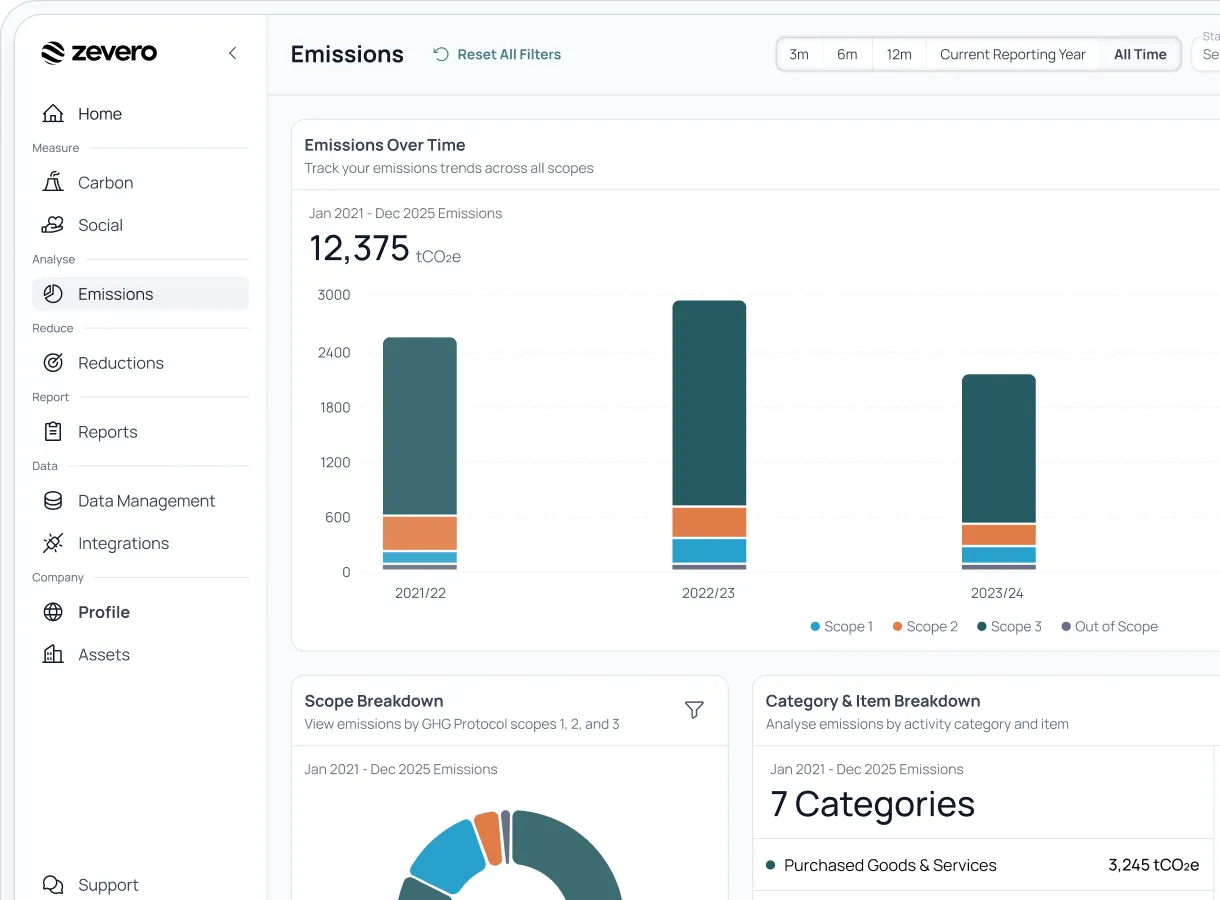
CSDS preparation starts with a robust carbon data foundation, and the Zevero platform is built to support exactly that. Measure the carbon footprint of your operations and supply chain using GHG Protocol-aligned methodology, producing the traceable carbon data that CSDS 2 and OSFI B-15 disclosures require. Convert existing data into audit-ready ESG reports aligned with global frameworks, using the AI-Powered ESG Reporting Tool. This is the data trail an external auditor will need when assurance requirements arrive.
While the mandatory picture in Canada may be uncertain, the business case for preparing now is not. Get in touch with our team to find out how Zevero can help.
FAQs
What is the CSSB and who oversees it?
Does the CSA pause mean companies no longer need to disclose climate risks?
What is the Bill C-59 greenwashing risk for CSDS disclosures?
Do CSDS apply to private companies?
How does CSDS handle Indigenous Peoples' rights?
Thanks for reading!
Understanding Canada's Sustainability Disclosure Standards
Add us as a preferred source

Related posts

Read more

Blog
May 12, 2026
Mexico's Sustainability Reporting Standards: The CNBV Resolution and NIS Explained
Mexico's Sustainability Reporting Standards: The CNBV Resolution and NIS Explained

Read more
Blog
Feb 10, 2026
What Is IFRS? A Finance & Sustainability Leader's Guide to S1 and S2
What Is IFRS? A Finance & Sustainability Leader's Guide to S1 and S2

Read more
Blog
Feb 12, 2025
What is CSRD? How the Corporate Sustainability Reporting Directive Impacts Businesses Worldwide
What is CSRD? How the Corporate Sustainability Reporting Directive Impacts Businesses Worldwide
See how Zevero can streamline your carbon reporting
Grow your business and reduce your impact