Education

.webp)
Quick summary
- Methodology documentation and emissions factor quality are the foundation of everything. A vendor that cannot clearly explain where their emissions factors come from or show their methodology documentation is not audit-ready, regardless of how polished the demo looks.
- How a platform handles supplier data and what happens to data if the relationship ends are both questions with significant practical consequences that are rarely asked early enough.
- Ask to see outputs, not features. A real example report for the relevant framework, and a reference customer in a comparable industry, tell you more than any feature list or comparison table.
The carbon accounting software market has grown rapidly, and most platforms look similar from the outside. The demos are polished. The feature lists overlap. Every vendor says they support the Corporate Sustainability Reporting Directive (CSRD), cover all fifteen Scope 3 categories, and make carbon accounting easy.
The real differences only surface when the right questions are asked. This blog provides ten of them, along with the reasoning behind each one, so that anyone evaluating carbon accounting software can approach vendor conversations with a clearer sense of what actually matters. For companies still building the case for why carbon accounting matters, that context is worth establishing first.
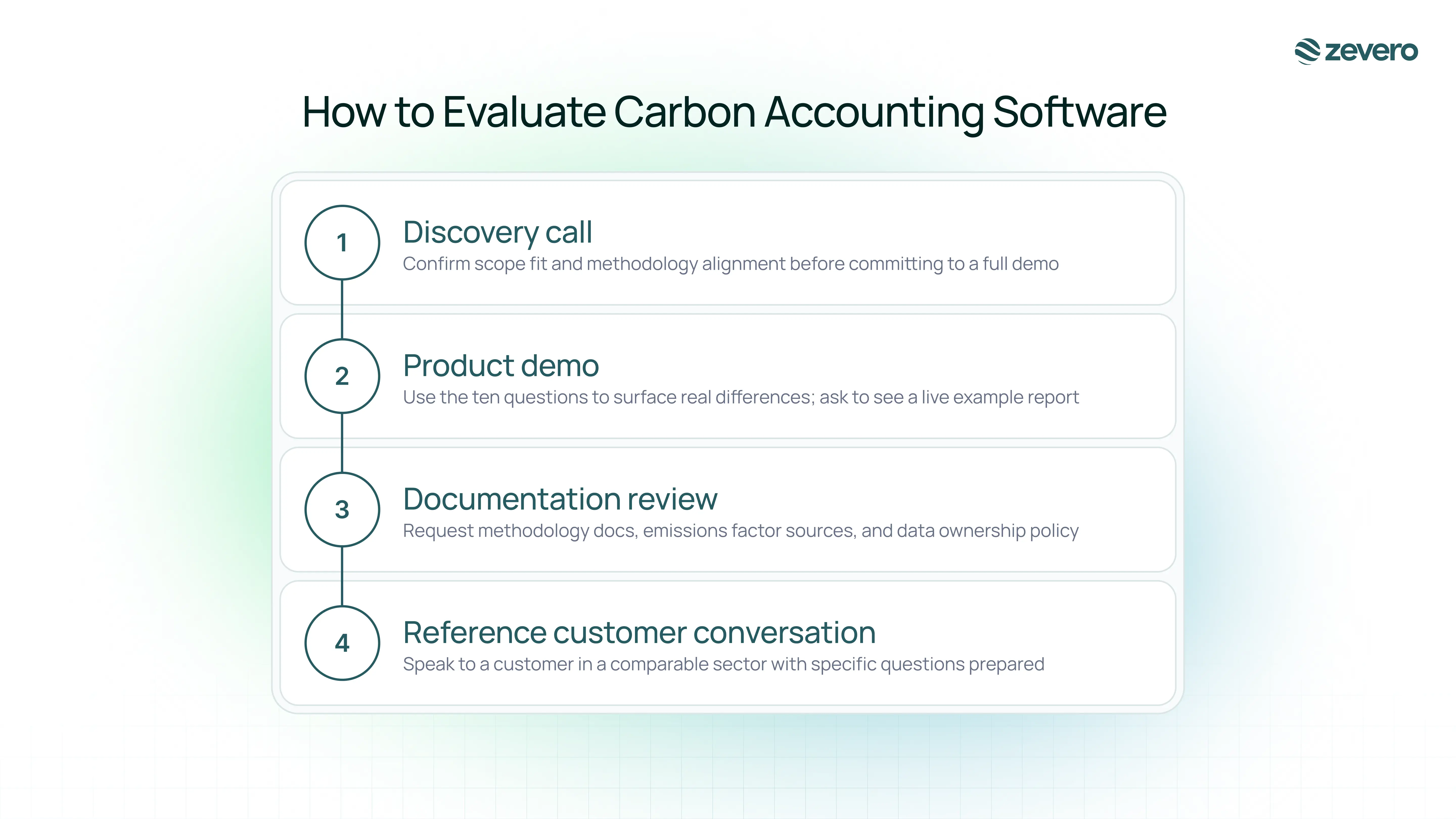
Ten questions for your next vendor demo
1. Is your methodology GHG Protocol-aligned, and is that documented?
The GHG Protocol is the most widely used international standard for corporate carbon accounting. Most vendors claim alignment, but the meaningful follow-up is whether that alignment is formally documented, publicly available, and verified by an independent third party.
Why this matters: if the methodology is not clearly documented, it will not hold up under external assurance. As CSRD and other disclosure frameworks require third-party verification, audit defensibility is a practical requirement, not a nice-to-have. Asking to see the methodology documentation during the evaluation, rather than as a post-meeting follow-up, is a reasonable and revealing test. It is also worth asking whether the platform aligns with data security frameworks such as ISO 27001, particularly if sensitive commercial or supplier data will be processed.
2. How often are your emissions factors updated, and where do they come from?
Emissions factors are the conversion rates that turn activity or spend data into carbon figures. Their quality, source, and update frequency directly affect the reliability of every calculation the platform produces.
Why this matters: outdated factors produce inaccurate baselines, and inaccurate baselines undermine the reduction targets built on top of them. Ask which databases the vendor draws from, and how frequently those factors are refreshed. Common sources include the UK Department for Energy Security and Net Zero (DESNZ, formerly DEFRA), the US Environmental Protection Agency (EPA), EXIOBASE, or ecoinvent, A platform that cannot name its emissions factor sources cannot be properly audited. It is also worth asking whether the vendor can point to a track record of successful external audits among their existing customers.
3. How does the platform handle Scope 3, and what data does the company need to provide?
Scope 3 emissions represent the majority of most companies' carbon footprints. The GHG Protocol defines fifteen Scope 3 categories covering everything from purchased goods to the use of sold products. How a vendor handles these categories, and what data inputs they require, is where the real work lives.
Why this matters: the answer reveals how much internal resource and supplier engagement the platform will demand, and how accurate the Scope 3 output will actually be. A vendor that handles Scope 3 using spend-based estimates for everything is a different proposition to one that can ingest supplier-specific activity data. The evaluation should cover which categories the platform supports, what data is needed for each, and how gaps in supplier data are handled.
4. What does implementation look like, and how long before usable data is available?
Some vendors require extensive configuration or external consultancy to implement. Those costs are not always visible in the initial pricing conversation, and implementation timelines vary significantly across platforms.
Why this matters: a realistic implementation timeline affects when the platform starts delivering value, and hidden consultancy requirements increase the true cost of the platform significantly. Ask for a step-by-step breakdown of the implementation process, who is responsible for each step, and what a typical timeline looks like for a company of similar size and complexity. Confirm whether any professional services are required and what they cost.
5. Who owns the data, and what happens to it if the company leaves?
Data ownership and portability are rarely discussed during vendor demos but matter significantly if the relationship ends or if data needs to be exported for audit or regulatory purposes.
Why this matters: sustainability data is increasingly material to regulatory disclosures, investor reporting, and legal obligations. If a vendor retains ownership of data or restricts how it can be exported, that creates a vendor dependency that is difficult to exit cleanly. Confirm what format data can be exported in, whether historical data is retained and for how long, and what the process looks like if the company decides to leave.
6. What reporting frameworks does the platform output to, and can we see an example report?
Knowing a platform "supports CSRD" or "covers the Carbon Disclosure Project (CDP)" is a starting point, not an answer. What matters is what the output actually looks like and whether it meets the specific requirements of the frameworks the company needs to report against.
Why this matters: a platform can technically support a framework without producing output that satisfies its requirements in practice. Ask to see a real example report in the format needed, not a template or a screenshot. If a vendor cannot show a complete output for the relevant framework, that is a reason to ask for clarification before signing a contract.
7. Is expert support included, or is it a self-serve platform?
Carbon accounting involves decisions about which emissions sources to include, methodology choices, and data quality judgements that software cannot make automatically.
Why this matters: the true cost of a self-serve platform includes the internal time and expertise needed to make those decisions well. If the platform does not include access to human sustainability expertise, that cost may need to be sourced elsewhere. Clarify what support is included in the price, what access to sustainability experts looks like, and what falls outside the standard package.
8. How does the platform handle gaps or inconsistencies in input data?
No company has perfectly complete data, particularly for Scope 3. How a platform responds when data is missing, inconsistent, or below acceptable quality is a meaningful indicator of how the output should be interpreted and trusted.
Why this matters: a platform that silently accepts incomplete or inconsistent data and produces a clean-looking output gives a false sense of accuracy. One that flags problems clearly is the more reliable tool. Ask the vendor to walk through what happens when a data upload contains gaps or anomalies, how the platform communicates data quality issues, and what assumptions are made when input data is missing.
9. What integrations exist with ERP, procurement, or finance systems?
The volume and quality of emissions data a platform can process depends significantly on how easily it connects to the systems where that data already lives.
Why this matters: manual data entry is the hidden cost of many carbon accounting implementations. A platform that cannot integrate with existing finance or procurement systems may require significant ongoing manual effort to keep the footprint current. Listing the company's key systems in advance and asking about each one specifically is the most efficient way to assess integration fit.
10. Can you show us a customer in a similar industry or at a similar stage?
A reference customer in a comparable sector or at a comparable stage of carbon measurement is more informative than any feature list or case study the vendor has produced themselves.
Why this matters: it reveals how the vendor handles implementation for companies with similar data challenges, similar Scope 3 profiles, and similar reporting obligations. It also tests whether the vendor's claimed capabilities translate into practical outcomes for organisations like the one evaluating them. Ask for an introduction to a reference customer, not just a written case study, and preparing a short list of specific questions to ask the reference customer directly will make that conversation significantly more useful than a general reference call.
Before you choose
These ten questions will not eliminate the effort of a software evaluation, but they will surface the differences that matter. The carbon accounting software market is crowded and capabilities vary more than demos suggest. The companies that get the most from their evaluation are those that define their requirements clearly before entering vendor conversations, rather than letting feature demonstrations shape their expectations.
For companies at the start of their measurement journey, Zevero's corporate carbon footprint software is built around GHG Protocol-aligned methodology, with in-house sustainability experts included as standard and audit-ready documentation built into every calculation. Speak to the Zevero team to find out if it is the right fit.
FAQs
How is carbon accounting software different from ESG reporting software?
Do smaller companies need enterprise-grade carbon accounting software?
What should a carbon accounting software implementation realistically cost?
How long should a carbon accounting software evaluation take?
What is the difference between carbon accounting software and a carbon calculator?
Thanks for reading!
10 Questions to Ask When Evaluating Carbon Accounting Software
Add us as a preferred source

Related posts
.jpeg)

Read more

Blog
May 8, 2024
Location Vs Market-Based Carbon Reporting
Location Vs Market-Based Carbon Reporting
Read more
Blog
Jul 22, 2025
The 7 Best Carbon Accounting Software in 2025
The 7 Best Carbon Accounting Software in 2025
See how Zevero can streamline your carbon reporting
Grow your business and reduce your impact