Policy

%205000.webp)
On 12 November 2025 the Financial Reporting Council announced the publication of ISSA (UK) 5000, titled General Requirements for Sustainability Assurance Engagements.
The International Standard on Sustainability Assurance (UK) 5000, or ISSA (UK) 5000, is the UK-version of the global standard for verifying sustainability information. It was published on 12 November 2025 by the Financial Reporting Council, titled General Requirements for Sustainability Assurance Engagements.
introduces a consistent and internationally aligned assurance framework for sustainability disclosures. For UK organisations, ISSA (UK) 5000 marks an important milestone. Reliable and comparable ESG and climate reporting is now expected by investors, regulators, and stakeholders.In this blog we explain what ISSA (UK) 5000 is, why it matters, and how teams can begin to prepare.
What is the ISSA (UK) 5000?
ISSA (UK) 5000 is the UK-adopted standard for sustainability assurance engagements. It is based on the global International Auditing and Assurance Standards Board (IAASB)’s standard and sets out the general requirements for assurance over sustainability reporting. The standard is profession-agnostic and applies to any sustainability topic, including climate, social, biodiversity, governance, or wider ESG metrics.
It covers both limited assurance and reasonable assurance engagements, depending on the scope and depth of review. The standard is framework-neutral, meaning it can be applied regardless of whether an organisation reports under the GHG Protocol, ESRS, ISSB, or other sustainability standards.
The UK version includes one key adaptation: external assurance providers are prohibited from receiving “direct assistance” from the organisation’s internal audit function. This safeguards independence and aligns sustainability assurance with the level of rigor expected in financial audits.
Why the ISSA (UK) 5000 matters now
Rising demand for trusted sustainability data
Investor and stakeholder expectations for credible ESG disclosures are growing. Without a common assurance standard, companies have used varied methods, making comparisons difficult. ISSA (UK) 5000 provides a consistent benchmark that increases confidence in reported sustainability information.
Alignment with emerging reporting requirements
As sustainability reporting regulations evolve, such as the Corporate Sustainability Reporting Directive (CSRD) and forthcoming UK reforms, assurance will become more common. ISSA (UK) 5000 ensures companies use a globally consistent assurance approach, reducing the risk of fragmented or inconsistent practices.
Improved governance, transparency, and comparability
The standard requires robust internal controls, well documented methodology, transparent assumptions, and clear disclosure boundaries. This strengthens the credibility and comparability of sustainability information across markets and reporting frameworks.
What the ISSA (UK) 5000 requires in practice
Clear methodology and criteria alignment: Organisations must align their sustainability disclosures with a defined reporting framework such as the GHG Protocol, ESRS or ISSB. Assurance providers assess whether information is prepared fairly in all material respects against that criteria.
Materiality assessment across financial and impact dimensions: ISSA (UK) 5000 supports both financial materiality, which considers how sustainability issues affect business performance, and impact materiality, which considers the organisation’s effects on people and the environment. This mirrors the direction of many regulatory frameworks.
Evidence, documentation, and professional judgement: Assurance providers require sufficient and appropriate evidence. This includes clear documentation of assumptions, calculations, boundaries and internal controls. Organisations need reliable data systems, traceable audit trails and structured governance.
Independence and quality management: Assurance providers must remain independent and comply with ethical requirements and quality-management standards. Internal audit cannot provide direct assistance, which reinforces the objectivity of the assurance process.
What this means for carbon accounting and emissions measurement
ISSA (UK) 5000 raises expectations for emissions data quality. Organisations must show how emissions are measured, how they are calculated and how accuracy is maintained over time. This includes internal controls, transparent methodologies and consistent reporting structures.
For carbon accounting, this means:
- Greater scrutiny of Scope 1, Scope 2 and Scope 3 calculations
- Clear justification for emission factors and data sources, including supplier data
- Standardised processes rather than ad-hoc or manual data collection
- Alignment with the GHG Protocol, ISO 14064, ISO 14067 and recognised life cycle assessment methodologies
- A documented approach for product carbon footprints and environmental declarations
Organisations still relying on manual spreadsheets or inconsistent methods may find it challenging to meet assurance expectations.
Which organisations will be most affected?
ISSA (UK) 5000 is relevant for any organisation preparing sustainability disclosures that could be subject to assurance. It is particularly important for:
- UK-listed or large private companies preparing climate-related financial disclosures
- Companies in high-emission or supply chain-intensive sectors, including consumer goods, FMCG, food and beverage, brewing, manufacturing, packaging and construction
- Organisations preparing for CSRD or ESRS alignment
- Companies setting or validating science-based targets
- Organisations developing Product Carbon Footprints or Environmental Product Declarations
These businesses often need consistent emissions calculations across multiple facilities, countries, and product lines, which makes assurance readiness essential.
How ISSA (UK) 5000 fits into the wider regulatory landscape
ISSA (UK) 5000 is part of a broader shift in the UK toward more consistent, decision-useful sustainability reporting. The UK government is developing its own Sustainability Disclosure Requirements, which are expected to be based heavily on the IFRS Sustainability Disclosure Standards published by the ISSB. As the UK Endorsement Board evaluates IFRS S1 and S2 for adoption, assurance will become increasingly common. ISSA (UK) 5000 supports this transition by providing a clear and internationally aligned framework for verifying sustainability information.
ISSA (UK) 5000 also matters for UK organisations that fall within the scope of the Corporate Sustainability Reporting Directive. CSRD applies to many UK companies with significant operations in the EU. It requires reporting under ESRS and external assurance. Because ISSA (UK) 5000 is aligned with global assurance principles, it helps organisations build reporting systems that meet both UK and EU expectations without duplication.
Taken together, these developments show a clear direction. The UK is moving toward structured sustainability reporting backed by high-quality assurance. ISSA (UK) 5000 is one of the core standards shaping that transition, and it gives organisations a practical foundation for preparing for future reporting and assurance requirements in multiple jurisdictions.
How organisations can prepare for ISSA (UK) 5000
1. Conduct a readiness assessment: Review current sustainability reporting practices, data systems, controls, and boundaries. Identify gaps relative to assurance requirements.
2. Strengthen data governance and process controls: Define data ownership, establish regular data collection cycles, standardise emission factors, and implement validation procedures.
3. Document methodology, assumptions, and scope: Ensure every figure–including emissions, energy consumption, product footprint, etc.— has traceable sources, boundaries, and assumptions.
4. Align reporting with a recognised framework: Use frameworks such as the GHG Protocol, ISO 14064/14067, ESRS, or ISSB as the foundation for your sustainability disclosures.
5. Build internal capacity and governance: Clarify responsibilities across sustainability, operations, and finance teams. Prepare for external assurance by documenting controls and decisions.
6. Combine technology and expert support: Automation reduces manual errors and improves consistency. Expert guidance ensures robust methodology, accurate calculations, and clear governance
Why Early Adoption Matters
Although ISSA (UK) 5000 is voluntary for now, early adopters will certainly benefit. They will build credibility, strengthen investor confidence, and reduce the risk of rushed compliance when assurance becomes mandatory. Early adoption also allows organisations to stress-test their data governance, systems, and reporting process before regulatory pressure increases. It can also create a competitive advantage in sectors where sustainability performance is heavily scrutinised.
How Zevero supports ISSA-ready sustainability reporting
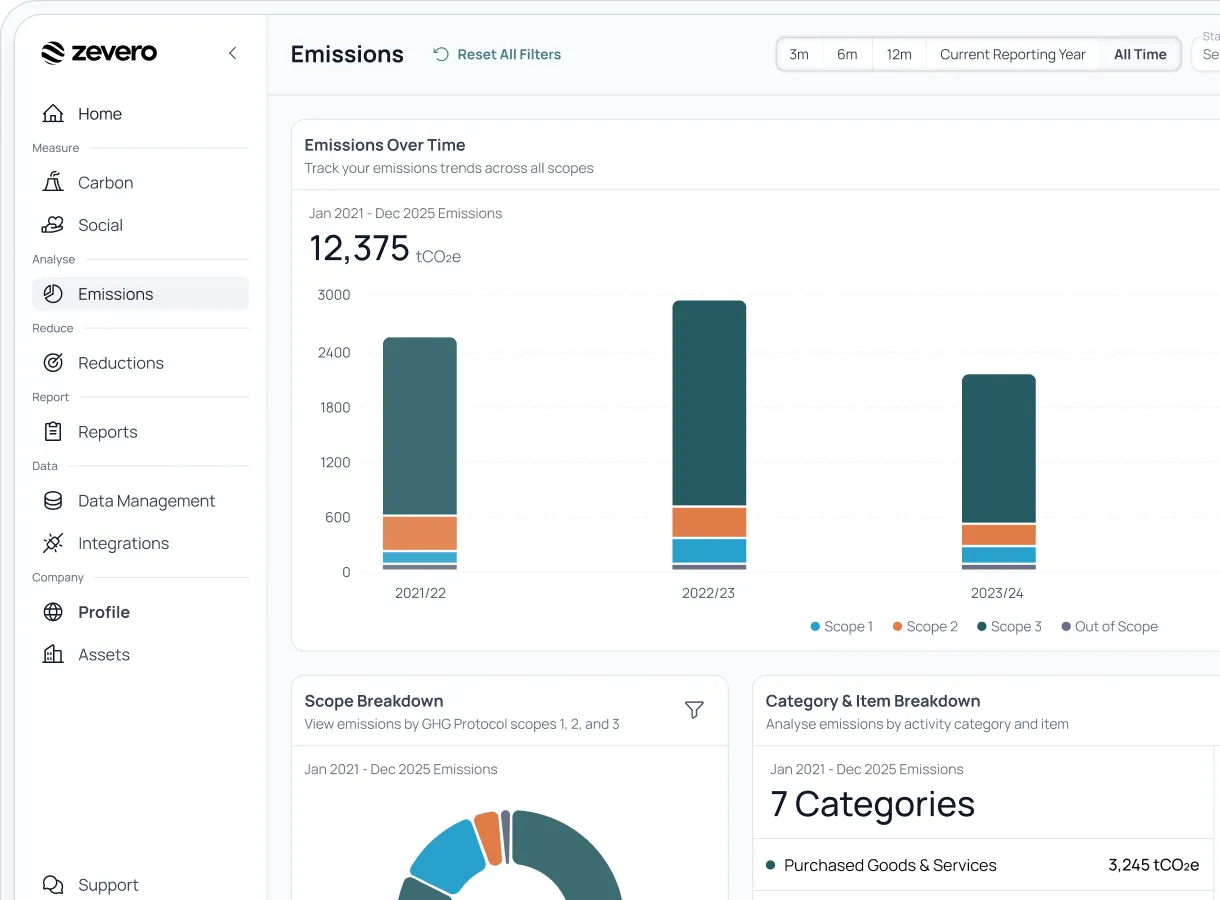
Zevero helps organisations collect, measure, and manage emissions data in a structured and transparent way. Our platform uses AI to match activity data with accurate emissions factors from global databases, while our in-house sustainability experts guide methodology, controls, and documentation. This combination of technology and expertise helps our clients meet assurance expectations with confidence.
We support organisations that want to:
- Strengthen carbon accounting workflows
- Prepare for emerging reporting requirements
- Improve the reliability and accuracy of emissions data
- Build audit-ready sustainability information
- Align with CSRD, ISSB, SBTi, ISO 14067, and the GHG Protocol
Key Takeaways
- ISSA (UK) 5000 is the UK benchmark for sustainability assurance.
- It focuses on consistency, transparency and accuracy across sustainability disclosures.
- Organisations need structured methodologies, strong controls and reliable data.
- The standard aligns with CSRD, ESRS, ISSB, SBTi and ISO frameworks.
- Combining technology with expert guidance is the most effective way to prepare for assurance.
Thanks for reading!
ISSA (UK) 5000 Explained: What UK Companies Need to Know
Add us as a preferred source

Related posts
.webp)
Read more

Blog
Oct 14, 2025
The UK Sustainability Reporting Standards (UK SRS) Explained
The UK Sustainability Reporting Standards (UK SRS) Explained

Read more
Blog
Jun 3, 2025
SECR Reporting: A Guide for UK Businesses
SECR Reporting: A Guide for UK Businesses

Read more
Blog
Aug 11, 2025
Green Claims Code in the UK: What businesses need to know
Green Claims Code in the UK: What businesses need to know
See how Zevero can streamline your carbon reporting
Grow your business and reduce your impact