Education


Every few months, another major organisation announces it has offset its way to carbon neutrality. Shortly after, another investigation reveals that the credits it purchased were low-quality, non-additional or outright fictitious. The debate that follows tends to generate more heat than light - with one side defending offsetting as essential climate finance and the other dismissing it as a mechanism for delay. Neither position is particularly useful for a sustainability manager trying to build a credible net-zero strategy.
The reality is that carbon offsetting is a legitimate and necessary tool in corporate climate action, but only when used for the right reasons, with the right credits, and in the right sequence. The quality of the market varies enormously. Regular scrutiny is increasing and organisations that do not understand the distinction between a good offset and a poor one are taking on real reputational and legal risk, often without realising it.
This guide sets out what carbon offsetting actually is, where it adds genuine value, where it falls short and what responsible practice looks like in 2026 and beyond.
What is Carbon Offsetting?
Carbon offsetting is the practice of funding a certified project that reduces or removes greenhouse gas emissions elsewhere, in order to compensate for emissions a company has not yet been able to eliminate from its own operations.
When an organisation purchases a carbon credit, it is paying for a verified reduction or removal of one tonne of CO2e from the atmosphere, achieved through a project operating outside its own value chain. Those credits are typically certified through recognised voluntary registries such as Gold Standard or Verra's Verified Carbon Standard (VCS), which apply methodological standards and require independent third-party verification before credits are issued.
The projects generating those credits fall into two broad categories:
1. Nature-based solutions
These projects store carbon in natural ecosystems while often supporting biodiversity and local communities.
Examples include:
- Reforestation and afforestation
- Forest conservation (REDD+)
- Soil carbon sequestration
- Wetland restoration
2. Technology-based solutions
These projects reduce emissions through technological solutions such as:
- Renewable energy deployment
- Methane capture from landfills
- Direct air capture and carbon removal technologies
Once verified by recognised carbon standards, these projects generate carbon credits that organisations can purchase and retire to offset their emissions.

Where carbon offsetting adds genuine value
Used correctly, carbon offsetting plays an important role in corporate climate strategy. Its purpose is specific: to address emissions that cannot yet be eliminated, not to compensate for ones that have not yet been attempted.
Addressing hard-to-abate residual emissions. Not every emission source can be eliminated with current technology or within a commercially viable timeframe. Steel, cement, aviation, and certain industrial processes present genuine decarbonisation challenges. For organisations with emissions in these categories, high-quality offsets provide a credible way to address residuals while reduction pathways mature.
Financing climate action in developing markets. Many offset projects fund renewable energy, forest conservation, or clean cooking solutions in regions where climate finance would not otherwise flow. Purchasing verified credits from these project channels is a meaningful contribution to global emissions reduction, not just an accounting exercise.
Bridging toward deeper reductions. For organisations early in their decarbonisation journey, offsets can provide short-term accountability while longer-term reduction strategies are built out. This is a reasonable approach, provided it comes with a genuine reduction roadmap and does not become a substitute for one.
The key framing: offsets are a complement to emissions reduction, not a replacement for it.
The limits of carbon offsetting
The offset market is not uniform. The gap between a high-quality credit and a low-quality one is significant, and buying the wrong kind creates both reputational and regulatory exposure.
Quality varies enormously
A verified, permanent credit from a credible registry is fundamentally different from an unverified, low-cost credit purchased through an unregulated broker. Price is not a reliable proxy for quality. Organisations should evaluate credits against four criteria: verification standard, project type, permanence, and co-benefits (social and biodiversity outcomes). Credits certified under Gold Standard or Verra VCS, with independent third-party verification, provide a stronger baseline than uncertified alternatives.
Additionality is the central test
Additionality is the most important concept in offset quality assessment. It asks: would this emissions reduction have happened anyway, without the funding from carbon credits?If the answer is yes, the credit does not represent a genuine climate contribution. A practical example: a renewable energy project in a market where solar capacity was already expanding rapidly at commercial rates may not be additional. The project would likely have been built regardless of offset revenue. Paying for that credit does not represent a genuine climate contribution, it represents a payment for something that was going to happen anyway.
Assessing additionality requires scrutiny of the project design and the market context. Credible registries apply additionality tests, but the methodology varies. It is worth understanding how a project has demonstrated additionality before purchasing credits from it.

Greenwashing risk is real
Organisations that offset without first reducing their own emissions face increasing exposure, both reputationally and legally. Regulators in the UK, EU, and elsewhere are tightening rules around environmental claims. The Voluntary Carbon Markets Integrity Initiative has published guidance on what constitutes a credible use of carbon credits in corporate claims. Making claims based primarily on offsetting, rather than demonstrated emissions reduction, is likely to attract challenges.
Several major organisations have faced significant reputational damage following investigative journalism into the quality of their offset portfolios. The standard of scrutiny applied to offset claims has materially increased.
Impermanence affects nature-based offsets
A forest credited for carbon storage can burn, be affected by disease, or face land-use change, releasing the stored carbon back into the atmosphere. Credible registries maintain buffer pools to account for this risk, but impermanence remains a genuine limitation. It does not make forestry credits worthless, but it does mean they are better suited to near-term bridging than to accounting for permanent emissions reductions.
What "good" offsetting practice looks like
Good offset practice follows a clear sequence: measure, reduce, then offset the residual.
This means:
- Measure accurately. Get reliable, complete emissions data across Scopes 1, 2 and 3 before making any offset decisions. You cannot credibly offset what you have not measured.
- Reduce first. Prioritise emissions reductions within your operations and value chain. Offsets should address what remains after genuine reduction efforts.
- Select high-quality credits. Use verified credits from credible registries. Assess additionality, permanence, and co-benefits. Avoid purchasing solely on price.
- Disclose transparently. Be clear about what you are offsetting, which credits you are using, and how they fit into your broader net-zero strategy. Vague claims about being "carbon neutral" without supporting methodology are increasingly unwarranted.
- Align with recognised frameworks. Guidance from VCMI and the Science Based Targets initiative (SBTi) sets out how offsets can be used credibly within corporate climate commitments. Understanding where your approach sits relative to these frameworks matters for stakeholder credibility.

Organisations that follow this approach are in a fundamentally different position from those using offsets as a shortcut. The difference is visible in the data, the documentation, and the ability to withstand external scrutiny.
Building a credible net zero strategy
Carbon offsetting is not going away. As more organisations confront emissions they can’t yet eliminate, demand for high-quality credits will continue to grow. The question isn’t whether to use offsets but how to use them credibly.
That depends almost entirely on the quality of your carbon accounting. Organisations that know exactly what they're emitting, where reductions are achievable, and what genuinely can't be eliminated yet are equipped to make defensible offset decisions. Those without that foundation are guessing—and in an environment of tightening regulation and increasing scrutiny, guesswork is a liability.
One distinction worth resolving before purchasing any credits: carbon neutrality and net zero are not the same thing, and the difference has direct implications for how offsets can legitimately be used within each type of commitment.
Build the foundation first with Zevero
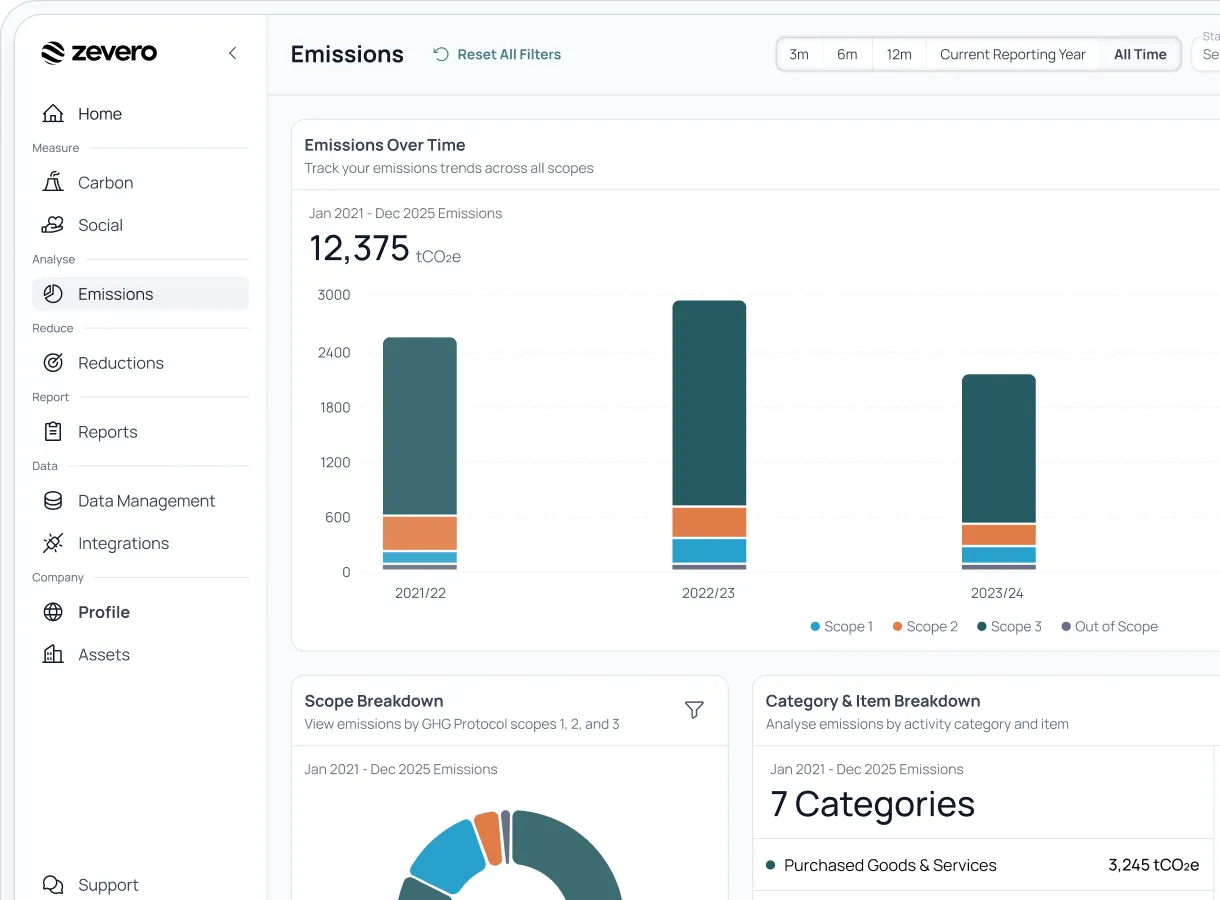
Before offsetting can play a credible role in your climate strategy, the underlying data has to be accurate, complete, and defensible. Zevero helps organisations build exactly that foundation.
- Measure with confidence. Scope 1, 2 and 3 emissions consolidated into one system, aligned with the GHG Protocol, so you know what you're actually offsetting before you buy a single credit.
- Identify where reductions are possible. Reduction opportunities across your operations and supply chain, surfaced clearly so you can prioritise action before reaching for offsets.
- Report with credibility. Audit-ready outputs aligned with CSRD, IFRS S2 and other global frameworks — so your offset disclosures hold up to investor and regulatory scrutiny.
- Get expert support. Our advisory team works alongside sustainability, finance and risk functions to navigate methodological decisions, including how to approach offset selection within a credible net zero plan.
Not sure where your emissions stand? Start with our free carbon calculator for an initial view of your footprint.
Frequently asked questions
1. What is the difference between a carbon offset and a carbon credit?
In most cases, the same thing: a certified unit representing one tonne of CO₂e reduced or removed from the atmosphere. The terms are used interchangeably in corporate reporting, and the distinction rarely affects how credits are measured or disclosed.
2. Do we need to reduce our emissions before we can start offsetting?
Yes. Offsets are designed for emissions you cannot yet eliminate, not emissions you haven't yet tried to reduce. The right order is to measure your full footprint, cut what you can, then use verified credits to cover what genuinely remains.
3. Can a company claim to be net zero if it uses carbon offsets?
Not straightforwardly. Under the SBTi framework, companies must reduce emissions by at least 90% across all scopes before offsets can address residuals, and those offsets must focus on removal, not avoidance. A net zero claim built primarily on offsetting, without that reduction foundation, is likely to attract regulatory and reputational challenges.
4. What makes a carbon credit high quality?
Look for credits verified by Gold Standard or Verra VCS, with clear evidence of additionality, permanence, and transparent methodology. Co-benefits are a bonus, not a substitute for the basics.
5. Are nature-based offsets less credible than technology-based ones?
Not less credible, but they carry a specific risk: nature-based projects can release stored carbon through fire, land use change, or ecosystem disturbance. Technology-based solutions like direct air capture store carbon geologically, making reversal far less likely.

Related posts

Read more

Blog
Jun 3, 2025
Carbon Avoidance vs Carbon Removals: What’s the Difference?
Carbon Avoidance vs Carbon Removals: What’s the Difference?

Read more
Blog
May 8, 2024
What Is Greenwashing, And How Can Brands Avoid It?
What Is Greenwashing, And How Can Brands Avoid It?
See how Zevero can streamline your carbon reporting
Grow your business and reduce your impact