Policy

Expectations around ESG disclosure in India are changing. Global investors are asking for clearer, more comparable data, regulators are tightening disclosure requirements, and companies are facing greater scrutiny from markets, customers and supply chains.
In response, Business Responsibility and Sustainability Reporting (BRSR) became the mandatory ESG reporting framework for the top 1,000 listed companies in India by market capitalisation. Introduced by the Securities and Exchange Board of India (SEBI), BRSR replaced the earlier Business Responsibility Report (BRR) from FY 2022–23 onwards and sets a standard format for how companies disclose sustainability and governance information.
This article explains how BRSR reporting works, how it has evolved, and what listed companies need to be aware of as requirements continue to develop.
What is BRSR reporting?
BRSR is a structured sustainability and business responsibility disclosure framework prescribed by SEBI for listed companies in India.
It is built on the National Guidelines on Responsible Business Conduct (NGRBC) and reflects a shift from earlier, more narrative approaches to a regulator-defined, standardised reporting format. BRSR disclosures form part of a company’s annual report and are designed to make ESG information more consistent and comparable across the Indian market.
More recently, SEBI has introduced BRSR Core for the largest listed entities, with phased expansion over time, alongside requirements for external assessment and value-chain disclosures, to improve confidence in reported ESG data.
Who BRSR applies to
BRSR reporting applies to the top 1,000 listed companies in India by market capitalisation.
These companies are required to include BRSR disclosures in their annual reports and submit them in the prescribed PDF and XBRL formats to stock exchanges. Oversight is expected at the board level, or through a designated board committee, with the BRSR approved alongside the annual report.
While smaller or unlisted organisations are not directly in scope, many are already being affected indirectly as listed companies extend ESG data requests into their value chains.
What a BRSR report includes
The BRSR framework is detailed, but deliberately structured to make disclosures easier to follow and compare. It uses a SEBI-prescribed template and is made up of three main sections:
1. General disclosures
This includes information about the organisation and its operations, including products, locations, workforce composition and value chain.
2. Management and process disclosures
This covers details on governance structures, policies, risk management, stakeholder engagement and grievance mechanisms.
3. Principle-wise performance disclosures
This section reports against the nine principles of the NGRBC, which are as follows:
- Ethics, transparency and accountability
- Sustainable and safe goods and services
- Employee wellbeing
- Stakeholder engagement
- Human rights
- Environmental responsibility
- Responsible public policy engagement
- Inclusive growth and equitable development
- Consumer value and protection, covering how businesses provide transparent, reliable and safe products and services and address consumer concerns responsibly across the product or service lifecycle
Across these sections, the framework includes around 140 indicators. These are split into:
- Essential indicators: which are mandatory and largely quantitative
- Leadership indicators: which are voluntary and allow companies to provide additional context or demonstrate more advanced practices
BRSR Core explained
BRSR Core is a focused subset of key performance indicators drawn from the wider BRSR framework. It is designed to improve comparability and support external assessment.
Rather than introducing new themes, BRSR Core concentrates on metrics that are considered most material and measurable across sectors. In practice, these fall into three broad areas.
Climate and environment: This includes greenhouse gas emissions across Scope 1, 2 and selected Scope 3 categories, energy consumption and renewable energy use, water withdrawal and discharge, waste generation and intensity metrics.
Social and workforce: This covers workforce size and composition, use of contract labour, diversity, health and safety performance, training, wages and access to social security benefits.
Governance and conduct: This includes indicators related to ethics, anti-bribery and corruption, grievance mechanisms, whistleblowing, human rights due diligence and supply-chain screening.
BRSR Core disclosures are subject to phased external assessment or assurance, starting with the largest listed entities and expanding over time as SEBI guidance evolves. Certain indicators are also being extended into defined parts of the upstream and downstream value chain on a comply-or-explain basis.
How BRSR compares to other ESG frameworks
For many companies, BRSR provides a structured foundation that can later support alignment with international reporting expectations. The table below compares BRSR to other reporting frameworks, the EU’s CSRD and GRI.
How Zevero supports BRSR reporting
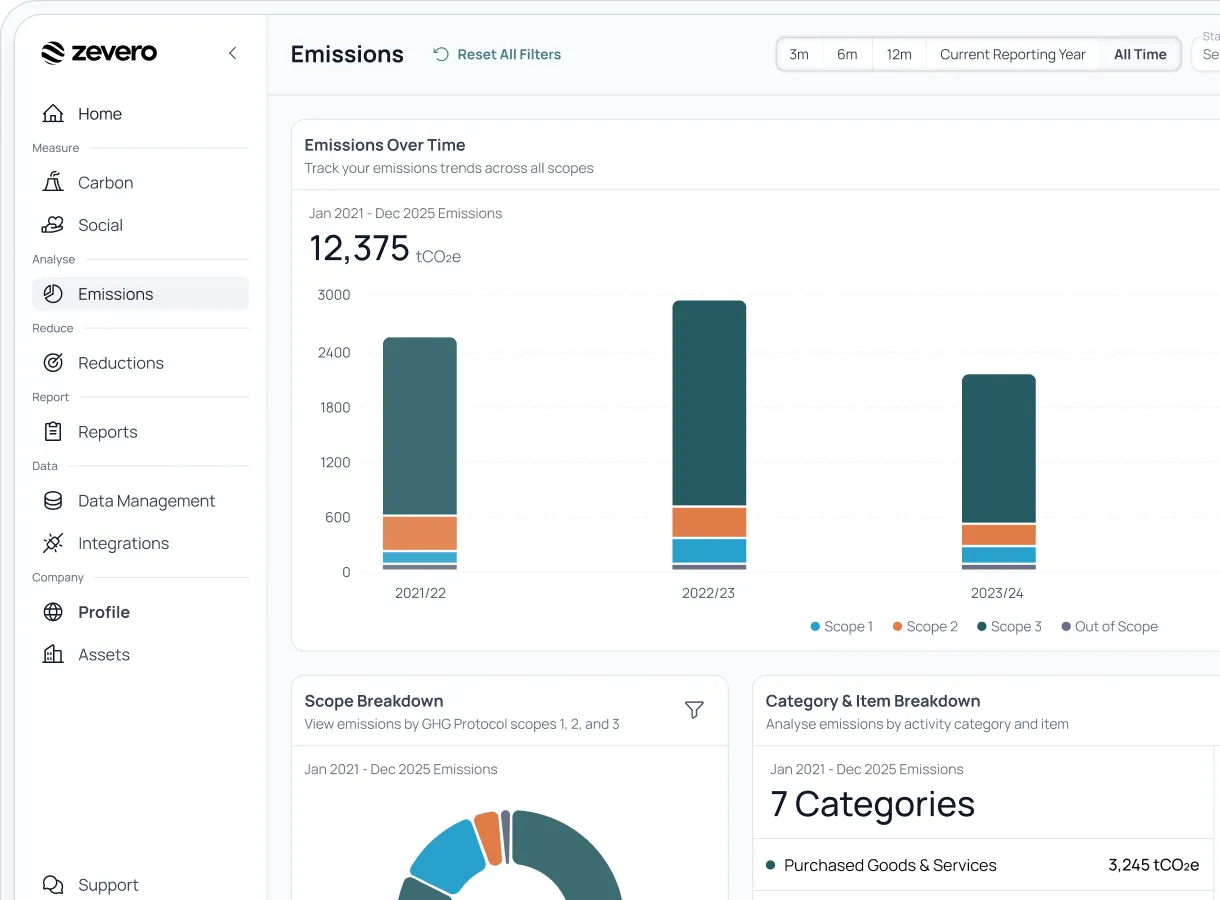
Zevero works with organisations to measure and manage their carbon footprint as part of wider ESG and regulatory reporting requirements. The platform helps teams bring carbon data into one place, supporting clear, consistent measurement across Scope 1, 2 and relevant Scope 3 categories.
Alongside the platform, Zevero’s climate experts support teams with methodology, data quality and reporting considerations. This combination makes it easier to respond to changes in the regulatory landscape as requirements develop over time. If you’d like to explore this with an expert, get in touch here.
What to expect next
BRSR reporting will continue to develop over time. Requirements are expected to tighten, with broader value-chain coverage, deeper assurance expectations and closer alignment with global sustainability and climate disclosure frameworks.
For businesses, BRSR can be seen as a foundation for stronger ESG data management, supporting both regulatory compliance and longer-term reporting readiness.
BRSR reporting FAQs
- When and how does BRSR need to be filed?
BRSR must be submitted in both PDF and XBRL formats on the same day the annual report is filed with the stock exchanges. It also forms part of the annual report, usually as a dedicated section.
- What happens if a company later falls out of the top 1,000 by market capitalisation?
Once a company becomes subject to BRSR, it must continue reporting until it has remained below the threshold for three consecutive years. The requirement then ends after the financial year following the third year below the threshold, based on SEBI’s market-capitalisation criteria at the relevant cut-off date.
- Are unlisted companies required to report under BRSR?
No. BRSR applies to listed companies within scope. However, unlisted companies may be asked to provide ESG data as part of their customers’ or partners’ BRSR and value-chain disclosures.
- How often does BRSR need to be updated?
BRSR is an annual disclosure and must be updated and filed each financial year as part of the annual reporting cycle.
- What is BRSR Core, and how does it relate to the full BRSR?
BRSR Core is a focused subset of the full BRSR, covering a smaller set of priority, mostly quantitative ESG metrics. While the full BRSR spans all nine NGRBC principles, BRSR Core highlights key indicators, such as emissions and workforce data, that are being phased into external assessment for larger listed companies.
Thanks for reading!
BRSR Reporting in India: What it Means for Listed Companies
Add us as a preferred source

See how Zevero can streamline your carbon reporting
Grow your business and reduce your impact