Education


Quick summary
- The IEA Emissions Factors dataset is the global benchmark for country-specific electricity emission factors, covering more than 150 countries with annual updates and historical data back to 1990. It is the most widely accepted source for location-based Scope 2 calculations under the GHG Protocol Corporate Standard.
- Electricity emission factors vary substantially between countries; coal-heavy grids carry much higher carbon intensity than those dominated by nuclear or hydropower.
- For multinational companies, applying the wrong country-specific factor, or using an outdated one, produces a materially incorrect Scope 2 figure.
If you've spent any time working on Scope 2 emissions reporting, you'll have encountered the question of which emission factors to use for purchased electricity. It sounds like a technical detail. In practice, it's one of the most consequential decisions in the entire reporting process, and one that a surprisingly large number of organisations get wrong, not through carelessness, but because the landscape of available data is genuinely confusing and the guidance on how to navigate it is scattered.
This post focuses specifically on the International Energy Agency's electricity emission factors: what they contain, how they're structured, why they're considered the global benchmark for this type of data, and how they should be applied in corporate carbon reporting. We'll also look at what the GHG Protocol's proposed revisions to its Scope 2 Guidance signal about where requirements are heading, and what that means for organisations that haven't yet taken a close look at the data underpinning their electricity-related emissions calculations.
What the IEA emission factors dataset actually contains
The IEA publishes two related datasets that together cover what most corporate reporters need for location-based Scope 2 accounting.
The first is the IEA Emissions Factors database, which contains CO₂ emission factors for electricity generation by country, updated annually and covering historical data back to 1990 for most countries. These are combustion-point figures; they reflect the carbon intensity of the electricity generation mix in a given country's grid in a given year, expressed in grams of CO₂ per kilowatt hour.
The second is the IEA Life Cycle Upstream Emissions Factors database, which goes further. Rather than stopping at the point of generation, it accounts for the full upstream lifecycle of the fuels used to produce electricity (i.e., extraction, processing, and transport) as well as the emissions associated with transmission and distribution losses in the grid. These figures are expressed in CO₂ equivalent per kilowatt hour, covering all relevant greenhouse gases rather than CO₂ alone. This dataset currently covers data from 2015 onwards for up to 150 countries.
Together, these two databases provide the most comprehensive and methodologically consistent source of country-level electricity emission factors available globally. The IEA draws on national statistical data, its own energy balances, and the latest scientific studies to produce figures that are regularly updated and applied consistently across countries, which is precisely why they have become the de facto international benchmark.
Which factors to use and when
The practical question for most corporate reporters is which of these figures to apply, and in which context. The answer depends on what your reporting framework requires.
For location-based Scope 2 reporting under the GHG Protocol Corporate Standard, the relevant figure is the combustion-point CO₂ emission factor from the Emissions Factors database. This reflects the average carbon intensity of the grid in the country where your facilities consume electricity, and it is the figure that should be matched to your metered or estimated electricity consumption at each location.
The upstream lifecycle factors from the second database are relevant in a different context: Scope 3, Category 3, which covers fuel and energy-related activities not included in Scope 1 or Scope 2. Specifically, they capture the indirect emissions associated with the production of electricity you consume — the emissions that occurred before the power reached your meter. Under the GHG Protocol, these are reported separately from your Scope 2 total rather than folded into it, but they are increasingly expected as part of a complete and credible disclosure.
It is worth being explicit about what these datasets do not cover. They are specific to electricity. They do not include emission factors for natural gas, diesel, or other fuels used in direct combustion, which are drawn from separate sources. This distinction matters because it is a common source of confusion when teams are trying to assemble a complete set of emission factors for a multinational reporting exercise.
Why the data source matters more than most teams realise
Electricity emission factors are not uniform across countries, and the differences are not marginal. A country with a grid powered predominantly by coal will carry a carbon intensity several times higher than one where nuclear or hydropower dominates. For a company with large electricity consumption across multiple markets, using the wrong factors, or the same factor across all locations, can produce a materially incorrect Scope 2 figure.

The other issue is recency. Grids change as countries add renewable capacity, retire fossil fuel plants, or shift their generation mix in response to policy or market conditions. An emission factor that was accurate three years ago may not reflect current grid reality. This is particularly relevant for markets that have seen rapid changes in their energy mix, where outdated figures can meaningfully understate or overstate reported emissions.
Both of these issues become harder to manage when teams are sourcing emission factors manually: downloading datasets, maintaining spreadsheets, and applying factors through disconnected processes at each reporting cycle. At scale, across multiple markets, errors accumulate and are difficult to audit.
What the GHG Protocol revisions signal
In October 2025, the GHG Protocol published proposed revisions to its Scope 2 Guidance for public consultation. The proposals would, if adopted, introduce a stricter hierarchy for location-based emission factors, with a requirement to use the most precise and geographically specific factors accessible to the reporting organisation, and greater temporal precision in how those factors are applied.
This is a meaningful shift in direction. The existing guidance already recommends using the most precise available data, but the proposed revisions would make that a requirement and tighten the criteria for what counts as sufficiently precise. For organisations that have relied on regional averages or older datasets, the proposals would require a material change in approach.
The GHG Protocol's Corporate Standard is referenced by IFRS S2 and the European Sustainability Reporting Standards that underpin CSRD, meaning changes to the Protocol have downstream implications for regulated disclosure. The consultation period closed in January 2026, and while the final revised guidance has not yet been published, the direction of travel is clear: the quality and traceability of the emission factors used in Scope 2 calculations will face increasing scrutiny, and the expectation is that organisations will use the best available data rather than whatever is most convenient.
What this means in practice
For sustainability and reporting teams, the practical implication is straightforward: the emission factors you use for electricity are not a second-order concern. They are a core input to calculations that will appear in mandatory disclosures, be reviewed by auditors, and increasingly be compared across companies and reporting periods by investors and analysts. Getting them right matters, and doing so consistently across geographies and reporting cycles without manual processes that introduce variability, is where the operational challenge lies.
The IEA dataset is the right starting point for most organisations. It is methodologically rigorous, updated regularly, covers the vast majority of markets where multinationals operate, and is widely accepted by disclosure frameworks and standard-setters. The question is less which dataset to use than how to use it reliably at scale.
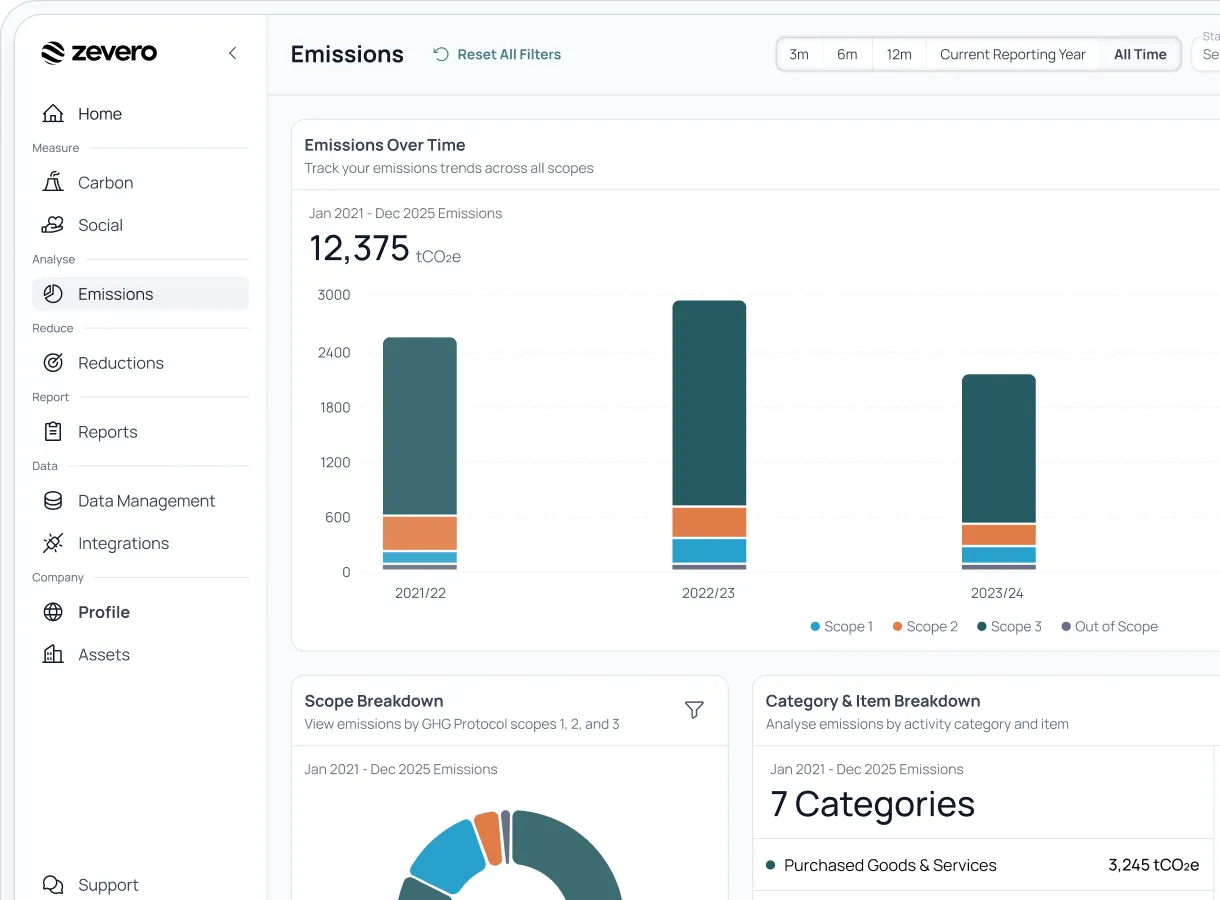
At Zevero, we've addressed this by embedding the IEA's electricity emission factors directly into our platform, so that the appropriate country-specific factor is applied automatically within the existing calculation and reporting workflow. Customers operating across multiple markets don't need to source, maintain, or manually apply this data; it’s already there and mapped to where it needs to go.
FAQs
Do IEA electricity emission factors apply to market-based Scope 2 reporting as well as location-based?
What should companies do if the IEA does not publish an emission factor for a country where they operate?
Can IEA emission factors be used to restate historical Scope 2 emissions figures?
What is the difference between grid-average emission factors and marginal emission factors, and which does the GHG Protocol require?
Thanks for reading!
The Role of IEA Emission Factors in Scope 2 Reporting
Add us as a preferred source

Related posts
Read more

Blog
Jul 22, 2026
GHG Protocol Scope 2 Updates: What It Means for Your Reporting
GHG Protocol Scope 2 Updates: What It Means for Your Reporting

Read more
Blog
May 8, 2024
Location Vs Market-Based Carbon Reporting
Location Vs Market-Based Carbon Reporting
.png)
Read more
Blog
Mar 14, 2025
The Importance of Emission Factors: How Accurate Data Drives Climate Action
The Importance of Emission Factors: How Accurate Data Drives Climate Action
See how Zevero can streamline your carbon reporting
Grow your business and reduce your impact